
Asian hornets in Auderghem: A story of intervention and local solutions
Contents
-
Understanding the invasion: identifying the Asian hornet in Auderghem
-
What to do when faced with a nest? A step-by-step guide for Auderghemois
-
The municipal control plan: free trapping and volunteers in Auderghem
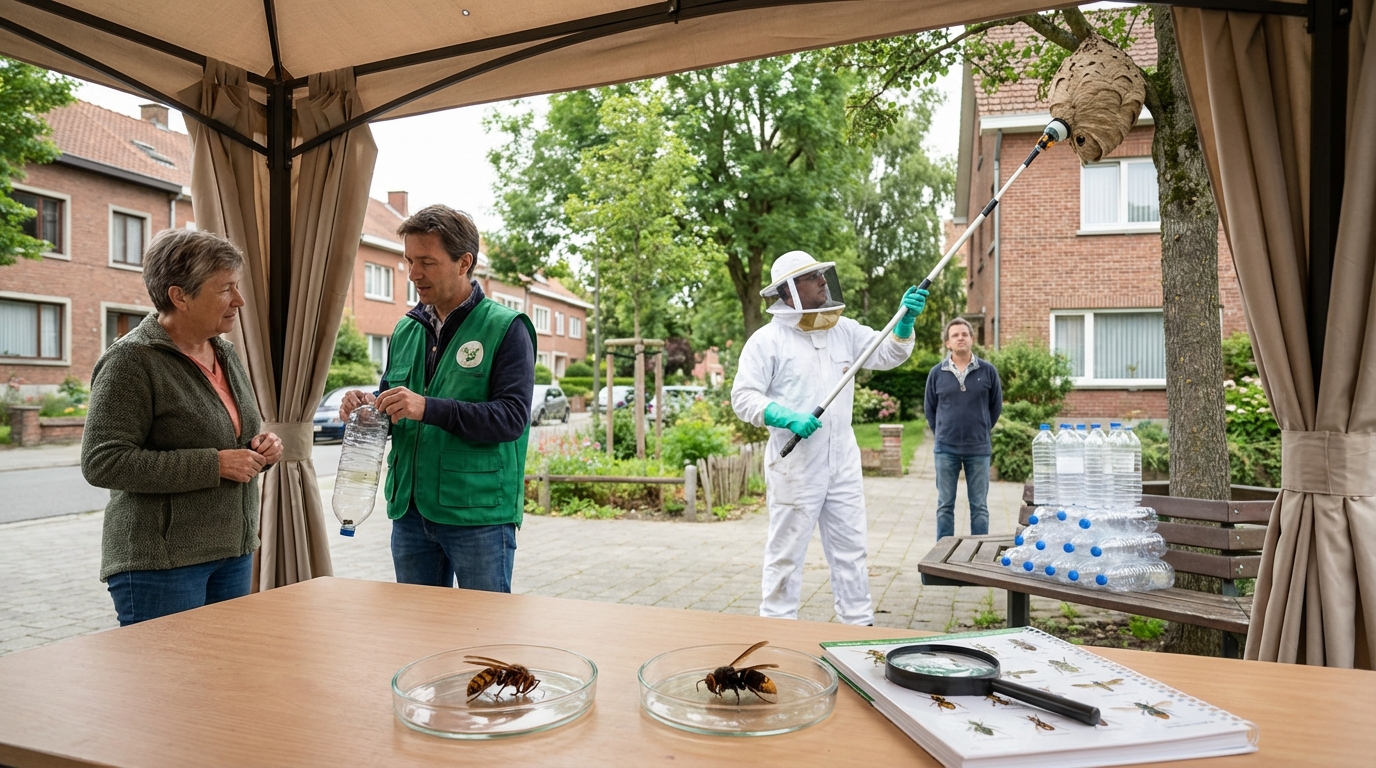
Last September, a call from a resident of the drève du Duc. A dull, continuous buzzing came from the bottom of the garden. As he approached the old cherry tree, he saw the comings and goings: dozens of insects, darker than wasps, swarmed in and out of a grayish mass hanging seven meters high. An Asian hornet's nest in Auderghem, as big as a basketball. Not the first of the season, far from it.
Things to remember
-
An immersive account of a real-life pest control operation in Auderghem, coupled with an ultra-local practical guide.
-
The article highlights the municipality's special features (free traps, Vespa Hunter 1160 volunteers) to transform a citizen's fear into concrete, organized action.
-
Identifying the Asian hornet in Auderghem
-
What to do when faced with a nest? A step-by-step guide for Auderghemois
Since 2021, the Asian hornet has taken up permanent residence in Brussels. Auderghem, with its many gardens, wooded parks and proximity to the Forêt de Soignes, has become one of the communes most affected. But it's not inevitable. The municipality has set up a concrete system, with trained volunteers, free equipment and a real collective control plan. But you still need to know how it works, and above all what to do when you come face to face with a nest or an isolated individual.
This article is both an account of the intervention on the drève du Duc and a practical guide for all Auderghemois. Identification, reporting, destruction, trapping: we go through it all, with information specific to your commune.
Understanding the invasion: identifying the Asian hornet in Auderghem
The first mistake is to confuse the Asian hornet with the European hornet. It happens all the time. A big insect flies near your terrace, you panic, you call. Except that in 40% of cases, it's a European hornet, which is harmless to bees and generally unaggressive towards humans. Knowing how to recognize the Asian hornet is the first step before taking any action.
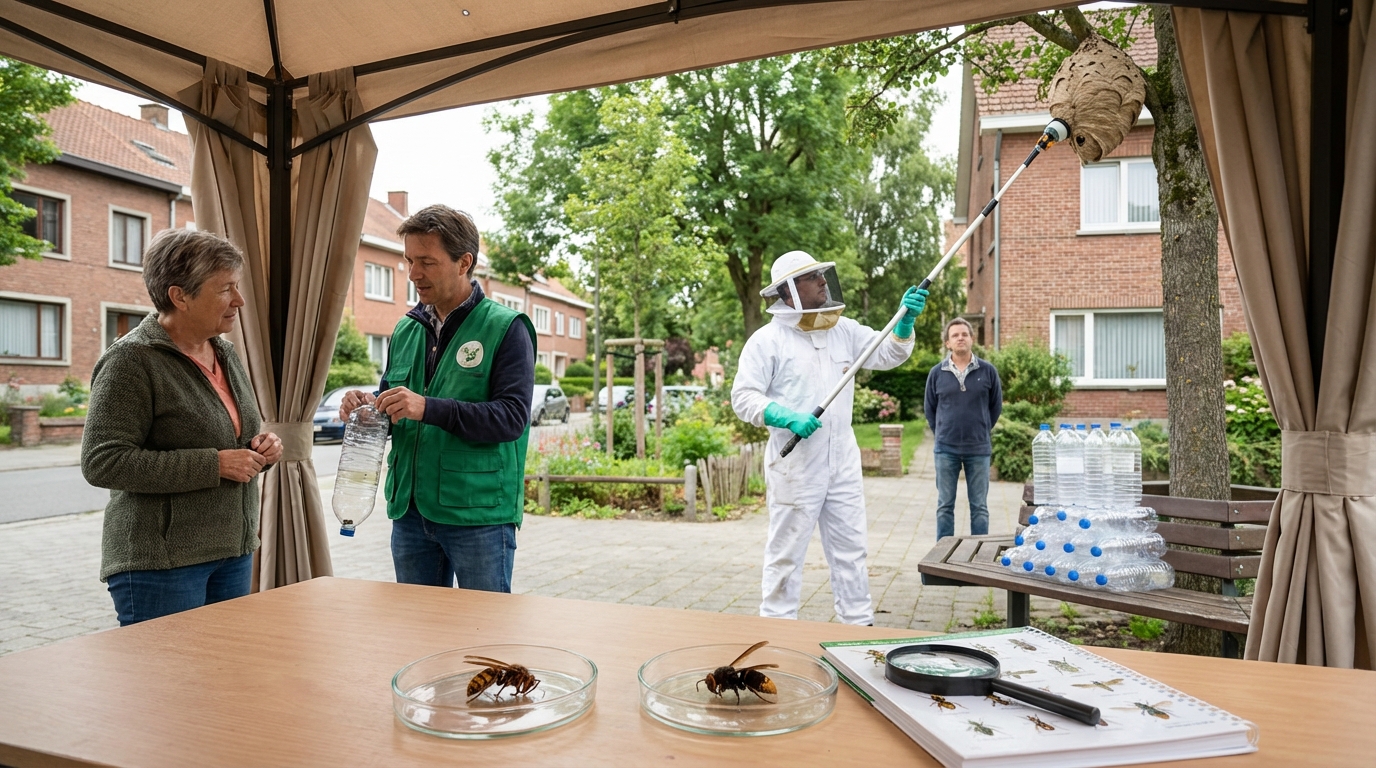
The scientific name for the Asian hornet is Vespa velutina nigrithorax. Take note of his appearance: he is smaller than the European Hornet (around 3 cm vs. 3.5 cm for its cousin). Its body is predominantly black, with a single orange segment on the abdomen. And the detail that makes no mistake: its legs are yellow. The European hornet, on the other hand, has a yellow and black striped abdomen (a bit like a large wasp) and brown legs. If you see yellow legs, it's him.
Another clue: flight behavior. The Asian hornet hovers in front of hives. They stand there motionless, waiting for a bee to emerge and capture it in mid-flight. A formidable predator. A single colony can decimate an entire hive in a matter of weeks. Auderghem beekeepers are well aware of this, and some have lost colonies in the last two years.
Where can you find it in Auderghem? Just about everywhere, but especially in wooded areas. The edges of the Soignes forest, the Seny park, the chaussée de Wavre gardens, the Rouge-Cloître. Primary nests (small in spring, often under an awning or in a garden shed) are easy to miss. Secondary nests, those in summer and autumn, are high up in the trees, under roofs, sometimes over 10 meters away. The one on the drève du Duc was typical: hidden in the foliage, invisible from the street.
A question that often comes up is: «Why shouldn't I kill a lone Asian Hornet?» The answer is nuanced. If it's a founding queen in spring, yes, killing it can prevent the creation of an entire colony. An individual worker in summer? Crushing it won't change a thing, since the colony is made up of hundreds of individuals. The real challenge is to locate the nest. An isolated hornet is an indicator: follow its flight path, it will often lead you to the nest.
If you see an Asian hornet in Auderghem, don't remain in doubt. If possible, take a photo (even a blurry one, even from a distance) and report it. We'll look at exactly what to do in the next section. Correct identification is the key to triggering the right response at the right time.
What to do when faced with a nest? A step-by-step guide for Auderghemois
Let's go back to our intervention on the drève du Duc. The resident did exactly the right thing: he didn't touch the nest. That's rule number one. An active Asian hornet nest is potentially 500 to 1,000 individuals ready to defend their colony. Unlike wasps, Asian hornets are not spontaneously aggressive towards humans, but if you get within five meters of the nest, that changes. Stings are painful, and for allergy sufferers, it's a medical emergency.
Step 1: Secure the area. Keep children and pets away. If the nest is in your garden, mentally mark out a safety perimeter. Don't throw anything on it, don't try to water it, don't build a fire under it. Every year, people injure themselves trying to destroy a nest themselves. It's pointless and dangerous.
Step 2: Report the nest. In Auderghem, you have several channels. The most direct is to contact the local Environment Department. You can also use the iNaturalist platform or the «Vespa Watch» application for geolocated reporting. The Vespa Hunter network of volunteers (more on this later) can also be alerted. The key: give the precise address and estimated height of the nest, and attach a photo if you have one.
Step 3: Wait for the procedure. This is often the hardest part. You see the nest, you know it's there, and you'd like it to be taken care of within the hour. The reality is that destroying a hornet's nest requires specific equipment (telescopic pole, full-body suit, suitable insecticide) and a trained professional. In Auderghem, timescales vary according to the season: at the height of the season (August-September), it can take a few days.
The question of price always comes up. How much does it cost to remove an Asian hornet nest? In Belgium, you should expect to pay between 100 and 250 euros, depending on height and accessibility. A nest 4 meters under an awning is a quick job. A nest 15 metres up in a lime tree may require a gondola. The good news for the people of Auderghem is that the commune contributes to the financing. For more information, please contact the municipal service directly, as the terms and conditions of funding change from year to year.
Be careful not to confuse wasp nest destruction with Asian hornet nest destruction. The techniques are different, and so are the risks. A general disinsectician will be able to treat a classic wasp nest, but for the Asian hornet, you need someone who knows the species. Check that the service provider has already dealt with Vespa velutina.
On the drève du Duc, the operation lasted an hour and a half. The operator climbed up with an 8-metre pole, injected a biocide directly into the nest entrance, then waited 20 minutes for the activity to cease before unhooking the structure. Inside: nine tiers of combs, hundreds of larvae. The nest had been active for at least three months without anyone noticing. That's exactly why early trapping and collective monitoring are making a difference.
The municipal control plan: free trapping and volunteers in Auderghem
Auderghem doesn't just react when a nest is reported. The commune has set up a real collective pest control system, and frankly, it's one of the most advanced in the Brussels region.
The heart of the system is the Vespa Hunter 1160. This network of volunteers, identified by Auderghem's zip code, is made up of local residents trained in Asian hornet detection and trapping. They patrol, set traps, monitor sensitive areas and act as intermediaries between citizens and municipal services. No need to be a beekeeper or entomologist to join the group: a few hours' training is all that's required, and the commune provides the equipment.
Let's talk about equipment. The municipality of Auderghem provides free access to trap covers for plastic bottles. The principle is simple: you attach the lid to a bottle containing an attractive mixture (dark beer, blackcurrant syrup and a little white wine is the most effective recipe), and hang the trap in your garden, ideally between February and May. It's during this period that the founding queens emerge from hibernation and look for a place to build their primary nest. One queen trapped in spring means a colony of 500 fewer individuals in autumn.
Where can I pick up these free trap lids? Directly from the Maison Communale or at the distribution events organized by the Environment Department. Dates are announced on the commune's website and relayed by Vespa Hunter 1160 on social networks. Last year, over 300 traps were distributed to residents. The mesh is now becoming dense, and the results are clear to see: more queens captured in spring, fewer secondary nests discovered in summer.
To be effective, Asian Hornet trapping needs to be coordinated. An isolated trap in a garden catches a few individuals. Fifty traps spread throughout the commune, set at the right time with the right bait, changes the equation. That's the logic behind this collective fight: each garden becomes a link in the chain.
An important detail: traps must be selective. The risk is to capture non-target insects (butterflies, bees, flies). The lids supplied by the commune of Auderghem are designed with calibrated openings that let small insects through. Add a little white wine to the mixture: it repels bees but attracts hornets. It's not a detail, but essential if you don't want to aggravate the problem by eliminating pollinators.
Brussels is one of the areas with the highest number of Asian hornets in Belgium, and the trend is not reversing itself. Without the help of the municipality and the commitment of local residents, the situation would be much worse. The Vespa Hunter 1160 reported and destroyed around 15 nests in Auderghem last season. Each nest removed means thousands fewer hornets in the local ecosystem, and beehives saved.
If you live in Auderghem and have a garden, however small, you can take action. Get a trap cover, set your trap from February onwards, and report any suspicious individuals. Want to go further? Join the Vespa Hunter 1160. The next training session is usually announced at the beginning of the year on the commune's website.
Conclusion
The Asian hornet is not going to disappear from Auderghem. It's an established species, adapted to our climate, and growing every year. The only response that works is a combination of individual vigilance and organized collective action. Knowing how to recognize the insect, never touching a nest yourself, reporting it quickly, and taking part in spring trapping: these four gestures make all the difference.
Auderghem has the tools. The free trapping lids, the Vespa Hunter 1160 volunteers, the support of the Environment Department. What's still missing is a sense of legitimacy on the part of every concerned resident. You don't need to be an expert. All you need is a trap, a little attention, and the commune number to hand. The rest will follow.
Frequently asked questions
How can you tell an Asian Hornet from a European Hornet?
The Asian Hornet is smaller (3 cm), has a predominantly black body with a single orange ring on the abdomen and, above all, yellow legs. In contrast, the European Hornet resembles a large wasp, with a yellow striped abdomen and brown legs.
What should I do if I discover a hornet's nest in my garden in Auderghem?
Never come closer than 5 meters and do not attempt to destroy it yourself. Report it immediately to your local Environment Department or via the Vespa Watch app to arrange a safe, professional intervention.
How much does it cost to remove a hornet's nest in Auderghem?
An intervention generally costs between €100 and €250, depending on the height of the nest. The municipality of Auderghem often offers financial assistance or partial coverage of costs; please contact the municipal office for current details.
How much does it cost to remove an Asian hornet nest?
Selective trapping lids are available free of charge from the Auderghem town hall or via the Vespa Hunter 1160 volunteer network, and should be installed between February and May to capture founding queens before they create colonies.
 French
  English
  Dutch
Dutch
0 Comments