
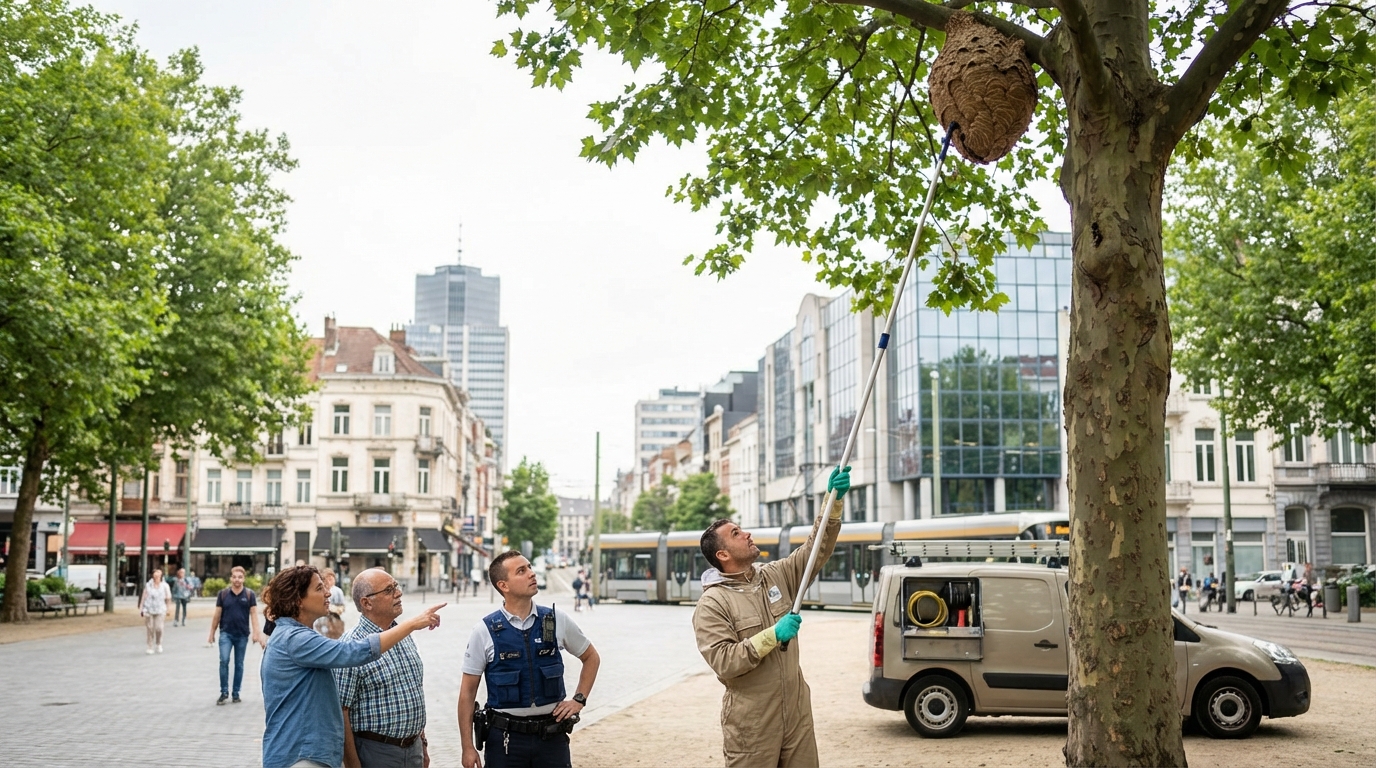
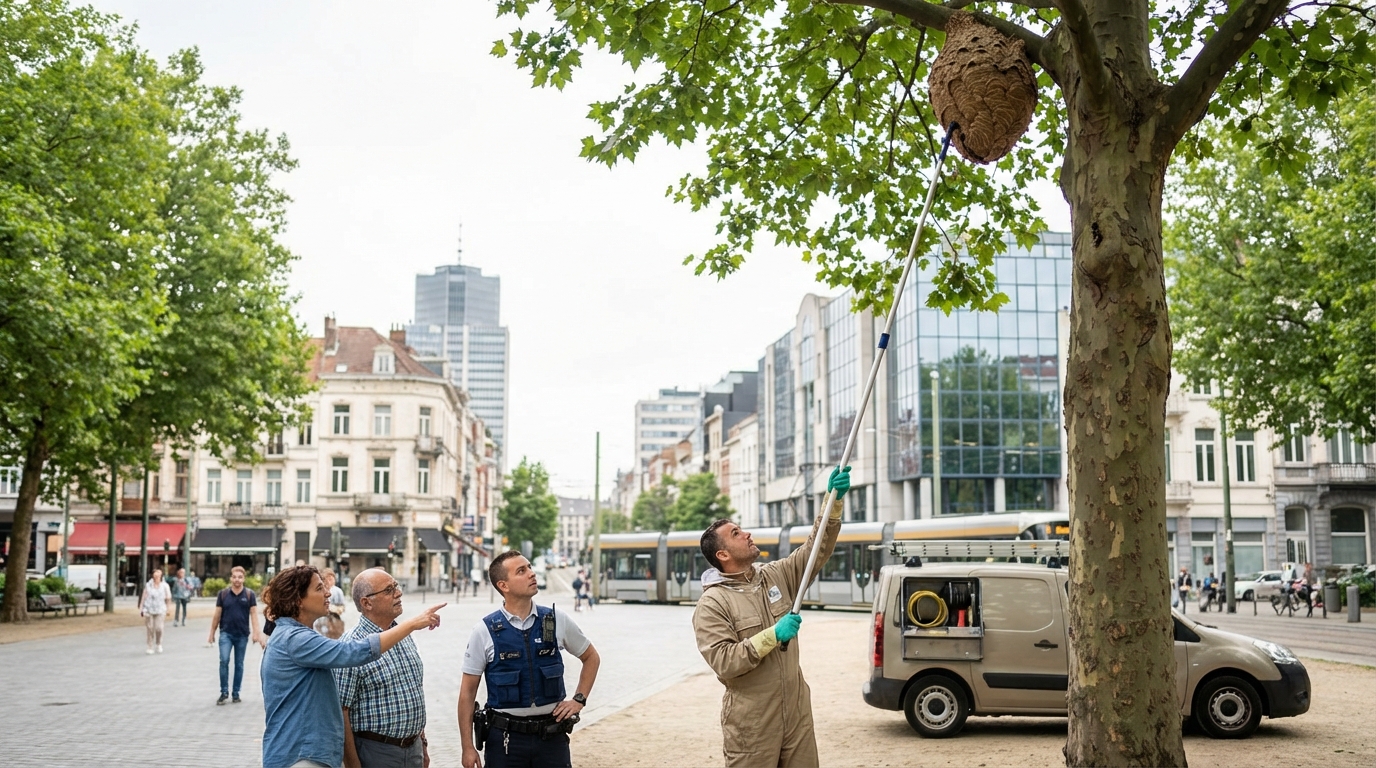
Asian hornets in Saint-Josse-ten-Noode : Guide to intervention
Contents
-
Understanding the presence of the Asian hornet in Saint-Josse-ten-Noode
-
Step-by-step guide: what to do if you suspect a nest near Place Madou?
-
The operation of professional destruction and annual prevention
Last summer, a shopkeeper on Rue de la Limite discovered a nest of Asian hornets under the awning of his shop window. As big as a basketball. Two meters from the heads of passers-by. This kind of situation is becoming increasingly common in Saint-Josse, and not just in summer. The Asian hornet is settling in, colonizing our urban neighborhoods, and it has no intention of leaving on its own.
Things to remember
-
An ultra-local article that uses the Saint-Josse-ten-Noode setting (Botanique, Place Madou) to humanize technical expertise.
-
We treat intervention as a local service essential to neighborhood safety, with vigilance maintained all year round.
-
Understanding the presence of the Asian hornet in Saint-Josse-ten-Noode
-
What should you do if you suspect a nest near Place Madou?
If you live or work in Saint-Josse-ten-Noode, you've probably already come across these characteristic flying insects, a little darker than our European hornets. Maybe around the Parc du Botanique in Brussels, maybe on your terrace. The question is no longer «are there any?» but «what do we do about it? That's what this guide is here for: to give you the right reflexes, the right steps, and above all to avoid mistakes that can be costly.
At hornets.be, We operate all year round in Brussels. St. Josse is one of our priority action zones, because the urban density here makes every nest potentially dangerous for a large number of people. Here's what you need to know.
Understanding the presence of the Asian hornet in Saint-Josse-ten-Noode
Vespa velutina is its scientific name. In Brussels, it's known simply as the Asian hornet, and its expansion in the Belgian capital is hardly surprising. Having arrived in Europe from the south of France in the mid-2000s, it has been moving northwards at a steady pace. Belgium has been affected for a good ten years now, and the most densely populated communes such as Saint-Josse-ten-Noode paradoxically offer a favorable terrain: lots of nooks and crannies, rooftops, cornices, trees in the parks. Everything you need to build a nest in complete tranquillity.
Identifying the Asian Hornet isn't all that complicated once you know what to look for. It is slightly smaller than the European Hornet (around 3 cm for the workers), with a very dark, almost black body and an orange stripe on the abdomen. Its legs are yellow at the tips, clearly distinguishing it from its European cousin, whose legs are brown. The European Hornet, on the other hand, has a much lighter yellow and black striped abdomen. This distinction between the European and Asian hornets is important, because the European hornet is actually quite harmless and even useful in the ecosystem. There's no need to eradicate them.
So why is the Asian hornet a problem in Saint-Josse? There are several reasons. Firstly, their urban nests can reach impressive sizes: 60, 70, sometimes 80 cm in diameter. They are often built high up, in trees in the Botanique district of Brussels, under the roofs of buildings on Place Madou, or in air ducts. They can also be found in lower places, in hedges or garden sheds, and these are the most dangerous because they can be dropped on by accident.
In terms of behavior, Vespa velutina is more aggressive than the European hornet when you approach its nest. At a distance, it ignores you. But within five meters of the nest, sentinels sound the alarm and attacks can be collective. An isolated sting is painful, but rarely serious for a non-allergic person. The real risk is multiple stings or allergic reactions. Every year in Belgium, people end up in emergency wards because of this.
What scent does the Asian hornet hate? You read a lot online about cloves, burnt coffee and citronella. Let's be honest: none of these solutions has proven to be really effective in keeping an established colony away for long. They may bother a few individuals in flight, but when faced with an active nest, it's like trying to put out a fire with a spray bottle. The only reliable answer is professional intervention.
One last point that directly concerns Saint-Josse: the commune is part of the 1210 postal code, and the network Vespa Hunter 1210 actively monitors the area. This monitoring program, linked to regional initiatives in Brussels, maps reported nests and coordinates destruction. If you spot an Asian hornet in your neighborhood, your report feeds this database and helps protect the whole neighborhood.
Step-by-step guide: what to do if you suspect a nest near Place Madou?
You're on your balcony on the Place Madou side, and you see dark insects coming and going, all converging on the same point under a cornice. First instinct: don't touch anything. Seriously. Every year, people try to unhook a nest with a broomstick or hose it down. The result is a swarm of angry hornets and a dash to the emergency room. No heroic DIY.
Here's the step-by-step procedure.
Step 1: Observe from a secure distance. Stay at least ten metres away from the suspected nest. Try to identify the shape (often pear-shaped, with an opening on the side) and exact location. If you can take a zoomed-in photo without getting too close, that's a plus for reporting. Also note the time of day: hornets are most active at the end of the day.
Step 2: Secure the people around you. If the nest is close to a busy passageway (building entrance, schoolyard, café terrace), immediately warn anyone nearby. Safety in the face of a hornet's sting begins with distance. Children and the elderly are the most vulnerable. If someone is stung and shows signs of allergy (swelling of the face, difficulty breathing, malaise), don't hesitate to call 112. This is an emergency procedure, not an abundance of caution.
Step 3: Report the nest. There are several ways to report a hornet in Saint-Josse. You can contact hornets.be We take calls all year round, including weekends. You can also use the Vespa Hunter 1210 network reporting platform or contact the commune of Saint-Josse, which will relay the information. The important thing is not to leave a nest lying around. A nest discovered in June can contain 200 individuals. By September, we're talking 2,000 to 3,000.
Step 4: Don't attempt destruction yourself. We insist on this. No fire, no insecticide bombs from the supermarket, no garbage bags wrapped around the nest (yes, we've seen this before). These attempts almost always fail, and they make the colony much more aggressive in the days that follow. You're putting your neighbors, your children and yourself at risk.
What should you do if you see an isolated Asian hornet with no visible nest? There's no need to panic. A single individual in flight poses no direct threat. Why shouldn't I kill an isolated Asian Hornet? Because there's absolutely no point in solving the problem. The queen produces hundreds of workers. Crushing an individual does not weaken the colony. And if it's a spring-founding queen, it's better to report it so that it can be traced back to the primary nest than to kill it without further action.
Is it dangerous to be stung by an Asian hornet? The honest answer: for the vast majority of people, a single sting is very painful, but not dangerous. The pain is more intense than a wasp sting, with local swelling that can last several days. The real danger is for people allergic to Hymenoptera venom (around 3% of the population) and in cases of multiple stings. Beyond 10 to 15 bites on an adult, the toxic effects of the venom accumulate and can cause serious complications. For children, the threshold is lower.
If you're stung: remove the stinger if it's still there (which is rare with hornets), disinfect, apply cold, and monitor for an hour. At the slightest sign of a generalized reaction, head for the emergency room. If you know you're allergic, keep your adrenaline auto-injector handy all summer long.
The operation of professional destruction and annual prevention
72 hours. This is the average time between a report to hornets.be and the actual destruction of the nest in Saint-Josse-ten-Noode. For situations involving immediate risk (nest at human height, proximity to a school, allergic person in the household), we switch to urgent disinsectisation and intervene within 24 hours.
How does it work? Our technician arrives on site, assesses the situation and formally identifies the species. This is a step we never skip: it regularly happens that a nest reported as «Asian hornets» is in fact a nest of common wasps or European hornets. The destruction of a wasp nest in Saint-Josse follows a similar protocol, but the management differs according to the species. A European hornet's nest can be left alone until winter, in a place where no one is bothered by it. A Vespa velutina nest, never.
For the actual destruction, we use a method of injecting insecticide directly into the nest, using a telescopic boom that can reach a height of 20 meters. The insecticide takes effect within a few hours. The technician then returns to remove the nest and ensure that there is no further activity. All this is done in a full protective suit, of course. We don't mess around with a nest that can contain several thousand individuals.
The price of a Hornet intervention varies according to the difficulty of access. A nest in a hedge two meters above the ground is not the same as a nest stuck under a roof 15 meters away, requiring a cherry picker. In general, you should expect to pay between 100 and 250 euros for a standard destruction in the Brussels region. Some communes contribute to the cost: contact the commune of Saint-Josse to find out what assistance is available. At hornets.be, we'll give you a clear price before we intervene, so there are no surprises on the bill.
Now, let's talk about what happens outside the warm season. Many people think that the Asian hornet problem is a summer problem. It's not. Prevention starts in February-March with spring trapping. At this time, the founding queens emerge from hibernation and look for a place to build their primary nest (a small nest the size of a tennis ball). Each queen captured in spring means a colony of several thousand fewer individuals in autumn. The math is simple.
Spring trapping consists of placing selective traps, often containing dark beer and syrup, in areas where nests were spotted the previous year. In Saint-Josse, the area around the Botanique and the inner gardens of housing blocks are the spots to watch out for first. Traps should be set from mid-February to the end of April, then removed to avoid capturing other useful insects during the summer.
Frelons.be offers annual monitoring for building owners and managers in Saint-Josse-ten-Noode. We inspect facades and roofs in spring, set traps if necessary, and remain on call all year round for rapid intervention if a nest appears. It's a preventive approach that costs much less than dealing with a mature nest in the middle of August, when the colony is at its most aggressive.
A technical point for the curious: Asian hornets in Saint-Josse don't really disappear in winter. The colony dies, yes, but the young fertilized queens hide in crevices, woodpiles and wall cracks. They hibernate until the warm weather returns. That's why we stay active twelve months out of twelve. If you let your guard down in November, you're asking for trouble in April.
Conclusion
The Asian hornet is now a fact of life in Saint-Josse-ten-Noode. Denying the problem or waiting for it to «go away» is not an option, especially in such a densely populated commune. The right reflexes are simple: observe, don't touch, report and call in the professionals.
If you spot a nest or even just have doubts about the presence of Asian hornets near you, contact hornets.be. We operate throughout Saint-Josse, all year round. One call, a quick assessment, and we'll take care of the rest. Your safety and that of your neighbors is our business.
Frequently asked questions
How to recognize an Asian hornet in Saint-Josse?
Darker than the European hornet, the Asian hornet has a black body, a wide orange stripe on the abdomen and yellow-tipped legs. If you see one near the Botanique or Place Madou, observe its hovering flight, typical of this predator.
What should I do if I discover a hornet's nest in or around rue de la Limite?
Never try to destroy it yourself with a water jet or stick, as the collective attack is lightning-fast. Keep a safe distance of 10 meters and immediately contact hornets.be or the Vespa Hunter 1210 network for a safe, professional intervention.
How much does it cost to destroy a hornet's nest in Saint-Josse-ten-Noode?
The cost of a standard intervention in Brussels generally varies between €100 and €250, depending on the height of the nest (ledge, tree, pipe). Some urgent interventions near schools or public places in the commune may benefit from specific protocols; ask for a free estimate before taking any action.
Why report hornet nests even in autumn?
Even if the colony dies out in winter, an untreated nest in Saint-Josse can release dozens of founding queens that hibernate in the neighborhood. Reporting them allows us to map the infestation and prepare for preventive trapping as early as February.
 French
  English
  Dutch
Dutch
0 Comments