
Controlling the Asian hornet in Ixelles: Everything you need to know to take effective action at 1050
Contents
-
Understand the impact of the Asian hornet on Ixelles' biodiversity and identify the species.
-
How to take part in the Vespa Hunter 1050 campaign and set your traps in Ixelles
-
Notification and intervention: what to do when faced with an Asian hornet nest in Ixelles?
In recent years, the Asian hornet has taken up residence in Brussels. And Ixelles is no exception. Sightings are multiplying in gardens, on terraces and near urban beehives. This is no longer a distant phenomenon confined to the south of France: the Vespa velutina is here, at 1050, and has no intention of leaving.
The good news is that the commune of Ixelles has taken the problem head-on. With the Vespa Hunter 1050 campaign, residents can play an active part in the fight against the Asian hornet. Free traps, easy reporting, coordinated nest destruction: the tools are there. It's just a question of using them at the right time and in the right way.
Things to remember
-
An ultra-local guide merging the initiatives of the commune of Ixelles (Vespa Hunter 1050 campaign) with on-the-ground expertise for citizens
-
The aim is to offer a comprehensive resource that turns Ixelles residents into vigilant actors for local biodiversity, all year round.
-
Understanding the impact of the Asian hornet on Ixelle's biodiversity
-
How to take part in the Vespa Hunter 1050 campaign and set your traps.
This article is your field guide. We'll be talking about identification, selective trapping, reporting and intervention. No theoretical blah-blah: just practical information to help you take action at your own level, whether you're a hobby gardener, a beekeeper or simply a neighbor who's spotted a suspicious beetle coming and going under the cornice.
Understand the impact of the Asian hornet on Ixelles' biodiversity and identify the species.
A single Asian hornet nest can house between 1,500 and 3,000 individuals at its peak in late summer. Each hornet consumes an average of 50 to 70 insects a day. Do the math. Over the course of a season, one nest can eliminate tens of thousands of bees, hoverflies and butterflies. For the urban biodiversity of Ixelles, this is a silent disaster.
Visit Vespa velutina nigrithorax, is a native of Southeast Asia. It arrived in France by accident in 2004 (in a consignment of Chinese pottery, we're not making this up), and has colonized all of Western Europe in less than twenty years. Brussels has been affected since 2016, and Asian hornets in Ixelles are now seen every year, earlier and earlier in the season.
Why is it so serious here in the city? Because Ixelles has a remarkable green heritage for a Brussels municipality. The Ixelles ponds, the Bois de la Cambre, the private gardens in the Boondael district and the shared vegetable gardens are all micro-ecosystems in which pollinators play an essential role. When the Asian hornet settles in, it primarily targets honey bees. It hovers in front of the hive, picking off the foragers one by one. The urban beekeepers of Ixelles are well aware of this, and some have lost entire colonies.
But bees aren't the only victims. Common wasps, flies, dragonflies - everything is affected. The Asian hornet is a generalist predator that destabilizes the entire local food chain. Fewer pollinators means less fruit in the garden, and less food for insectivorous birds. The domino effect is real.
So, how do you identify an Asian Hornet without making a mistake? It's the question everyone asks, and understandably so. It's often confused with the European Hornet (Vespa crabro), which is harmless to bees and protected. Here are the key criteria for identifying the Asian hornet:
-
The body is predominantly dark, almost black, with a single orange abdominal segment (the 4th).
-
Legs are yellow at the tips, This has earned it the nickname «Yellow-legged Hornet».
-
The face is orange, whereas the European hornet has a yellow face.
-
Smaller than the European Hornet 2.5 to 3 cm for a female worker, compared with 3.5 cm for a male worker. Vespa crabro.
The founding queen is slightly larger (up to 3.5 cm). She's the one we aim to capture in spring, between February and May, when she emerges from hibernation to found a new colony. One captured queen potentially means one less nest in the neighborhood. That's why spring trapping is so strategic.
Any doubts about the insect you've seen? Take a photo (even a blurry one is better than nothing) and report it. We'll come back to this below.
How to take part in the Vespa Hunter 1050 campaign and set your traps in Ixelles
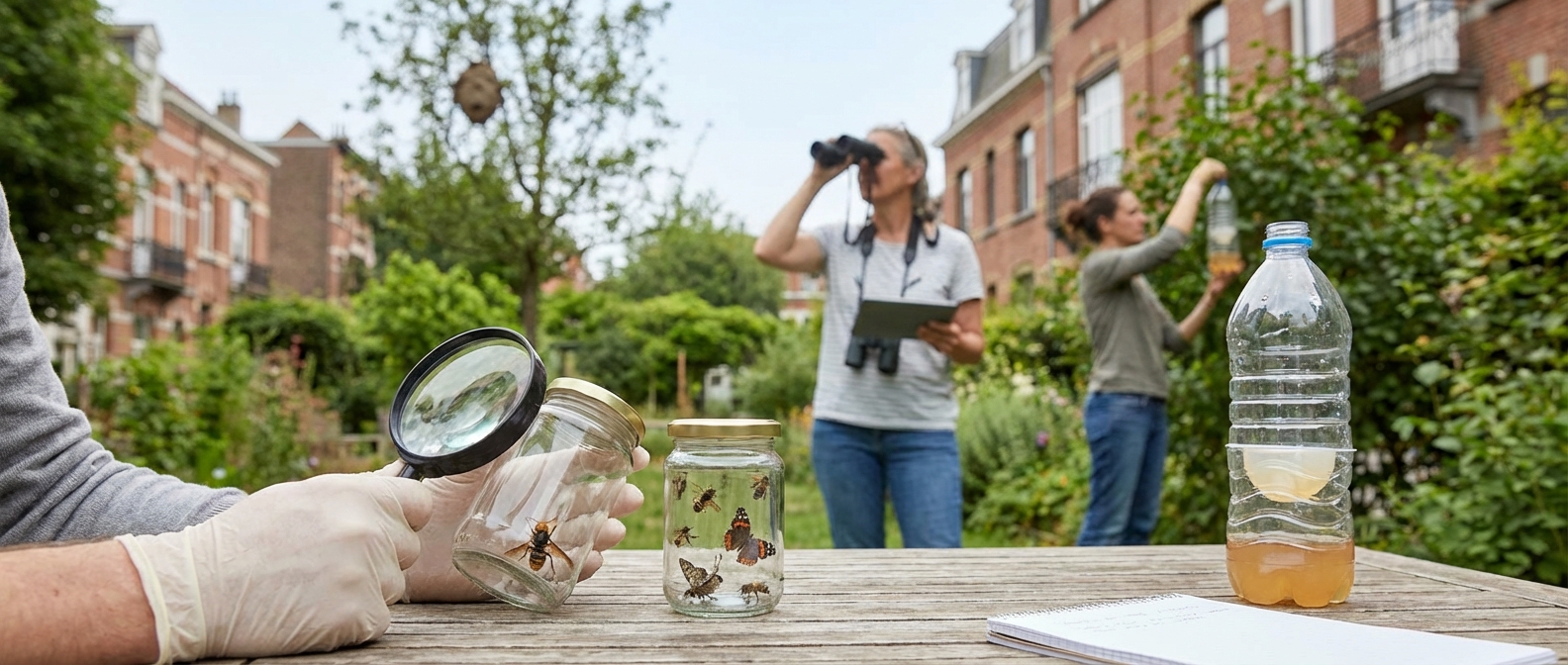
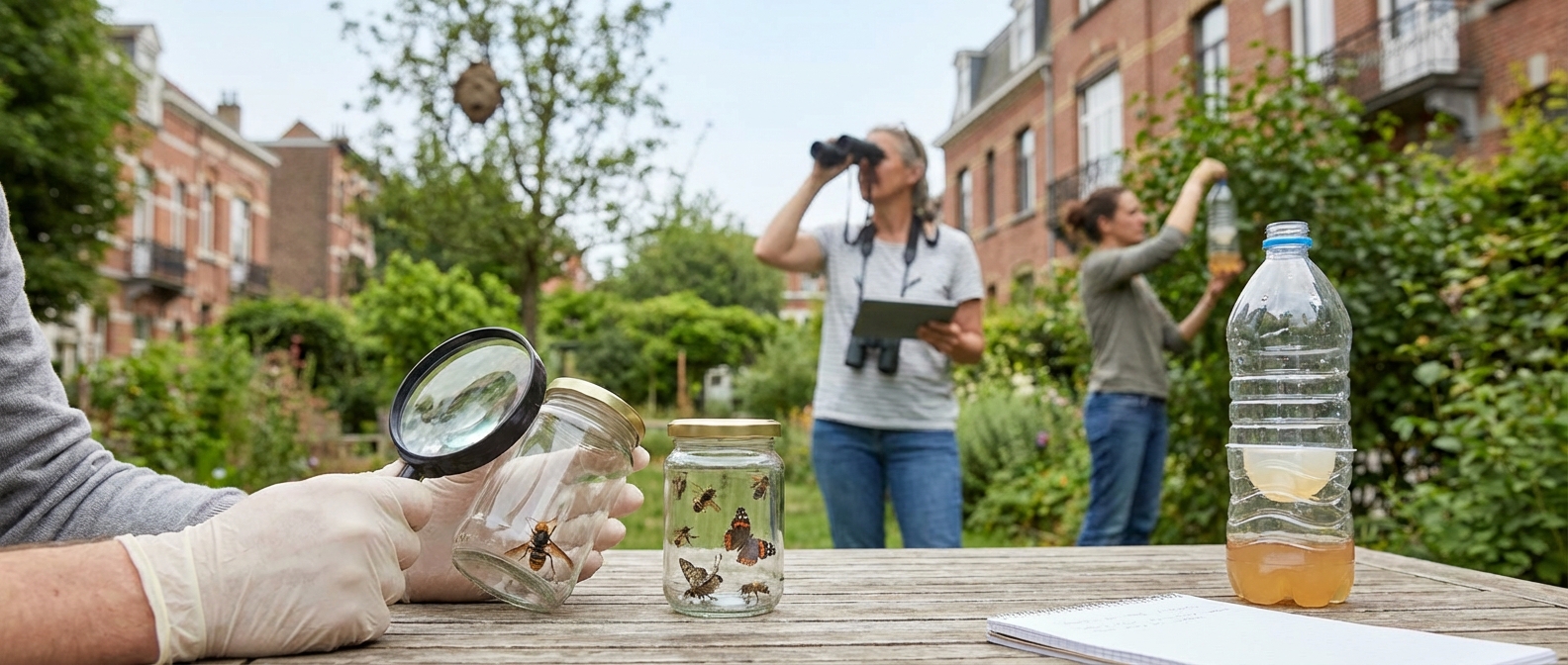
Do you live in Ixelles and want to do something concrete? The Vespa Hunter 1050 campaign is exactly what you need. Launched by the commune, it enables residents to become active sentinels in the fight against the Asian hornet in Brussels. The principle is simple: we provide you with a free trap in Ixelles, you set it up in your home, and watch what falls into it.
To obtain your trap, visit the Ixelles commune website or contact the Environment Department directly. Distribution generally starts in February-March, when the trapping campaign gets underway. Stocks are limited, so don't wait until June to come forward.
The trap supplied is a selective trap. This is an important point. You don't want to decimate beneficial insects by catching everything that flies. The trap is designed with calibrated openings and a specific bait (usually a mixture of dark beer, white wine and blackcurrant syrup or grenadine) which preferentially attracts Asian hornets. White wine, in particular, repels bees. Clever.
Where to set up your trap? Here are a few ground rules:
-
In height, between 1.5 and 2 metres from the ground, hanging from a branch or a stable support.
-
Sheltered from the wind, in a semi-shaded area. Not in full sun, otherwise the bait ferments too quickly and loses its effectiveness.
-
Near flowering areas If you have a garden with flowers, a vegetable garden or fruit trees, that's where you should place the trap.
-
Away from traffic children and pets. The trap is not dangerous in itself, but accidental handling should be avoided.
Selective spring trapping targets founding queens. This is the most effective period: from February to the end of May. A queen caught in March will never found her colony. After June, the workers have taken over and individual trapping becomes less decisive (although it remains useful for reducing pressure on hives).
Remember to check your trap every few days. If you catch an insect you don't recognize, don't throw it away. Photograph it, note the date and location, and pass on the information via the reporting platform (more about this later). Bruxelles Environnement centralizes this data to map the progression of the Asian hornet throughout the Region.
A final point that often comes up: «Won't my trap attract more hornets to my garden?» No. The trap captures individuals already passing through your area. It doesn't create a draught. On the contrary, it reduces the local population in a targeted way. And if several neighbors take part in the Vespa Hunter 1050 campaign, the network effect is considerable. A whole neighborhood trapping is much more effective than a single isolated garden. Talk to your neighbours.
At Frelons.be, we support this dynamic all year round. Not just in spring. The Asian hornet is a 12-month problem: trapping in spring, monitoring in summer, destroying nests in autumn, preparing for winter. Every season counts.
Notification and intervention: what to do when faced with an Asian hornet nest in Ixelles?
You've spotted a nest. Or at least, you think you've spotted one. First instinct: don't touch anything. Seriously. An Asian hornet nest can contain several hundred aggressive individuals when they feel threatened, and multiple stings represent a real safety risk for the neighborhood, especially for allergy sufferers, children and pets.
Nests take two forms, depending on the season. In spring, the founding queen builds a primary nest, often small (the size of a tennis ball to a grapefruit), in a sheltered spot: under an awning, in a garden shed, under a terrace, sometimes even in an unused mailbox. From summer onwards, the colony sometimes moves to a much larger secondary nest, high up in the trees, sometimes 15 or 20 meters above the ground. This nest can be the size of a football, or even larger.
There are several ways to report a nest in Ixelles:
-
The iNaturalist platform, used by Brussels Environment for hornets: you post a geolocated photo, and the experts validate the identification.
-
Ixelles Environment Department, They can be reached by phone or e-mail. They pass on the information to the appropriate teams.
-
The Vespa-Watch application, developed specifically for reporting Asian hornet sightings in Belgium.
What happens once the nest has been reported? The commune of Ixelles, in coordination with Bruxelles Environnement, commissions professionals to destroy the hornet's nest. This is an essential point: destroying a hornet's nest is not a job for weekend handymen. You need the right equipment (full-body suit, telescopic pole, approved biocidal product) and real expertise to intervene without endangering the neighborhood.
How much does it cost? For private customers in ixellois, the commune will pay for part or all of the cost of coordinated pest control. The terms and conditions vary from year to year, so please contact the municipal administration directly for current conditions.
Some situations that should alert you:
-
A regular flow of dark insects in the same place, especially at the end of the day.
-
Hornets circling your garbage cans, your compost or your fruit trees in droves.
-
A continuous dull buzzing sound from a tree, dense hedge or building.
-
Abnormal numbers of dead bees in front of a hive (sign of hornet attack).
Don't wait until you're 100 % sure to report. Reporting «for nothing» costs nothing. An unreported nest, on the other hand, can produce up to 300 new queens in the autumn, each of which will hibernate and found their own colony the following year. The snowball effect is formidable.
At Frelons.be, we cover the whole of Brussels, including Ixelles. If you're in doubt, if the municipality is slow to respond, if the situation seems urgent: contact us. We'll assess the situation quickly and tell you what to do. No unnecessary panic, no unnecessary delay.
Conclusion
The fight against the Asian hornet in Ixelles is everybody's business. Not just the municipality, not just beekeepers. Every resident of 1050 can play a part: by setting up a trap in the spring, by learning to identify the species, by reporting any suspicious sightings.
The tools are there. The Vespa Hunter 1050 campaign supplies the equipment, Bruxelles Environnement coordinates the data, and professionals like Frelons.be provide field interventions all year round. What's often missing is citizen vigilance. So share this article with your neighbors, talk to your building manager and post the information in your building. The more people keep an eye out, the more you can limit the spread of this invasive species.
Have you seen something suspicious in your garden or on your facade? Don't leave it lying around. Report it, contact us, take action. Ixelles' urban biodiversity depends on it.
Frequently asked questions
How can I get a free trap from the Vespa Hunter 1050 campaign?
Residents of Ixelles can obtain a selective trap by contacting the commune's Environment department. Distribution generally takes place in early spring (February-March) to capture the founding queens before they build their nests.
How to tell the difference between Asian and European hornets in Ixelles?
The Asian Hornet is smaller, with an almost entirely black body, a single orange segment on the abdomen and, above all, yellow-tipped legs. In contrast, the European Hornet resembles a large wasp, with a black-and-yellow striped body and reddish legs.
Who should I call to destroy an Asian hornet nest in Ixelles?
If you see a nest, report it on the Vespa-Watch platform or contact the Ixelles Environment Department. For an urgent or private intervention, call on a certified professional such as Frelons.be, as the fire department no longer systematically comes to deal with this invasive species.
Is there a charge for destroying a nest in 1050?
The commune of Ixelles, in collaboration with Bruxelles Environnement, often offers incentives or subsidies for the destruction of Asian hornet nests. It is advisable to check the current terms and conditions with the local authorities before hiring a private company.
When is the best time to install a hornet trap in Ixelles?
The crucial period is from February to the end of May. This is the time when queens emerge from hibernation to create new colonies; each queen captured at this time in Ixelles prevents the birth of thousands of workers in the summer.
 French
  English
  Dutch
Dutch
0 Comments