
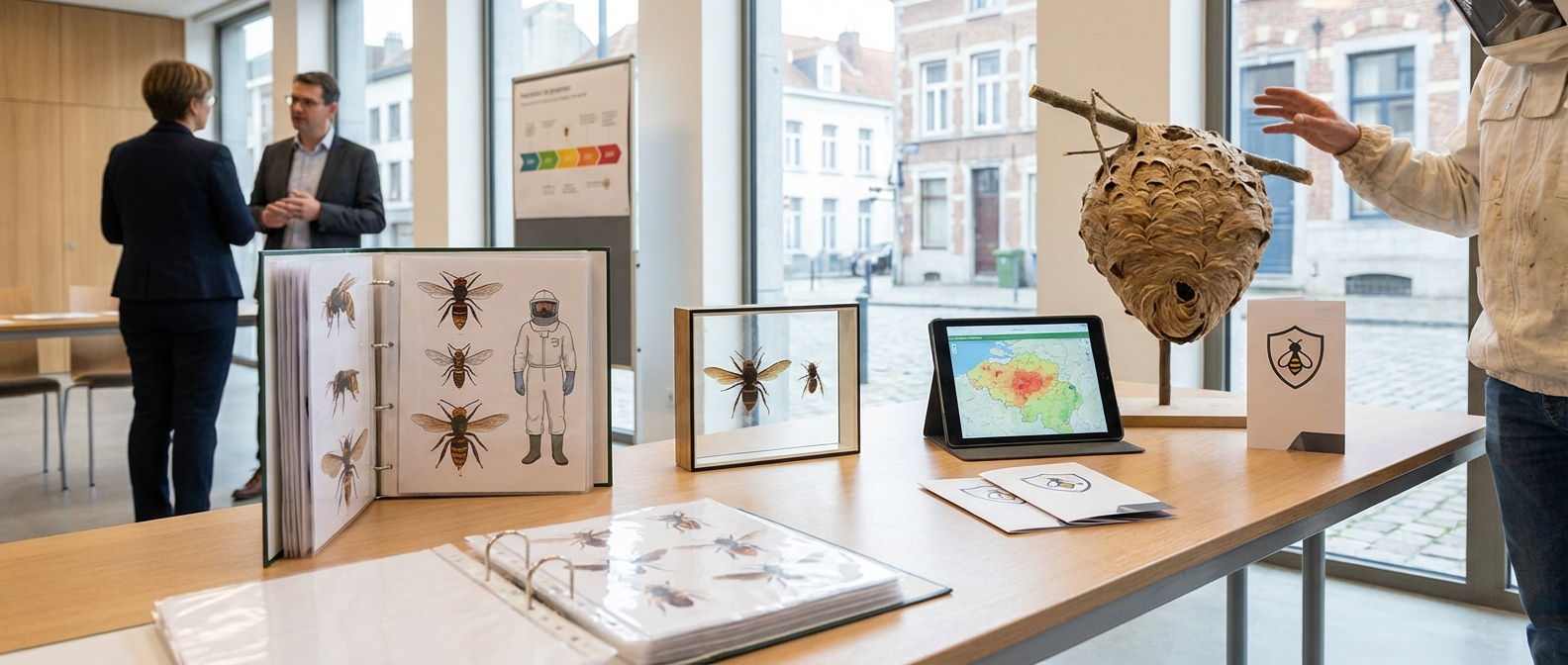
Asian hornet in Etterbeek: guide and 2026 report
Contents
-
How to identify the Asian hornet and act safely in Etterbeek?
-
Account of a successful intervention in Etterbeek by the Frelons.be team
-
Evolution of municipal aid in Etterbeek: from free aid in 2025 to the challenges of 2026
Since the summer of 2025, Asian hornets in Etterbeek are no longer a hypothesis. It's a reality that residents are seeing in their gardens, on their terraces, and sometimes even inside their apartments. The Vespa velutina has settled in the municipality, and it has no intention of leaving on its own.
Things to remember
-
A practical guide for the people of Etterbeek, combining safety tips, the story of a real-life intervention in the municipality and a reminder of the history of our official partnership with the mayor's office.
-
We are clarifying the situation with regard to free past interventions in 2025 and the unknowns of 2026.
-
How to identify the Asian hornet and act safely in Etterbeek?
-
Account of a successful intervention in Etterbeek by the Frelons.be team
At Frelons.be, we work in the field all year round. We know the streets of Etterbeek, the trees where nests hide and the roofs that provide refuge. We've written this guide to give you the right reflexes: how to recognize the bug, who to call and, above all, what's changed in terms of municipal aid this year. Because yes, the situation has changed, and not necessarily in the way we'd hoped.
Whether you've spotted a suspicious insect near your window or a nest as big as a football in a nearby tree, you'll find everything you need to know here to act quickly and safely.
How to identify the Asian hornet and act safely in Etterbeek?
A large insect flying around your table in summer is tempting to scream «Hornet!» and run. But before you panic, you need to know what you're looking at. Identifying the Asian Hornet is the first step, and it's not as complicated as you might think.
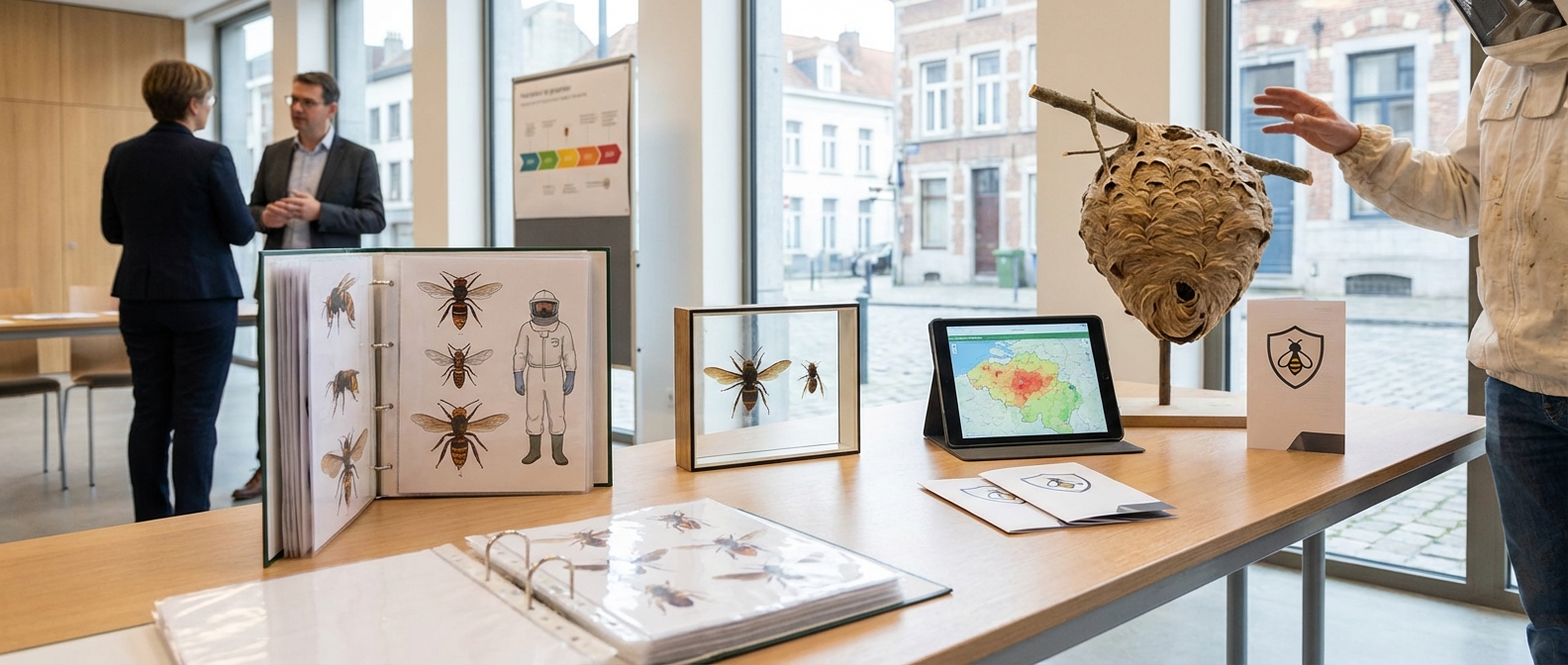
Vespa velutina is smaller than its European cousin. This often surprises people. The European Hornet is easily 3 cm long, with a brown-striped yellow abdomen. The Asian Hornet is more like 2.5 cm. Its body is dark, almost black, with a single orange segment clearly visible on the abdomen. Legs? Yellow at the tips. That's the detail that can't be mistaken. If you see a dark insect with «yellow socks», you've got your Asian hornet.
The difference between the European Hornet and the Asian Hornet is more than just appearance. Their behavior also differs. The European hornet is rather solitary when hunting, and is attracted by light in the evening. The Vespa velutina, on the other hand, hunts in groups in front of hives. It hovers in front of the entrance, catches bees in flight and decapitates them. Brutal, but effective. This is why urban beekeeping in Etterbeek is under direct threat: beehives installed on rooftops or in municipal parks are under enormous pressure.
So what should you do if you spot one in your home or neighborhood?
First rule: don't touch anything. Seriously. An isolated hornet foraging on a flower doesn't represent an immediate danger. But a nest is another story. Asian hornet nests can contain several thousand individuals at the height of the season. Approaching them, shaking a branch, trying to smoke them out with a lighter (yes, we've seen this before): that's the best way to get stung. And multiple stings by Vespa velutina in Brussels have already landed some people in emergency wards.
There are several ways to report a hornet in Etterbeek. You can contact the commune's environment department directly, use the iNaturalist platform to post a photo (experts quickly validate the identification), or call us at Frelons.be. We answer seven days a week. A clear photo is often enough to confirm the species from a distance.
Here are a few situations to report immediately:
-
You see several hornets moving back and forth to the same spot (tree, ledge, dense hedge). This is the sign of an active nest.
-
A nest is visible: teardrop shape, side entrance, often high up, but sometimes also in a low bush or garden shed.
-
You're a beekeeper and your bees are being attacked in front of the hive.
-
A hornet has entered your home and you can't get it out.
Spring trapping, between March and May, remains a good way of limiting proliferation. The principle: capture the founding queens before they build their nests. Selective traps, with a mixture of dark beer and syrup, are used to catch the foundresses while sparing (as far as possible) the other insects. The municipality of Etterbeek distributed traps during information sessions on hornets organized last year. Find out if the operation will be repeated this year.
Account of a successful intervention in Etterbeek by the Frelons.be team
Last September. We received a call from a slightly shaken sacristan. A hornet's nest on the street side of Saint-Antoine church, about thirty meters high. Parishioners were beginning to avoid the side entrance. Some had been followed by hornets for several meters. Atmosphere.
When we got there, the nest was clearly visible on the facade of the church. Characteristic pear shape, around 40 cm in diameter. Not the biggest we'd dealt with, but its position over a crosswalk made the job tricky. We couldn't simply climb up the ladder and vacuum: too much risk of hornets falling on passers-by below.
Our technician opted for a pole operation, carried out early in the morning, before 7 am. By this time, the majority of hornets are still in the nest. This is a point that many people don't realize: intervening in the middle of the day means treating a half-empty nest. The workers are out, they're coming back, they're aggressive. In the morning, everyone's at home.
Destruction of the hornet's nest took around forty minutes. A biocide is injected directly into the nest via a telescopic pole, activity ceases and the structure is removed. The nest near Saint-Antoine church contained just over 2,000 individuals, including larvae. The sacristan couldn't believe it.
We regularly carry out this type of pest control work in Etterbeek. Nests in urban areas pose specific constraints: proximity to dwellings, power cables, pedestrian traffic, pets. Every case is different. A nest in an attic is not the same approach as a nest in a clump of ivy at the bottom of a garden.
What we see in the commune is that nests are often reported late. Sometimes too late. A nest spotted in July is 15 cm long. By September, it can be over 60 cm. The longer you wait, the more complex the intervention, the higher the cost of insect control in Brussels, and the greater the health risk. Hence the importance of rapid reporting.
An important detail: after each intervention, we leave a report for the customer and the municipality. Estimated number of individuals, GPS location of nest, before/after photos. These data feed into the regional mapping of Vespa velutina. Each nest destroyed is an additional piece of data for a better understanding of how the species colonizes Brussels, neighborhood by neighborhood.
Evolution of municipal aid in Etterbeek: from free aid in 2025 to the challenges of 2026
Many Etterbeekers remember: last year, the destruction of Asian hornet nests was free of charge for residents. The municipality of Etterbeek had set up a partnership with Frelons.be, as an official partner, to cover the full cost of the intervention. You call, we come, you pay nothing. Simple, effective, and it enabled us to treat a record number of nests in the municipality.
This reimbursement scheme for nest destruction worked because it removed the main obstacle: price. When people know that it won't cost them anything, they report it more quickly. As a result, nests were treated earlier in the season, when they were still small. Less risk, less intervention time, fewer hornets released into the wild. It was a win-win situation.
Let's be honest: for 2026, we still don't know whether this scheme will be renewed in the same way. Communal budgets are under pressure, political priorities are changing, and nothing has yet been officially announced. We're in regular contact with the Etterbeek municipal services regarding the hornets, and we hope that the collaboration will continue. But we can't guarantee you free parking this year.
What we do know is that the Brussels-Capital Region is maintaining its framework for combating invasive species, of which Vespa velutina is one. Some neighboring communes have already confirmed partial subsidies. Others are offering reimbursement on invoice, up to 50 % or 75 %. Etterbeek could follow one of these models.
While we wait for a clear announcement, here's what we recommend:
-
Contact Etterbeek's environmental department as soon as you spot a nest. Even if the free service has not been confirmed, it is still essential to report the nest in order to trigger the procedure.
-
Ask us for a quote. At Frelons.be, diagnosis and estimates are free. We tell you exactly what it costs before we intervene.
-
Keep your invoice. If a reimbursement scheme is set up during the year (as has happened in the past), you can claim your expenses after the fact.
-
Take part in information sessions on hornets, if the commune organizes them. This is often where concrete announcements are made, and where you can put your questions directly to elected officials.
A word about prices, since this question comes up all the time. The cost of pest control in Brussels varies according to the height of the nest, its accessibility and the equipment required. For a nest less than 5 meters high, you should expect to pay between 90 and 150 euros. For higher nests, with the help of a cherry picker or rope access, the cost can rise to 250 euros, and sometimes more. These rates are comparable to those charged by other licensed operators in the Brussels region.
Our status as an official partner of Frelons.be with several Brussels communes means we can offer rapid intervention, often within 24 to 48 hours. We know the local contacts, the administrative procedures and the forms to be filled in. That saves everyone time.
The real issue for 2026 is prevention. Destroying nests is essential. But if we don't combine spring trapping campaigns, awareness-raising in schools and support for local beekeepers, we'll be chasing the problem every summer. Urban beekeeping in Etterbeek will not survive the constant pressure of the Asian hornet without a coordinated strategy involving the municipality, citizens and professionals.
Conclusion
The Asian hornet is here in Etterbeek. It's neither a rumor nor a projection: it's a fact of life in the municipality today. Identifying the insect, quickly reporting a nest and calling in the services of trained professionals: these are the three things that make the difference between a managed problem and a situation that gets out of hand.
At Frelons.be, we stay busy all year round, not just in summer. If you have any doubts about an insect, spot a nest, or just want to know what to do just in case: give us a call. That's what we're here for.
Frequently asked questions
QCo you recognize an Asian hornet in Etterbeek?
The Asian hornet (Vespa velutina) is smaller than the European hornet. It can be distinguished by its black body, a single orange segment on the abdomen and, above all, its yellow leg tips («yellow socks»), unlike the European hornet, which has brown legs.
Is nest destruction free in Etterbeek in 2026?
In 2025, the municipality will be offering the service free of charge through our partnership, but for 2026, the reimbursement terms have yet to be confirmed. We advise you to keep your invoices and contact Etterbeek's environment department to find out about current subsidies.
What should I do if I discover a hornet's nest in my garden or on my facade in Etterbeek?
Never try to destroy it yourself, as the Asian hornet is very aggressive around its nest. Report it immediately on a platform like iNaturalist or contact a team of professionals like Frelons.be for a fast, secure diagnosis.
When is the best time to report a nest in Etterbeek?
Ideally, nests should be reported as soon as they appear in spring (primary nests the size of tennis balls). The longer you wait until autumn, the larger the nest becomes (up to 60 cm) and the more complex and costly the intervention becomes, due to the height and number of individuals.
Why is the Asian hornet dangerous for Etterbeek?
In addition to the risk of stings for residents in densely populated areas, it represents a critical threat to biodiversity and urban beekeeping. A single nest can decimate entire colonies of bees in the parks and gardens of Etterbeek in a matter of weeks.
 French
  English
  Dutch
Dutch
0 Comments