
Carpenter bees: the complete guide to identifying them in 2026
Contents
-
Carpenter bees and the Hornet: how to recognize them in March?
-
Advantages and disadvantages of the xylocope: a useful pollinator or a threat to your woods?
-
Our recommendations before taking action: how to protect your woodwork effectively
March 2026, and already the first calls are arriving at Frelons.be: «I've got a huge black bee circling my pergola, is it a hornet?» No. In 9 cases out of 10, it's a carpenter bee. It's an impressive, noisy insect, easily 3 centimetres in size, but has absolutely nothing to do with an Asian hornet.
Things to remember
-
This guide is distinguished by its focus on the early appearance of xylocopes in March 2026.
-
We demystify the fear of this impressive insect by comparing it to the Asian hornet, while offering concrete solutions to protect your wooden structures without harming this essential pollinator.
-
How will we recognize it in March 2026?
-
Compare the different options before deciding.
The problem is confusion. A big black bee flying heavily around your woodwork is a worry. And so it should. Except that panicking and pulling out the insecticide is often the worst possible reaction. The carpenter bee, or Xylocopa violacea is a solitary bee that pollinates your garden better than you can imagine. She digs holes in wood, yes. She can sting, yes. But the real question is: should we get rid of them or learn to live together?
This guide is here to help you decide. We'll look at how to distinguish this bug from a hornet or a bumblebee, what it really does to your woodwork, and above all what practical solutions exist to protect your wooden structures without destroying an essential pollinator.
Carpenter bees and the Hornet: how to recognize them in March?
Every spring, it's the same story. Temperatures rise, and large black insects appear around terraces, garden sheds and exposed beams. Many people's reflex: «It's a hornet, call someone!» Except that identifying a flying black insect isn't done by feeling. It's done by observing three things: size, color and behavior.
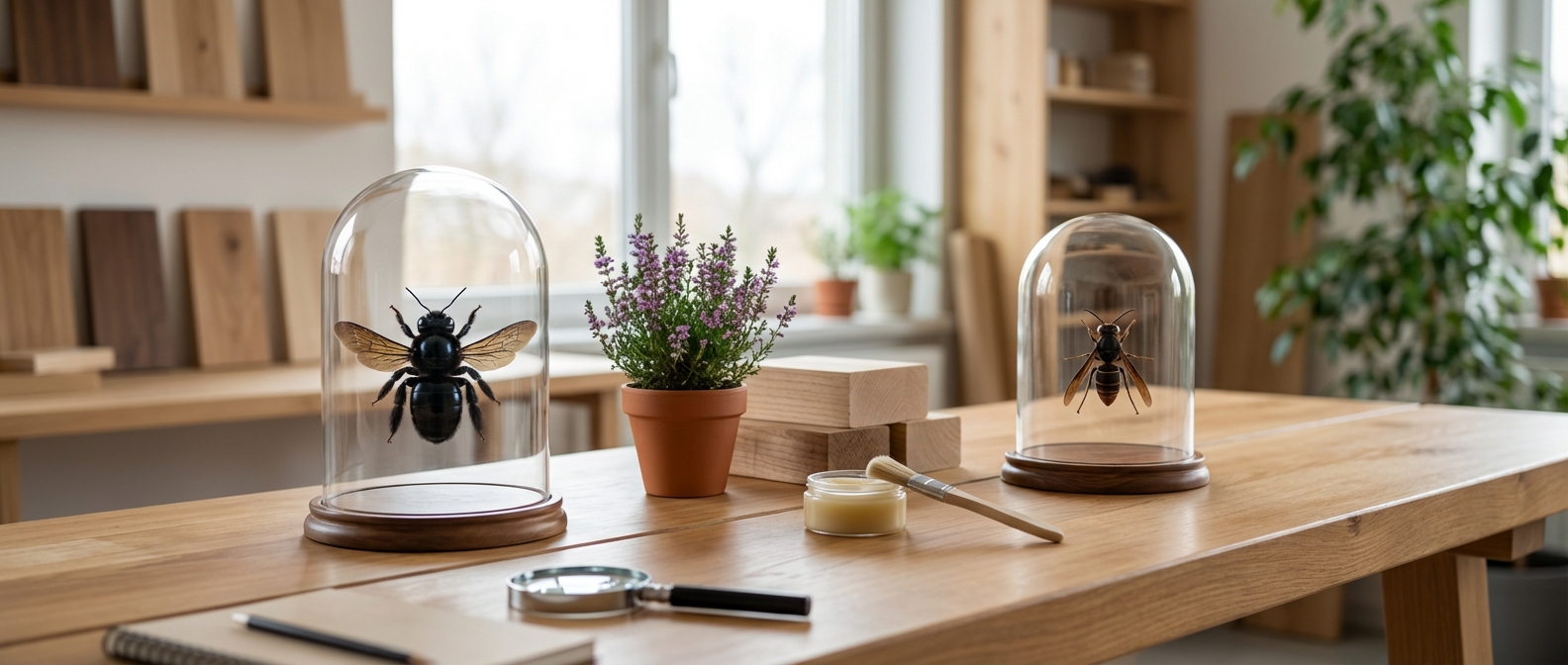
The carpenter bee, the famous purple xylocope, measures between 20 and 30 mm. That's big. Really big for a bee. Its body is entirely black, stocky, with metallic blue-violet reflections on the wings when the light hits them. These reflections are its signature. No hornet has this. In fact, they're sometimes called charcoal bees or carpenter bees, precisely because of their characteristic dark color. Some even refer to it as a blue carpenter bee, which aptly describes those famous reflections.
The Asian hornet is an entirely different animal. In comparison, it has a more elongated body, highly visible yellow legs, and a segmented black and orange abdomen. Its flight is different too: more nervous, more aggressive. Hornets hunt, they patrol. The carpenter bee, on the other hand, forages. It sits on flowers, moving in and out of galleries in the wood. They don't chase you.
What about the black bumblebee? Another common confusion. The bumblebee is smaller, rounder and, above all, covered in dense hair. The carpenter bee has a smooth, almost varnished appearance. When you see a shiny black insect with purple wings making a helicopter-like noise near a wooden beam, it's a xylocope. Not a bumblebee, not a hornet.
An important detail: the size of the carpenter bee is always surprising. People who have never seen one think that only hornets can be so imposing. But that's not true. The xylocope is one of Europe's largest bees, and is perfectly harmless in the vast majority of situations.
Another reliable clue is the period of appearance. Xylocope bees emerge early, as early as March, when temperatures exceed 12-13°C during the day. Asian hornets, on the other hand, don't really become visible until April-May, when their colonies are developing. If you see a large, solitary black insect in March circling your frame, it's almost certainly a carpenter bee.
Is the carpenter bee rare? Not at all. Today, they can be found throughout Belgium and France, and their populations are stable or even increasing thanks to global warming. You'll see them earlier and earlier in the season, and that's normal.
Advantages and disadvantages of the xylocope: a useful pollinator or a threat to your woods?
Let's get down to the nitty-gritty: yes, the carpenter bee digs holes in wood. In fact, that's where its name comes from. The female drills circular galleries about 10 to 12 mm in diameter in softwood or dead wood to lay her eggs. Each gallery can extend for 15 to 30 cm. She deposits pollen, lays an egg, closes with sawdust, and starts again. A real little nesting workshop in dead wood, or sometimes in woodwork: beams, shutters, siding, window frames.
How serious is the damage to the wood? Let's be honest: for a structural beam in good condition, one or two galleries make no difference to its strength. The problem arises when several females return to the same spot year after year. Then the wood can end up looking like Swiss cheese. On a garden shed or decorative cladding, the holes in the wood left by the insect are mainly an aesthetic problem. On a load-bearing structure, it's a different story if it goes on for years without intervention.
A carpenter bee nest doesn't look at all like what you'd imagine. No hive, no organized colony. The carpenter bee is a solitary bee. There is no carpenter bee hive in the classical sense of the word. Each female works alone, digging her own gallery and raising her own offspring. Nor do they produce honey, contrary to popular belief. Carpenter bees don't make honey. They store pollen to feed their larvae, period.
Let's talk danger. Is the carpenter bee's sting rightly frightening? Not really. The male bee, the one that hovers impressively in front of your face to defend its territory, simply doesn't have a stinger. He's bluffing. The female, on the other hand, can sting, but you really have to provoke her: grab her, pin her down, step on her bare feet. The pain is comparable to that of a classic bee sting. Nothing like a hornet's. In terms of real danger, the carpenter bee is far less worrying than a common wasp.
In ecological terms, however, the xylocope is a champion. Its large size enables it to pollinate flowers that honeybees can't reach. Wisteria, sage, lavender: it loves it. Adults have a lifespan of around one year, which means a whole generation works from spring to the following autumn. It's a powerful and efficient pollinator, and in a context where insect populations are declining everywhere, every xylocope counts.
The real dilemma for a homeowner is whether to accept a few holes in a non-structural beam to benefit from an unrivalled pollinator, or to protect expensive woodwork without eliminating the animal. The good news is that you can do both.
Our recommendations before taking action: how to protect your woodwork effectively
The first thing to do when you discover carpenter bee galleries in your woodwork is not to rush to the carpenter bee insecticide. Firstly, because it's often useless (the insect may already have left), secondly, because killing a pollinator that is protected in certain regions can get you into trouble, and thirdly, because there are much smarter solutions.
The best approach is prevention. Preventive wood treatment is by far the most effective method of keeping carpenter bees away. Wood bees target soft, untreated, unpainted wood. Untreated wood exposed to the elements is a magnet for them. Apply a woodstain, varnish or paint to all your exterior woodwork. Surface-treated wood no longer attracts nesting females. It's as simple as that.
For structures already affected, carpenter bees can be treated by filling in existing galleries. Wait until autumn, when the adults have left and the larvae have hatched. Fill the holes with wood filler or putty-coated dowels, then apply a protective coating. The aim: to render the wood unusable for the next generation.
Another trick that works well is to offer an alternative. If you have a wild corner of the garden, leave an old log or a piece of untreated wood there. Carpenter bees will settle there rather than in your new pergola. It's intelligent cohabitation with biodiversity, and it works. You protect your structure while providing a habitat for these insects.
A few natural methods are circulating on the Internet: almond oil, citrus fruits, white vinegar. To be honest, the results are highly uncertain. It may work temporarily as a repellent, but it's not reliable over the long term. The only truly lasting treatment is mechanical wood protection.
What if the situation gets out of hand? If you have dozens of galleries in a structural framework, if you can't tell a carpenter bee from a hornet, or if you're afraid of stings: call in a professional. At Frelons.be, we work all year round to identify the insects you're worried about and offer you the right response. Sometimes it's the destruction of an Asian hornet nest. Sometimes it's simply advice on how to protect your woodwork and leave the Asian hornet alone.
The important thing to remember is that action doesn't have to mean destruction. Protecting your woodwork and preserving biodiversity are not mutually exclusive. Well-maintained and well-treated wood will never be a target for carpenter bees. And a garden that welcomes xylocopes is a healthy garden.
Conclusion
The carpenter bee impresses with its size, deep buzz and black color. But it deserves neither panic nor insecticide. It's a precious pollinator, a solitary bee that only needs a piece of wood to raise its offspring. Protect your woodwork with a suitable surface treatment, offer it an alternative habitat in a corner of the garden, and you'll have solved the problem without harming anyone.
If you have any doubts about the identification of the insect you are observing, or if you suspect the presence of an Asian hornet, contact Frelons.be. We're active all year round, and we'd rather reassure you for nothing than leave you facing a real problem with no solution.
Frequently asked questions
How to tell the difference between a carpenter bee and an Asian hornet?
The carpenter bee is entirely black with purple highlights and a stocky body, while the Asian hornet has yellow legs and a black and orange abdomen. In March, a large solitary insect circling the wood is almost always a carpenter bee, as hornets are only active from April onwards.
Is the carpenter bee a danger to my roof structure?
Although they excavate galleries 10 to 12 mm wide to lay their eggs, they do not compromise the strength of a healthy beam in an isolated attack. The risk only becomes structural if several generations return to burrow in the same wood over a period of years; a surface treatment (woodstain or paint) is generally sufficient to keep them away.
Do carpenter bees sting and should I get rid of them?
It's a peaceful and harmless pollinator: the male has no sting and the female only stings when handled. As it is a useful insect for biodiversity, we recommend that you avoid using insecticides, and instead opt for prevention by protecting your woodwork and offering dead wood at the bottom of the garden.
Do carpenter bees make honey?
This bee doesn't make honey.
 French
  English
  Dutch
Dutch
0 Comments