
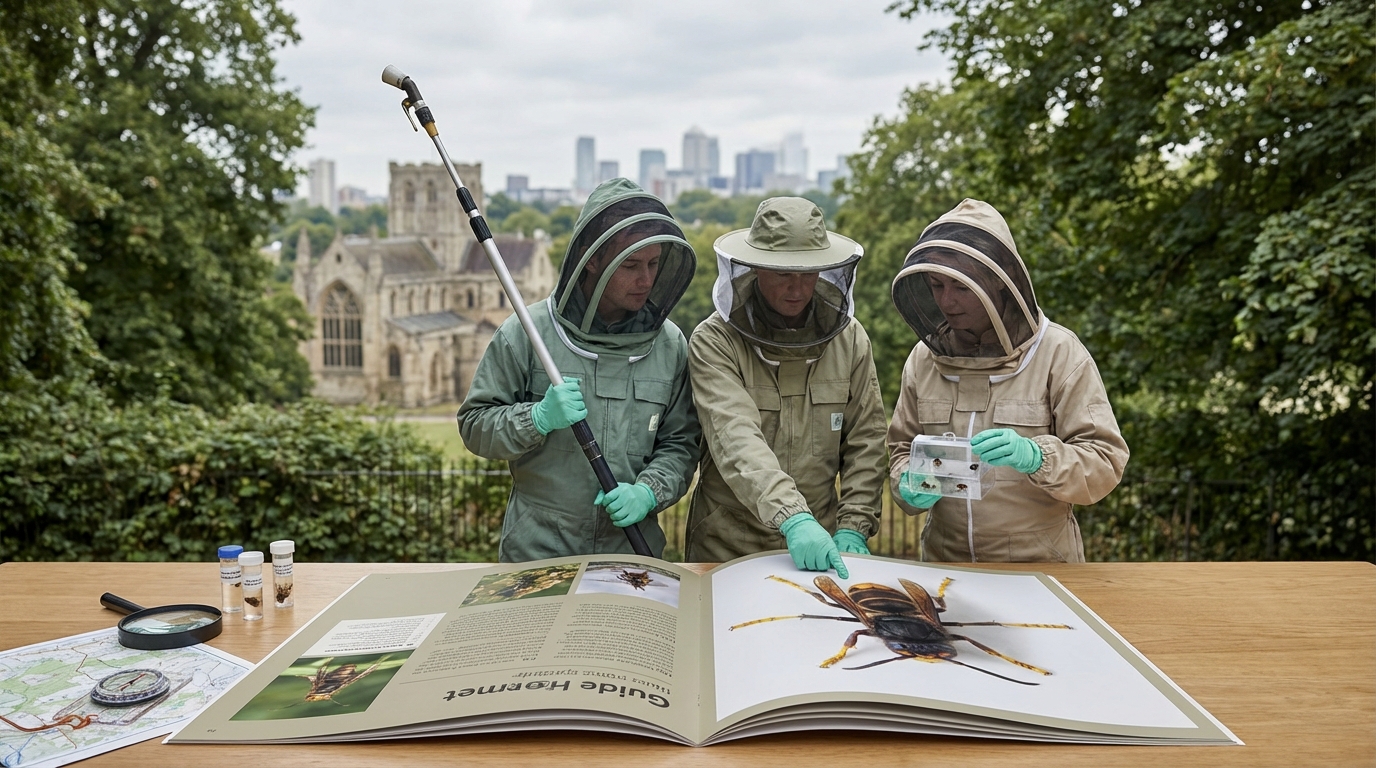
Asian hornets in Forest: A complete guide to local intervention
Contents
-
Identifying Asian hornets and their nests in Forest neighborhoods
-
Destruction procedure in Forest: Who to contact from the Abbey to Parc Duden?
-
Risk prevention and management: Protecting your garden and forest public spaces
Last summer, a homeowner on Chaussée de Bruxelles called me one Saturday morning in a panic. A constant, dull buzzing was coming from the lime tree at the bottom of his garden. As he approached, he saw a grayish ball the size of a basketball, hanging from a branch six meters high. Asian hornets. In the middle of the Forest, 200 meters from Wiels.
Things to remember
-
An expert account combining real-life intervention near Wiels and Parc Duden with rigorous scientific analysis
-
We are clarifying the specific protocol for commune 1190 to offer a local, secure and authoritative solution to Vespa velutina.
-
Identifying Asian hornets and their nests in Forest neighborhoods
-
Who to contact from the Abbey to Parc Duden
This kind of scene has been repeated every year since the Vespa velutina has become established in Belgium. The commune of Forest, with its mature parks, tree-lined gardens and the canopy of Parc Duden, offers ideal terrain for this invasive species. The problem is, most residents don't know exactly what to do when they come across a nest. Call the fire department? The local council? Private insect control? Answers vary depending on the source, and this creates real confusion.
This article sets things out clearly. We're going to talk about identification, destruction procedures and prevention, all rooted in the reality of the forest: the streets, the parks, the local contacts. No general blah, blah, blah about the 1190 zip code.
Identifying Asian hornets and their nests in Forest neighborhoods
Recognizing an Asian hornet is the first step, and it's not as easy as you might think. Many people confuse the Vespa velutina with the European hornet (Vespa crabro), which is harmless to local biodiversity. So here are the criteria you need to know.
The Asian hornet is smaller than its European cousin: around 2.5 to 3 cm for a worker. Its body is predominantly black, with a single orange abdominal segment (the fourth). Legs? Yellow at the tips, as if wearing light-colored socks. The European hornet, on the other hand, has a yellow abdomen with black stripes and a bright red head. If the insect you're looking at is dark overall, with an orange face, it's most likely a Vespa velutina.
As far as nests are concerned, a distinction must be made between two phases. In spring, the founding queen builds a primary nest, often the size of a tennis ball, in a sheltered spot: under an awning, in a garden shed, under a balcony. In Forest, they are regularly found in the cornices of terraced houses on the Rue du Mystère or Avenue du Globe sides. These primary nests are discreet and easy to miss.
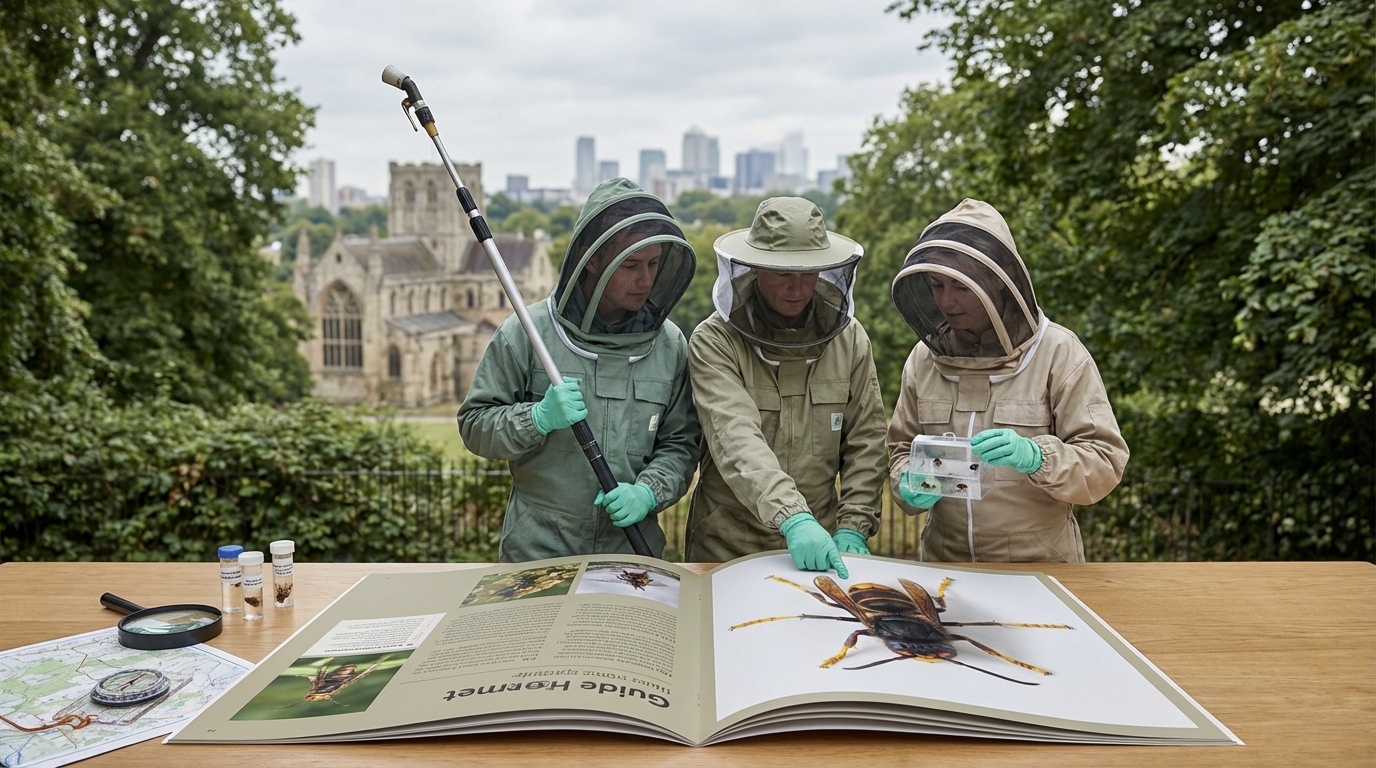
As the colony grows, it migrates to a secondary nest, usually spotted in summer or autumn. This one is impressive: sometimes 80 cm in diameter, high up in the trees. Parc Duden, with its hundred-year-old beech and oak trees, is a recurring spot. Last year, Bruxelles Environnement counted several active nests. The lime trees along Avenue Victor Rousseau are also frequent locations.
Why is Forest particularly concerned? Biodiversity in Brussels both attracts and suffers from the Asian hornet. Visit Vespa velutina is a formidable predator of honeybees: it hovers in front of hives and captures foragers one by one. Forest beekeepers, particularly those with hives near the Abbaye de Forest or in the shared gardens of the Saint-Denis district, see this every season. A study published in the Journal of Pest Science (Monceau et al., 2014) has shown that a single Asian hornet colony can decimate 30% of a hive in a matter of weeks.
If you think you've spotted an Asian hornet or a nest in your neighborhood, don't try anything yourself. Take a clear photo (your phone will do), note the exact address and approximate height of the nest. This information is essential for further action.
An important point: don't kill an isolated Asian Hornet on impulse. Crushing one worker solves nothing, as the colony is made up of thousands. Worse still, a crushed hornet releases a warning pheromone that can make fellow workers aggressive within a short radius. The objective is always the nest.
Destruction procedure in Forest: Who to contact from the Abbey to Parc Duden?
Three nests discovered in one week in the same area, between Place Saint-Denis and Avenue Jupiter. It was September 2023, and local residents didn't know where to turn. Here's the step-by-step protocol for effective intervention in 1190.
Step 1: Report. The number one reflex is to report it via the iNaturalist or directly to Bruxelles Environnement. In Belgium, any report of an Asian hornet feeds a national database managed by the Centre wallon de Recherches agronomiques (CRA-W) and Vespa-Watch. Your observation counts: it can be used to map the progress of the species and prioritize interventions. You can also call the toll-free number 1718 (non-police emergency number) to report a nest accessible on the public highway.
Step 2: Assess who's involved. This is where things get a little complicated. The Brussels fire department (SIAMU) intervenes free of charge for wasp and hornet nests that represent an immediate danger on public property, or where there is a safety risk (near schools, crèches, busy crosswalks). For Asian hornets specifically, the Brussels Region has set up a coordinated destruction program with approved operators.
If the nest is on your private property, the situation is different. The Forest local authority can help you, but the cost of destruction is generally borne by the owner. The price of a hornet's nest removal in Forest varies according to height and accessibility: expect to pay between 100 and 250 euros for an accessible nest, and up to 350 euros if a cherry picker is required. Some operators charge a weekend supplement. Always ask for a quotation beforehand.
Step 3: Choose the right service provider. Not just anyone. A conventional exterminator doesn't necessarily have experience of Vespa velutina. Secondary nests at height require special equipment (telescopic injection pole, reinforced suit) and knowledge of the species' behavior. Choose companies approved by Bruxelles Environnement or the Vespa-Watch network. At Frelons.be, we know the terrain of the forest: the complicated access to the inner gardens near Wiels, the monumental trees of Parc Duden, where nests nest at 15 meters.
A case in point: the intervention near Wiels I mentioned in my introduction. The nest was in a lime tree on the garden side, inaccessible from the street. We had to pass through the neighboring property, install lighting (the intervention took place at dusk, when the whole colony had returned to the nest) and inject a biocide directly into the structure. Total duration: 45 minutes. The next morning, there was no further activity. The nest was removed and destroyed three days later, once it was certain that all the workers had died.
Interventions in the evening or at dawn are the norm for serious professionals. If you intervene in the middle of the day, you run the risk of neutralizing only part of the colony, as the foragers are absent, and of ending up with disoriented, aggressive hornets in the neighborhood.
To summarize the contact chain in 1190:
-
Report : Vespa-Watch, iNaturalist or Bruxelles Environnement
-
Immediate danger on public roads: Brussels fire department (SIAMU) on 112
-
Nest on private property: approved operator (ask for regional references)
-
Administrative questions: Forest Environment Department
Risk prevention and management: Protecting your garden and forest public spaces
A neighbor in the Altitude Cent neighborhood showed me his homemade trap last year: a bottle cut with beer and syrup inside. The result? Three Asian hornets, but also around forty flies, moths and two bumblebees. This kind of non-selective trap does more harm than good to local biodiversity.
Selective trapping is a different matter. It's only used in spring (March-April), when the founding queens emerge from hibernation and seek a site for their primary nest. Approved traps use specific baits (wax tree juice, dark beer) and, above all, calibrated grids that allow smaller insects to escape. Brussels Environment formally advises against trapping in summer: at this time of year, you'll only be capturing workers, with no real impact on the colony, while at the same time massacring pollinators.
What scent does the Asian Hornet hate? We read a lot of things on the Internet. Burnt coffee, lemongrass, cloves. Let's be honest: no serious scientific study has demonstrated a reliable repellent effect of these substances on the Vespa velutina. An INRAE publication (2021) tested several volatile compounds without finding any effective garden-scale repellents. Burning coffee grounds may temporarily repel a few insects, but it won't protect your beehives or terrace from a colony 20 meters away.
The key to prevention is early vigilance. Inspect your garden sheds, roof overhangs and outdoor meters as early as March. A primary nest the size of a golf ball is a single queen with a few larvae: at this stage, a professional can intervene quickly and inexpensively, and prevent the formation of a colony of several thousand individuals.
The danger of an Asian hornet sting deserves to be discussed without dramatizing it, but without minimizing it either. For most people, a sting is painful (more so than a wasp) but not serious. The real risk is for people allergic to hymenoptera venom: possible anaphylactic shock, requiring immediate injection of adrenaline. If you know you're allergic, keep your auto-injector handy between May and November. And if you're stung several times (which happens when you disturb a nest without knowing it), head for the emergency room, even if you have no known allergy. Asian hornet venom contains cardiotoxic substances with a dose-dependent effect, as documented in a study by Bordeaux University Hospital (Langley et al., 2019).
The Asian Hornet's life cycle explains why timing is so crucial. The founding queen emerges in February-March. She builds the primary nest on her own. The first workers are born in May-June. The colony explodes in summer, with a peak in September-October (up to 2,000 individuals). In autumn, future queens and males leave the nest to mate. The males die. The new, fertilized queens seek shelter to overwinter. The old nest is abandoned and never used again.
For Forest's public spaces, Bruxelles Environnement coordinates active surveillance, notably in Parc Duden and around the Abbey. Municipal employees are trained in detection. But detection also relies on local residents. If you see an Asian hornet foraging on your flowering ivy or fallen fruit in September, report it. Every sighting helps to locate nests before they reach their maximum size.
One last practical point: never block the entrance to a nest. Hornets will find another way out, potentially inside your home. Don't shake a suspect tree. Don't attempt to smoke out a nest. Every year, the emergency services deal with cases of «home» interventions that have gone wrong. Destroying an Asian hornet nest in Forest, like anywhere else, is a job for a trained professional.
Conclusion
Asian hornets in the Forest commune are no longer a novelty: they're an established reality, requiring precise reflexes. Correctly identify the species, report it without delay, call on the right people to destroy it, and adopt preventive measures at the right moment in the annual cycle.
If you spot a nest or a suspicious individual in your garden, near Duden Park, on the outskirts of Wiels or anywhere else in 1190, don't be left alone with the problem. Contact Pest Patrol for a rapid assessment and safe intervention. We know Forest, we know the Asian hornet, and we know how to deal with it properly.
Frequently asked questions
How can I recognize an Asian hornet in my garden in Forest?
The Asian hornet (Vespa velutina) is darker than the European hornet, with a predominantly black body, a single orange abdominal segment and yellow-tipped legs. It is smaller than its native cousin and can often be recognized by its hovering flight in front of beehives or ivy flowers.
Where do hornet nests usually hide in Forest?
In spring, primary nests (the size of a tennis ball) are found under cornices, garden sheds or balconies, particularly in dense neighborhoods such as Rue du Mystère. In summer, secondary nests migrate up into the tall trees of Parc Duden or Avenue Victor Rousseau, sometimes reaching 80 cm in diameter.
Who should I call to destroy a hornet's nest in Forest?
For immediate danger on the public highway, call the Brussels fire department (SIAMU) on 112. On private property, responsibility lies with the owner: we strongly advise you to call in a Brussels Region-approved pest control operator, such as Pest Pestrol, as high-rise nests require special equipment and an injection of biocide.
Is there any point in placing homemade traps in Forest?
No, homemade traps (bottle with beer and syrup) are not recommended, as they capture many useful pollinating insects. Trapping should only be carried out in spring (March-April) with approved selective devices to target only the founding queens without harming local biodiversity.ranium.
 French
  English
  Dutch
Dutch
0 Comments