
Asian hornets in Anderlecht: everything you need to know about local intervention
Contents
-
Identifying the presence of the Asian hornet in Anderlecht neighborhoods
-
How a destruction operation works at Neerpede or Parc Astrid
-
Pricing, reporting and prevention: what to do when faced with a hornet's nest in Anderlecht?
Last summer, a resident of Neerpede called me on a Saturday morning. Panicked. His children were playing in the garden when they noticed a suspicious coming and going under the garage ledge. Dark insects, smaller than the European hornets he knew, with a conspicuous orange stripe down the abdomen. The nest was already the size of a football. In the middle of Anderlecht, yes.
Things to remember
-
An ultra-localized expert guide combining technical expertise and geographical knowledge of Anderlecht (Parc Astrid, Neerpede, Scheutbos)
-
Unlike cold institutional websites, we tell the real story of the Andersen area to reassure residents with a local approach.
-
Identifying the presence of the Asian hornet in Anderlecht neighborhoods
-
How a destruction operation works at Neerpede or Parc Astrid
This kind of scenario has been multiplying in the commune for some years now. The Asian hornet, or Vespa velutina, is no longer a phenomenon confined to the south of France or the Walloon countryside. It's well established in Belgium, and Anderlecht is no exception. Parc Astrid, Scheutbos, Cureghem, residential areas with gardens: reports increase every season. This guide has been designed for Anderlecht residents who want to understand what they're up against, know how to react and, above all, avoid putting themselves in danger.
We're going to talk about identification, concrete intervention and real costs. No sanitized institutional rhetoric. Just what we see on the ground, every day, in your neighborhoods.
Identifying the presence of the Asian hornet in Anderlecht neighborhoods
First thing to know: the Asian Hornet does not resemble the European Hornet. This is the most common confusion. The European hornet (Vespa crabro) is larger, redder, with a yellow abdomen streaked with black. The Vespa velutina, is darker. Almost black, with a single orange stripe on the fourth abdominal segment, and yellow legs at the tips. It's also slightly smaller, around 2.5 to 3 cm for the workers. The distinction between the European and Asian hornets is crucial, because the two do not present the same level of risk to the environment and local bees.
In Anderlecht, hornet nests appear in a wide variety of places. They can be found high up in trees, typically around the Scheutbos or in the tall trees of the Parc Astrid. But also under roofs, in garden sheds in Neerpede, or even in low hedges at the start of the season. Primary nests, those built by the founding queens in spring, are often small and close to the ground. In summer, the colony explodes and the secondary nest, sometimes perched 15 or 20 meters high, reaches the size of a large watermelon.
How to spot a nest? The most obvious sign is the aerial ballet. If you see a steady stream of insects flying in and out of the same spot, day after day, it's a strong indicator. Don't confuse this with a swarm of bees in transit: Asian hornets have a characteristic, more stationary flight, almost hovering in front of the nest entrance. Another clue: if you have beehives nearby, or an orchard, and you notice hornets chasing bees in hovering flight in front of the hives, it's Asian hornets. Vespa velutina. No doubt about it.
The neighborhoods most affected in Anderlecht are logically those that combine greenery and old buildings. Neerpede, with its semi-rural areas, vegetable gardens and open spaces, concentrates a good number of reports. Parc Astrid also attracts colonies thanks to its large mature trees. Cureghem, which is denser and more urban, is not spared either: hornets like to nest in gaps in facades or under flat roofs.
A question I'm often asked: is the Asian hornet really present in Belgium, or is it just psychosis? The answer is clear. Vespa velutina has been officially identified in the Brussels-Capital Region since 2016, and sightings are multiplying every year. Brussels Environment confirms it. Asian hornets in Anderlecht are a documented reality, not a neighborhood rumor.
If you think you've spotted a nest, stay away. Seriously. A mature nest can contain several hundred individuals, and even a slight disturbance triggers a collective attack. Identifying the Asian hornet is the first step, and conditions everything else.
How a destruction operation works at Neerpede or Parc Astrid
A call comes in at 9am on a Tuesday. A family in Neerpede, nest spotted in a lime tree at the bottom of the garden. The nest is about 12 meters away. The children can no longer play outside. We deal with this type of situation several times a week between May and November.
Here's how it works. First, a remote diagnosis is made, by telephone or via a photo sent by the customer. This is often enough to confirm that we're dealing with Asian hornets and not common wasps or European hornets. If in doubt, we'll come to you. Free in most cases for Anderlecht residents, because we know the terrain and won't charge for a ten-minute trip.
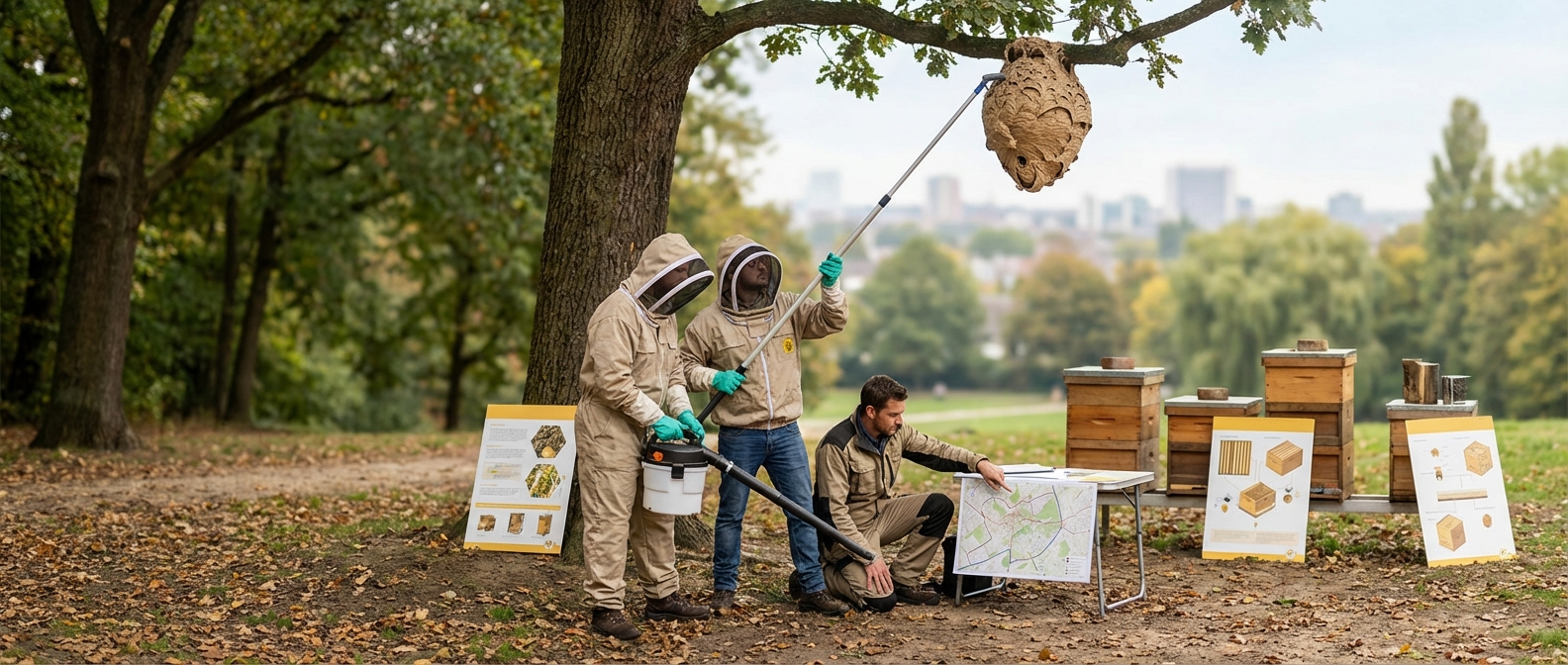
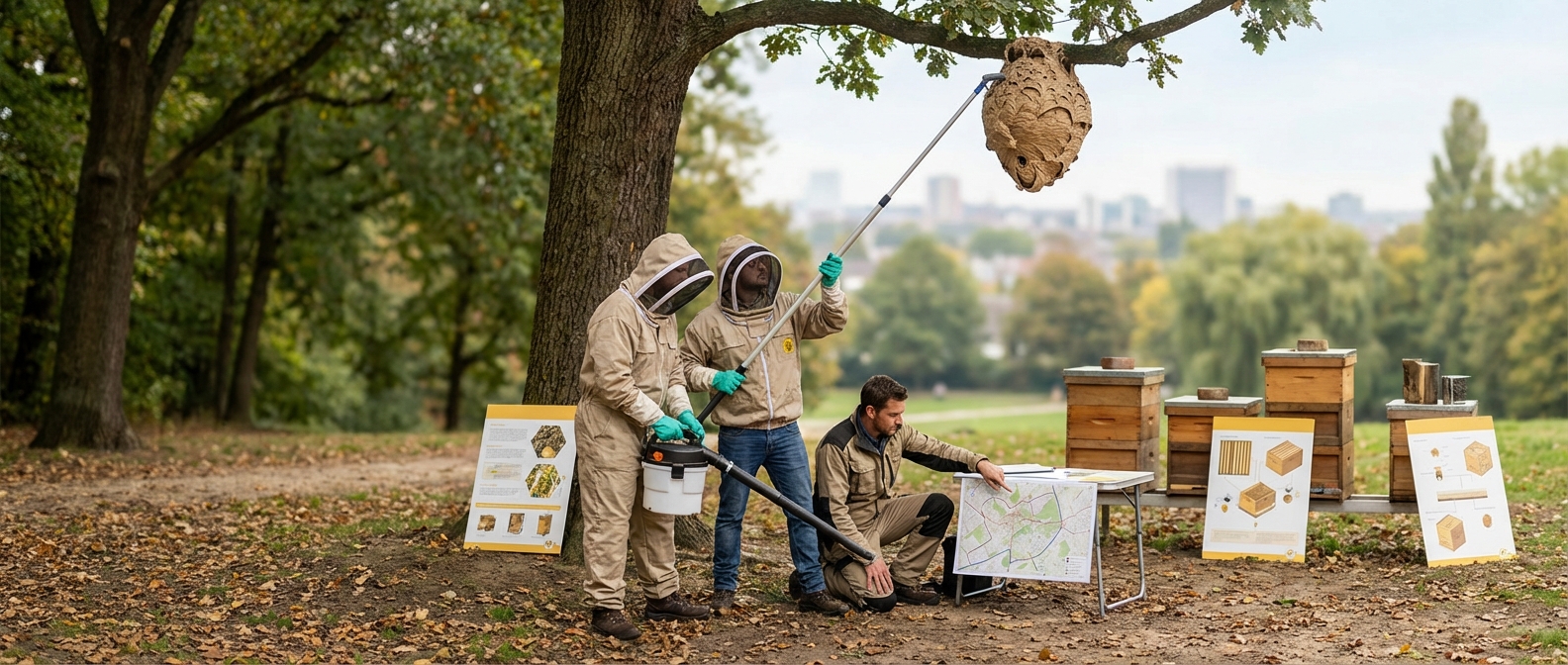
The destruction of a hornet's nest in Anderlecht follows a precise protocol. The insect killer arrives equipped with a full-body sting-proof suit, reinforced gloves and, depending on the height of the nest, a telescopic pole that can reach 20 meters or a gondola. For nests in the trees of Astrid Park or in the tall poplars of Neerpede, the pole is the tool of choice. A specific insecticide is injected directly into the nest entrance, at the end of the day or early in the morning, when the majority of individuals are inside.
Why not just unhook the nest? Because that's the best way to end up with hundreds of angry, disorientated hornets. The targeted injection neutralizes the colony within a few hours. The nest is then removed the next day or within 48 hours, once we're sure there's no more activity. The safety of the operation is non-negotiable. We secure a perimeter, notify neighbors if necessary, and make sure there are no pets in the area.
A pest control specialist in Brussels who knows Anderlecht makes all the difference. We know that a particular tree on the Scheutbos can be accessed via the towpath, that a particular building in Cureghem has roof access via the stairwell of building B, and that the gardens in Neerpede often have hedges between them that make access difficult. This local knowledge saves time and reduces risks for everyone.
The intervention lasts on average between 30 minutes and 1h30, depending on the location and size of the nest. The most complex cases involve nests integrated into built structures: under siding, in a chimney, behind a roller shutter. In these cases, it's sometimes necessary to dismantle, gain access, treat and then close again. We never botch this stage.
A final word on a subject that comes up a lot: why shouldn't you kill a lone Asian Hornet? The answer is nuanced. A single individual does not represent a major danger. Killing it solves nothing if the nest is still active. And crushing a founding queen in spring is useful, but you need to be sure of identification. The real issue is always the nest.
Pricing, reporting and prevention: what to do when faced with a hornet's nest in Anderlecht?
90 to 180 euros. This is the price range for removing a hornet's nest in most situations in Anderlecht. The price depends on three main factors: the height of the nest, its accessibility, and the time of year. A primary nest 2 meters high in a garden shed, treated in June, will cost less than a secondary nest perched 18 meters high in an oak tree in September. Logical.
Beware of scams. Some unscrupulous operators take advantage of the panic to charge 300, 400 euros or more. Always ask for a quote before the work is carried out. A serious professional will give you a clear price after seeing photos or inspecting the site. No surprises at the end. The price of destroying a hornet's nest should never be a mystery.
There are several ways to report an Asian hornet in Brussels. The platform iNaturalist allows you to post a geolocated observation with photo, and the experts validate the identification. If you're in Anderlecht and spot a nest, you can also contact your local council directly, which will redirect you to the appropriate services. At Frelons.be, we regularly receive calls from residents who don't know where to turn. We guide them, explain things to them, and if an intervention is necessary, we take care of it.
When it comes to hornet prevention, let's be honest: you can't stop a founding queen from setting up shop somewhere. Asian hornet traps, set in spring (March-April), can capture foundresses before they create their nests. They work, provided you use the right bait (a mixture of dark beer, white wine and blackcurrant syrup is effective) and position the traps in high-risk areas: near compost bins, fruit trees and watering holes.
A few simple gestures also reduce the attractiveness of your garden. Don't leave rotting fruit on the ground. Cover your garbage cans. Avoid sources of stagnant water. Asian hornets are looking for three things: food (proteins and sugars), water and a sheltered nesting site. Remove any one of these three resources, and you reduce the chances of their settling in.
Where are there the most Asian hornets in Belgium? The provinces of Hainaut and East Flanders are the most affected, but Brussels is catching up fast. Urban density doesn't protect: parks, shared gardens and communal green spaces offer everything you could wish for. Vespa velutina needs. Anderlecht, with its 40% of green surface, is a particularly favorable site.
If you're a building or green space manager in Anderlecht, make hornet surveillance part of your maintenance routine between April and November. Early detection means simpler, less costly and less risky intervention for occupants. Don't wait until the nest reaches 60 centimetres in diameter to call.
Conclusion
Asian hornets in Anderlecht are not an abstract threat. They are a concrete problem, in your gardens, under your roofs, in the trees of your parks. Rapid identification, reporting and professional intervention form the triptych that protects your family, your neighbors and local biodiversity.
If in doubt, take a photo and send it to us. We'll tell you in a few minutes whether it's an Asian hornet or not, and what to do about it. At Frelons.be, we work in Anderlecht all year round, with short lead times and transparent rates. A nest spotted today means a nest treated tomorrow. So don't wait any longer.
Frequently asked questions
How can you tell an Asian hornet from a European hornet in Anderlecht?
The Asian hornet is darker, almost black, with a single orange stripe on the abdomen and yellow-tipped legs. It is slightly smaller than the European Hornet, which is redder with a predominantly yellow abdomen and dark legs.
Where do hornet nests most often hide in Anderlecht?
In Anderlecht, they are often found high up in the trees of Parc Astrid or Scheutbos, but also in low hedges or garden sheds in Neerpede. In urban areas such as Cureghem, they are often found under cornices or in the gaps between facades.
How much does it cost to destroy a hornet's nest in Anderlecht 1070?
Treatment generally costs between €90 and €180, depending on the height and accessibility of the nest. A primary nest at the start of the season is less expensive to treat than an imposing secondary nest perched 25 meters up a tree in late summer.
Is it dangerous to destroy a hornet's nest yourself?
Yes, it's extremely risky, as a simple disturbance can trigger a mass attack of hundreds of hornets. Calling in a local professional guarantees safe neutralization with the right equipment, protecting your family and neighbors.
 French
  English
  Dutch
Dutch
0 Comments