
Asian hornets in Molenbeek: A complete guide to intervention
Contents
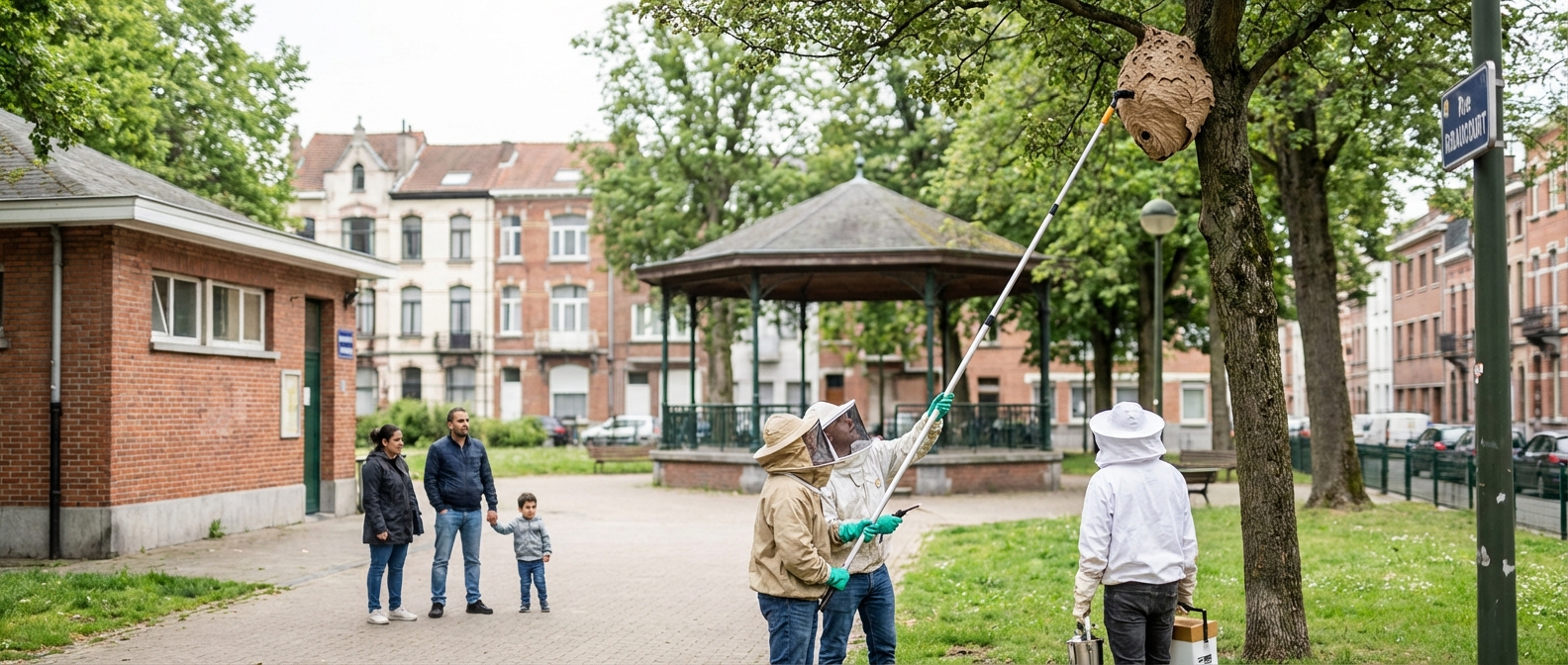
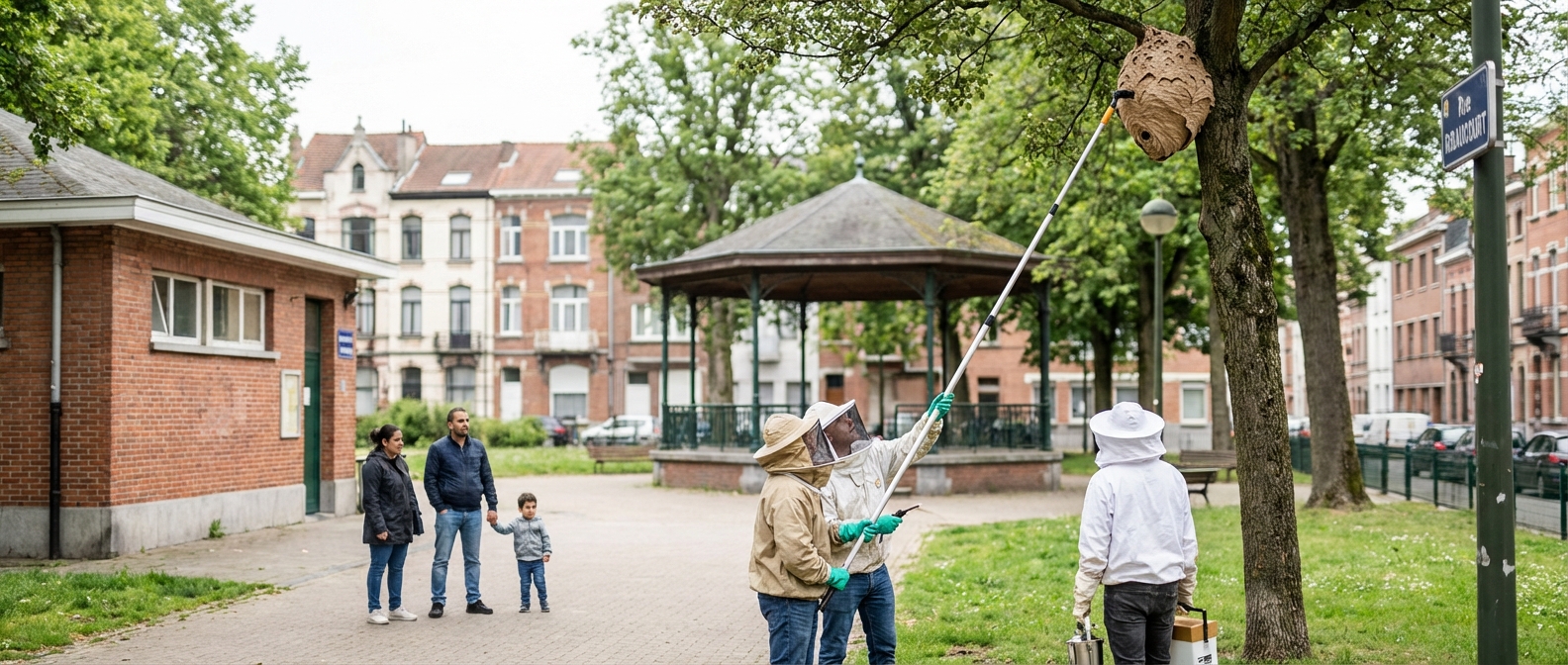
Last summer, an Asian hornet nest the size of a basketball was removed from under a cornice in Rue de Ribaucourt. Residents on the first floor hadn't dared open their windows for three weeks. This kind of situation is becoming more and more common in Molenbeek-Saint-Jean, and not just in remote corners: right in the center, in gardens, on balconies, under roofs.
Things to remember
-
We take a grassroots approach, reporting on the day-to-day operations in Molenbeek-Saint-Jean.
-
By citing emblematic sites such as the Karreveld Park or the Rue de Ribaucourt, we are creating a bond of trust with residents while responding to public safety emergencies linked to this invasive species.
-
Asian hornet invasion in the heart of Molenbeek-Saint-Jean
-
How a nest is destroyed in Molenbeek's neighborhoods
The Asian hornet (Vespa velutina) has become firmly established in the Brussels-Capital Region in recent years. Molenbeek has not been spared. Between Karreveld Park, shopping streets and apartment buildings, there's no shortage of places where they can nest. This guide is here to give you the keys: how to recognize the bug, what to do if you come across a nest, how much it costs and, above all, how to react quickly without taking risks.
At Frelons.be, we take action against Asian hornets all year round. Not just in summer. Secondary nests appear as early as spring, and the founding queens are active long before the warm weather arrives. So be prepared.
Asian hornet invasion in the heart of Molenbeek-Saint-Jean
In 2025, the Brussels Region recorded an increase of over 30 % in reports of Asian hornets compared with the previous year. Molenbeek is one of the municipalities most affected. Why is this so? Paradoxically, urban density offers exactly what Vespa velutina needs: cavities in old buildings, mature trees in parks, and an abundance of pollinating insects to hunt.
Karreveld Park is a good example. With its tall trees, hedges and proximity to the castle, it's an ideal playground for colonies. We've spotted nests suspended over 15 meters high in the treetops, almost invisible from the ground. Walkers pass beneath them unsuspecting. It's often a gardener or maintenance worker who finally raises the alarm.
Identifying the Asian hornet isn't all that complicated once you know what to look for. It's smaller than the European hornet: around 2.5 to 3 cm for the workers. Its thorax is entirely black, its legs are yellow at the tips (it's often said that it wears «yellow socks»), and its face is orange. The European Hornet, on the other hand, has a yellow abdomen with black stripes and a reddish-brown thorax. Confusion between the two is common, but has consequences: the European Hornet is a protected local species. Killing it would be a mistake. It's a question we're often asked: why shouldn't we kill an isolated Asian Hornet? Quite simply because crushing an individual does not solve anything. The nest must be located and destroyed. A single hornet is a symptom. The problem is the colony.
In Molenbeek, nests can be found in a wide variety of locations. Under the roofs of typical Brussels houses, in roller shutter boxes, under the eaves of shops, sometimes even in low hedges in spring (the smaller, primary nests). They have also been found in garden sheds, garages and once in a disused electricity meter. The diversity of Molenbeek's built environment, with its mix of old buildings, terraced houses and green spaces, multiplies the possibilities.
The danger of the Asian hornet is real, especially for people allergic to hymenoptera venom. A sting can cause anaphylactic shock in sensitive individuals. For others, it's painful but rarely serious, except in the case of multiple stings (which happens when you get too close to a nest). Asian hornets are not aggressive away from their nest, but within a 5-meter radius of the colony, they defend their territory with determination. That's why we insist: never try to destroy a nest yourself. Neither with a garden hose, nor with fire, nor with insecticide spray from the supermarket. We've seen the damage it can do.
How a nest is destroyed in Molenbeek's neighborhoods
Have you spotted large black and yellow insects coming and going near your home? Here's what happens when you call us for hornet control in Molenbeek-Saint-Jean.
First, we assess the situation. Either by telephone with your photos (a smartphone is more than enough), or by visiting us if there is any doubt about the species. This stage is free of charge. We don't charge for a diagnosis. If it's a wasp, European hornet or bee nest, we'll point you in the right direction. If it's an Asian hornet's nest, we plan to destroy it, usually within 24 to 48 hours. At the height of the season (July-September), it's often done on the same day when the situation is urgent, for example a nest at ground level near a school or a busy shop.
Destroying a hornet's nest in Molenbeek follows a precise protocol. You arrive wearing a full protective suit, with equipment adapted to the height and location of the nest. For high nests (trees in Parc Karreveld, building facades in Rue de Ribaucourt, ledges), we use a telescopic pole that can reach 20 meters. For accessible nests, we intervene directly. The principle: inject a biocide directly into the nest, wait for the colony to be neutralized, then physically remove the nest if possible and appropriate.
The actual operation takes between 30 minutes and an hour, depending on the situation. We often work at the end of the day or early in the morning, when the majority of hornets have returned to the nest. This maximizes the effectiveness of the treatment. Intervening in the middle of the afternoon, when half the colony is in flight, means leaving hundreds of individuals in the wild, who will be circling the site for days.
Something we're often asked: is it dangerous for the neighborhood? No, if it's done properly. We secure a perimeter around the work area. We warn the immediate neighbors. The products used are targeted and pose no risk to residents or pets once the operation is over. We don't spray in a vacuum: everything is injected into the nest structure.
After destruction, we follow up. If hornets return to the same site in the days that follow (they do, the workers who were absent during the treatment), we come back at no extra charge. It's all included. For us, destroying a hornet's nest in Molenbeek isn't just a quick visit: it's a guaranteed result.
A practical detail for owners and owners' associations: we systematically provide a report of the work carried out. Useful for insurance purposes, for condominiums, or simply to keep a record. Some property managers in Molenbeek have included us in their annual maintenance contracts, which means they can react even more quickly in the event of a new nest.
Reporting, tariffs and prevention: protecting Molenbeek for the long term
What should you do if you see an Asian hornet in Molenbeek? First thing: don't panic. Just observe. If you see an isolated individual on your fruit or near a beehive, note the location and try to follow its flight path. Hornets always return to the nest in a straight line. This is a valuable clue to the location of the colony.
To report a nest or a sighting, there are several options. You can contact us directly at Frelons.be, we're available 7 days a week. You can also use the iNaturalist platform or the vespawatch website, which centralizes reports for the region. The commune of Molenbeek-Saint-Jean, via its services at Place Communale, can also relay your request. The most important thing: don't leave it lying around. A nest spotted in May is the size of a tennis ball. By August, it can be over 80 cm in diameter and shelter several thousand individuals.
The question of how much it costs to remove an Asian hornet nest always comes up. Let's be clear: on average, you should expect to pay between 90 and 180 euros for a standard job in Molenbeek. Prices vary according to the height of the nest (a nest 3 meters up in a hedge is not the same logistics as one 18 meters up in a plane tree), accessibility and urgency. Some service providers charge extra for weekends or nights, but we don't. The price includes travel, intervention, nest removal when feasible, and post-treatment follow-up.
Good to know: the Brussels-Capital Region has set up a support system for insect control in Brussels. Check with your local council to find out whether partial coverage is available. Conditions vary from year to year, but it's worth checking before you pay.
When it comes to prevention, there are a few simple steps you can take to reduce the risks. Set up selective traps in spring (February-April) to catch the founding queens before they create their colony. These are funnel traps with a mixture of dark beer, white wine and syrup. White wine repels bees, so you don't trap the wrong species. Inspect your eaves, shutter boxes, garden sheds and attics regularly. A primary nest spotted early can be removed in two minutes, without chemicals and without risk.
For Molenbeek shopkeepers, especially those with terraces or fruit stalls: Asian hornets are attracted by sugar and protein. Cover your goods, quickly clean up any sugary residues, and report any unusual gatherings of insects. We regularly intervene in local businesses, often for nests nesting in the very structures of commercial buildings, invisible from the outside but very active.
Where are there the most Asian hornets in Belgium? The Brussels region is in the front line, along with Antwerp and certain areas of Flanders. On the Brussels scale, municipalities with a lot of urban greenery like Molenbeek (thanks to the Karreveld Park, private gardens and wasteland) are particularly exposed. The Asian hornet is not going to disappear. It's a species that's settled in for the long term. The only strategy that works is rapid detection and systematic elimination of nests, year after year.
Conclusion
Asian hornets in Molenbeek are no longer a curiosity. It's an annual reality that calls for vigilance and simple reflexes: observe, report and call in equipped professionals. Don't panic, don't do-it-yourself with a ladder and a spray can.
At Frelons.be, we know Molenbeek-Saint-Jean, its neighborhoods, its building types and the nooks and crannies where colonies settle. If you have a doubt, a nest spotted or even just a question, give us a call. We're here all year round, and every nest we destroy means one less problem for the neighborhood.
Frequently asked questions
How to recognize an Asian hornet in Molenbeek?
The Asian hornet is smaller than the European hornet (around 3 cm). It can be recognized by its black thorax, yellow-tipped legs (like socks) and orange face, unlike the European hornet, which is more reddish and yellow.
Where do hornet nests usually hide in Molenbeek?
Nests are often found high up in trees (as in the Karreveld Park), but also under the cornices of Brussels houses, in roller shutter boxes or garden sheds. They can also be found nesting under roofs in the Rue de Ribaucourt or in low hedges in spring.
How much does it cost to destroy a hornet's nest in Molenbeek-Saint-Jean?
The cost of a standard treatment generally varies between €90 and €180. This rate depends on the height of the nest (use of telescopic poles) and its accessibility, and includes travel, targeted biocidal treatment and guaranteed results.
What should I do if I find a hornet's nest in my home?
Never try to destroy it yourself with water or commercial insecticide; it's extremely dangerous. Keep a safe distance of 5 meters and contact a professional or report it via the Vespawatch platform to organize a safe intervention.
 French
  English
  Dutch
Dutch
I have an Asian hornet stuck in my mosquito net rue du Menuet 9 à 1080 molenbeek