
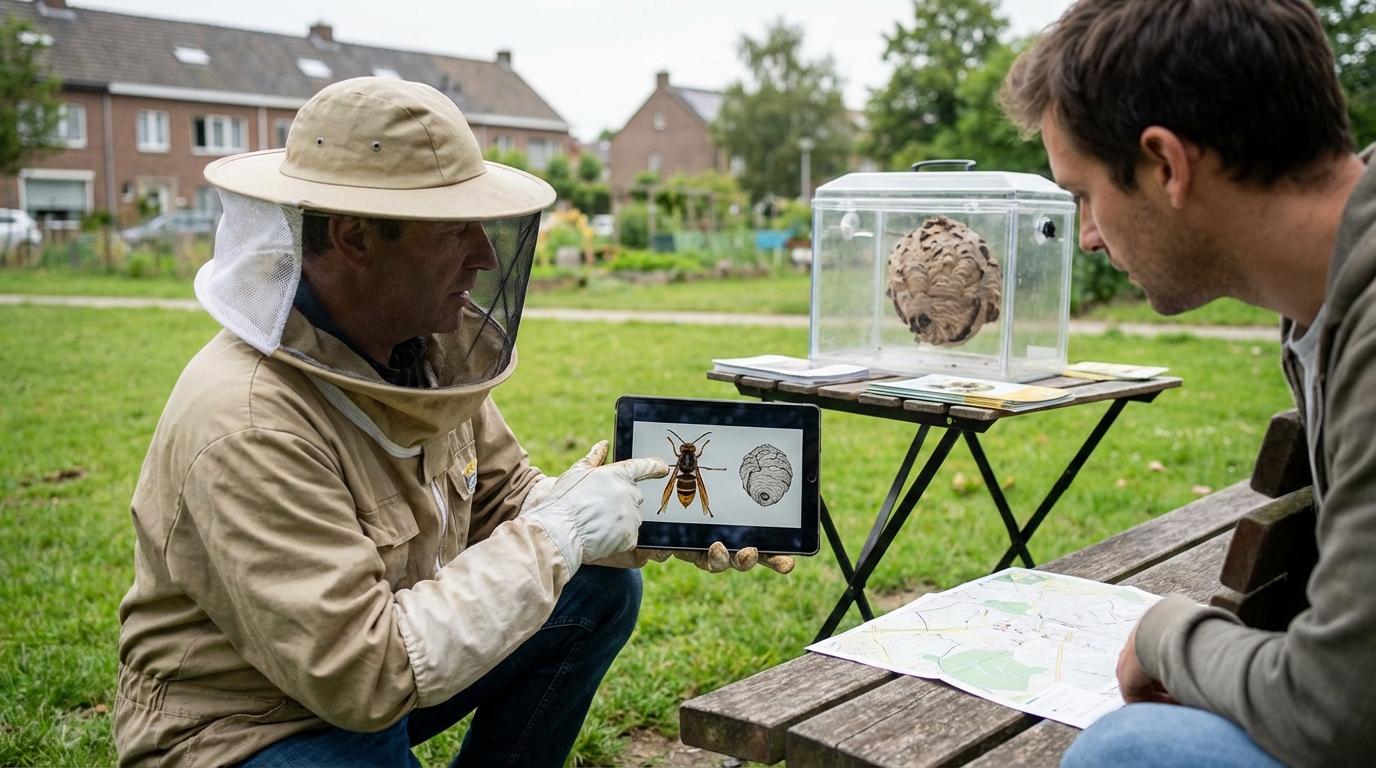
Asian hornets in Neder-Over-Heembeek: A complete guide to intervention
Contents
-
Understanding the proliferation of the Asian hornet in Neder-Over-Heembeek
-
Extermination solutions and municipal procedures for Heembeekers
Last summer, a resident of the Versailles neighborhood discovered an Asian hornet's nest the size of a basketball, hanging in his cherry tree. He didn't know who to call, or whether it was really Vespa velutina or a large wasp. He waited three weeks. Three weeks during which the colony doubled in size. You hear this story more and more often in Neder-Over-Heembeek.
Things to remember
-
This hyper-local guide combines technical expertise and geographical roots in Neder-Over-Heembeek
-
We are exploring critical areas such as the Ferme Urbaine or the Versailles district to offer the residents of 1120 a rapid identification and intervention solution all year round.
-
Understanding the proliferation of the Asian hornet in Neder-Over-Heembeek
-
How to identify and report a nest in NOH neighborhoods
The Asian hornet is no longer a distant problem confined to the south of France. It's here, in the 1120 region, and it's making its presence felt. Whether you've got a garden near Val Maria, a vegetable garden near Ferme Urbaine or simply a terrace on rue de Meudon, this guide is for you. We're going to talk about identification, reporting and concrete solutions, without unnecessary jargon.
At Frelons.be, we take action against Asian hornets all year round, including in winter when the founding queens seek shelter. Our aim here is to give you the right reflexes to protect your neighborhood and your family.
Understanding the proliferation of the Asian hornet in Neder-Over-Heembeek
In 2016, the first confirmed nest of Vespa velutina nigrithorax in the Brussels Region made headlines. Since then, progress has been steady. In Neder-Over-Heembeek, reports have risen sharply over the past two years, and this is no coincidence.
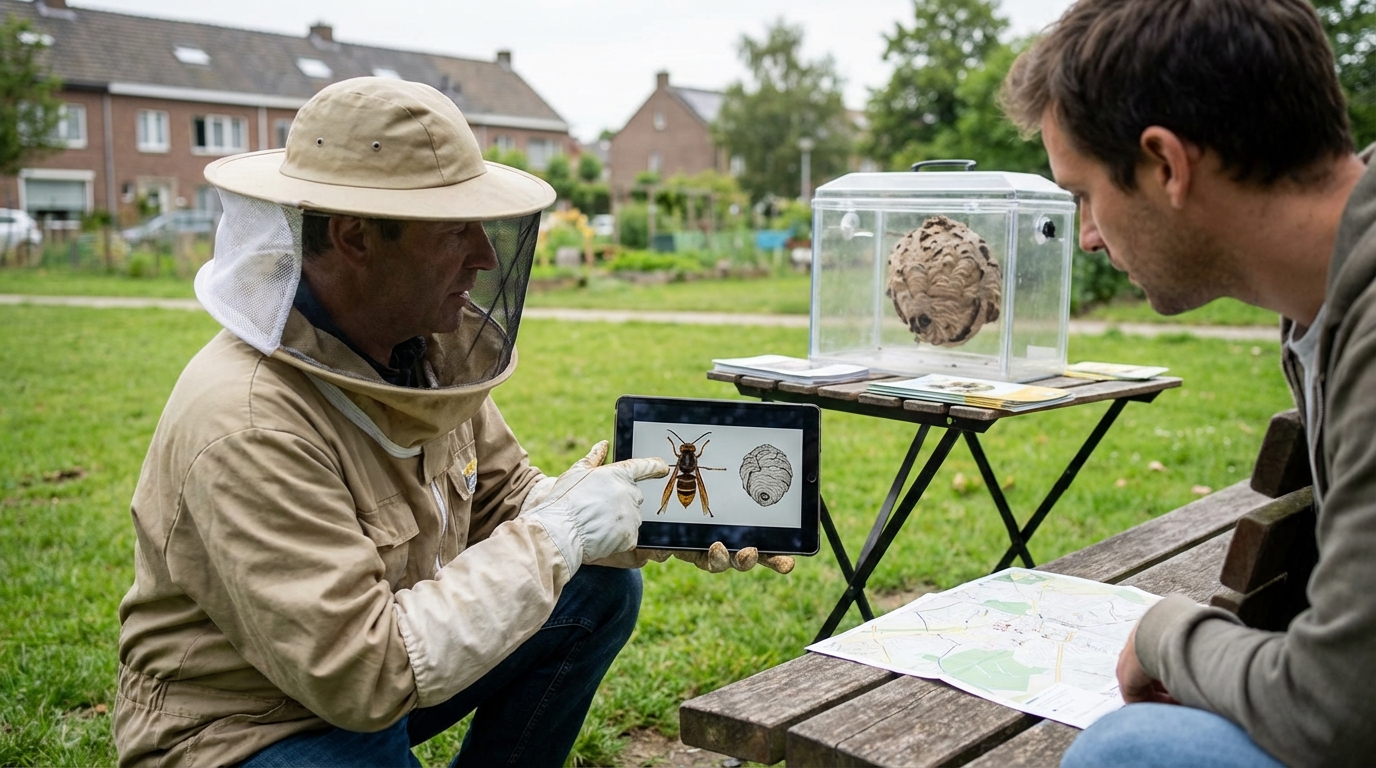
The 1120 offers the Asian hornet exactly what it's looking for: semi-urbanized areas with lots of vegetation, waterways (the nearby canal), private gardens and orchards. The Val Maria park, the area around the Ferme Urbaine, the tall trees along the Chemin Vert: all ideal nesting spots. And just what is it that attracts the Asian hornet? Sweet food sources (ripe fruit, sap) and, above all, beehives. Bees make up to 80% of an established colony's diet. For local beekeepers, this is a catastrophe.
Let's take a look at the Hornet's life cycle to understand why timing is so important. In spring, as soon as temperatures rise above 13°C, the founding queens emerge from hibernation. Each one builds a small primary nest, often in a discreet shelter: a garden shed, under a roof, sometimes even an unused mailbox. This primary nest is tiny, about the size of a ping-pong ball. It is at this stage that spring trapping is most effective. A queen caught in March or April means a colony of 2,000 fewer beetles in the autumn.
Around June-July, if the queen has not been intercepted, the colony moves. The secondary nest is built high up in the trees, on the facades of buildings or on pylons. It can reach 80 cm in diameter and house several thousand workers. It's this nest that people usually spot when the leaves fall in autumn. Too late for simple intervention.
The impact on biodiversity in the 1120 is real and measurable. Vespa velutina doesn't just attack bees: it also attacks hoverflies, butterflies and common wasps. The entire local pollination chain suffers. The community vegetable gardens of Neder-Over-Heembeek, the green spaces managed by Bruxelles Environnement, private gardens: the whole ecosystem is under pressure. When we talk about pest control in 1120, we're not just talking about comfort. It's about preserving a balance that benefits everyone.
And why shouldn't you kill a lone Asian hornet you come across in your garden? Because there's absolutely no point in crushing a single worker - the colony produces hundreds a day. Worse still, a crushed hornet releases an alarm pheromone that can make its fellow workers aggressive. The right thing to do is to note the location, observe the direction of flight and report it.
How to identify and report a nest in NOH neighborhoods
First question to ask: is it really an Asian hornet? Confusion with the European Hornet is common. The Vespa velutina is smaller (around 3 cm), darker, with a completely black thorax and yellow-tipped legs. The European Hornet, on the other hand, is larger, redder and, frankly, less aggressive towards bees. If you see a dark insect with bright yellow leg tips hovering in front of a beehive or flower bed, there's a good chance it's our invader.
In Neder-Over-Heembeek, some areas are more densely populated than others. The Versailles district, with its many wooded gardens and old houses with accessible attics, is a perfect playground for primary nests in spring. The area around the NOH Urban Farm also attracts hornets: logically, there are crops, flowers and water. The Val Maria area, with its lush greenery and mature trees, regularly sees secondary nests high up in the summer.
Reporting a nest of Asian hornets in Brussels is easy and free. There are several channels available:
-
The platform iNaturalist or the Vespawatch You take a photo, geolocate, and experts validate the identification.
-
Visit local nest search groups active in the area: trained volunteers who can come and confirm the presence of a nest and organize follow-up.
-
Directly at Hornets.be We take calls all year round and guide you through the process.
What to do if you see an Asian hornet? Don't panic. Seriously. A hornet isolated far from its nest is not particularly aggressive towards humans. Observe its flight direction: workers fly back and forth in a straight line between the nest and their hunting area. If you see several hornets following the same trajectory, the nest is probably not far away. Note the time, the precise location (street number, visual landmark) and take a photo if possible.
An important detail for the inhabitants of 1120: never attempt to destroy a nest yourself. Not with water, not with fire, not with commercial insecticides. An active nest contains hundreds of workers capable of stinging repeatedly, and unlike the bee, the hornet never loses its sting. Domestic accidents linked to amateur destruction attempts are on the increase every year. The safety of NOH residents depends on professional intervention, period.
When it comes to odors, we sometimes hear that certain scents repel the Asian hornet. Cloves, burnt coffee, lemongrass: none of these have been scientifically proven to keep a colony away for long. It may annoy an isolated individual for a few minutes, but it won't protect your hives or terrace in the long term. Better to invest in a selective trap in spring than in scented candles all summer long.
Extermination solutions and municipal procedures for Heembeekers
You've spotted a nest and reported it. Now what? Here's how it works in 1120.
The extermination of a hornet's nest in Neder-Over-Heembeek can be handled in different ways, depending on the location of the nest. If the nest is located in the public domain (a municipal tree, a municipal building), the Brussels municipality coordinates the intervention. Contact the City's Environment Department: they will pass on the information to the appropriate teams. For nests on private property, it's up to the owner to take action, but assistance is available.
The Brussels fire department (SIAMU) intervenes in cases of immediate danger to public safety: a nest above a school entrance, near a crèche, in a busy passageway. For other situations - and this is the majority - you need to call in a specialized exterminator. That's where we come in. At Frelons.be, we treat Asian hornet nests with techniques adapted to each configuration: injection of biocide for nests at height, physical removal when accessible, securing the perimeter.
Let's talk cost. Exterminating a hornet's nest in the 1120 area generally costs between 100 and 250 euros, depending on height and accessibility. Some Brussels communes offer partial reimbursement, so check with the Neder-Over-Heembeek local authority office. The Brussels Region also funds Vespa velutina control programs via Bruxelles Environnement, sometimes paying the full cost of nests confirmed by surveillance networks.
For residents of Rue de Meudon, the Versailles district or the Val Maria area, we know the terrain well. The tall lime trees along the avenues, the old roofs with their gaps, the sheds and garages at the bottom of the gardens: we know where to look and how to intervene without endangering the neighborhood. The safety of NOH residents is our top priority at every intervention.
Spring trapping deserves another mention here, because it's the most effective prevention method on a neighborhood scale. Between February and May, installing selective traps (with a mixture of dark beer, white wine and syrup) captures the founding queens before they create their colony. The white wine repels bees, making the trap relatively selective. If every garden in the 1120 installed two traps in spring, the impact would be considerable. We provide free advice on how to make them, just contact us.
A word about sustainability: the fight against Asian hornets in Neder-Over-Heembeek is not a seasonal affair. In winter, fertilized queens hide in the ground, under tree bark and in wood piles. Abandoned nests are never reused, but they indicate that the area has been colonized. We therefore also intervene in autumn and winter to identify sites at risk and prepare for the following season. It's this in-depth, year-round work that makes all the difference.
If you manage a green space, a shared orchard or beehives in the 1120, we can also help you set up an appropriate surveillance plan. Traps, regular inspections, identification training: all this can be set up quickly enough to avoid unpleasant surprises in midsummer.
Conclusion
The Asian hornet has settled in Neder-Over-Heembeek. It won't disappear overnight, but we can limit its progress and protect local biodiversity, our bees and our peace and quiet. The right reflexes are simple: observe, report and never intervene on a nest yourself.
Whether you live near Val Maria, in the Versailles district or elsewhere in the 1120, don't wait until a nest reaches the size of a sports bag before taking action. Contact Frelons.be as soon as you have the slightest doubt. We respond all year round, we're on the move fast and we'll guide you every step of the way. Your vigilance, combined with professional intervention, is the best weapon against Vespa velutina in our neighborhoods.
Frequently asked questions
How can you tell the difference between Asian and European hornets in 1120?
The Asian Hornet is darker, with a black thorax and, as a major distinguishing feature, bright yellow leg tips. It is slightly smaller than the European Hornet, which has russet hues and a predominantly yellow abdomen with black stripes.
Where are hornet nests usually found in Neder-Over-Heembeek?
In spring, primary nests often hide at ground level in garden sheds or ledges in neighborhoods such as Versailles or Val Maria. In summer, secondary nests migrate to the tops of tall trees, notably near the Urban Farm or along the canal.
Is it free to destroy an Asian hornet nest in Brussels?
Intervention is free of charge if the nest is located on public land; for private property, the cost is borne by the owner. However, the Brussels Region and certain municipal subsidies may sometimes cover the costs via monitoring programs such as Vespawatch, as the insect is classified as an invasive species.
How much does a professional intervention in Neder-Over-Heembeek cost?
For expert nest destruction in the 1120 area, prices generally range from €100 to €250. This price depends on the difficulty of access (need for a telescopic pole or a cherry picker) and the size of the colony to be treated.
 French
  English
  Dutch
Dutch
0 Comments