
Asian hornets in Laeken: Nest identification and management
Contents
-
Understanding the invasion of Asian hornets in Laeken's neighborhoods
-
Practical guide to reporting or destroying a hornet's nest in Laeken
Last summer, a resident of the Mutsaard neighborhood discovered a nest of Asian hornets the size of a football, hanging under his cornice. He thought he was dealing with wasps. When he saw the size of the insects, he realized it was something else. This kind of situation is becoming more and more common in Laeken.
Things to remember
-
This article proposes a strong local anchoring by identifying critical areas of Laeken such as the Japanese Tower and the Mutsaard district.
-
It offers a practical guide to recognition and action, featuring a community-based approach and expertise available 365 days a year.
-
Understanding the invasion of Asian hornets in Laeken's neighborhoods
-
Why is Laeken a favoured area for Vespa velutina?
Asian hornets in Laeken are no longer an isolated phenomenon. In recent years, reports of them have exploded in the municipality, from the area around the Japanese Tower to the residential gardens on Boulevard Houba de Strooper. The problem is that many people still don't know how to recognize them, or how to react when they come across a nest. Waiting, ignoring, trying to take care of it yourself: three mistakes that can be costly.
At Frelons.be, we're on call 365 days a year for this type of situation. We know Laeken, with its high-risk corners, tall trees and ancient roofs. This article is the guide we'd like to give to every local resident: how to identify the Asian hornet, why Laeken is particularly affected, and above all what to do when you spot a nest.
Understanding the invasion of Asian hornets in Laeken's neighborhoods
First thing to know: the Asian hornet, or Vespa velutina nigrithorax, The European hornet has nothing in common with the European hornet. It is smaller (around 3 cm for a worker), darker, with a black abdomen marked by a thin orange stripe. Its yellow-tipped legs are a fairly reliable distinguishing feature. If you see an insect that looks like a big black wasp with yellow «socks», chances are it's him.
In Laeken, the first confirmed reports date back a few years. But colonization has accelerated. Asian hornets in Laeken benefit from an environment that suits them perfectly: generous green spaces, old buildings with plenty of nooks and crannies, and a density of mature trees that provide ideal anchorage points for their nests.
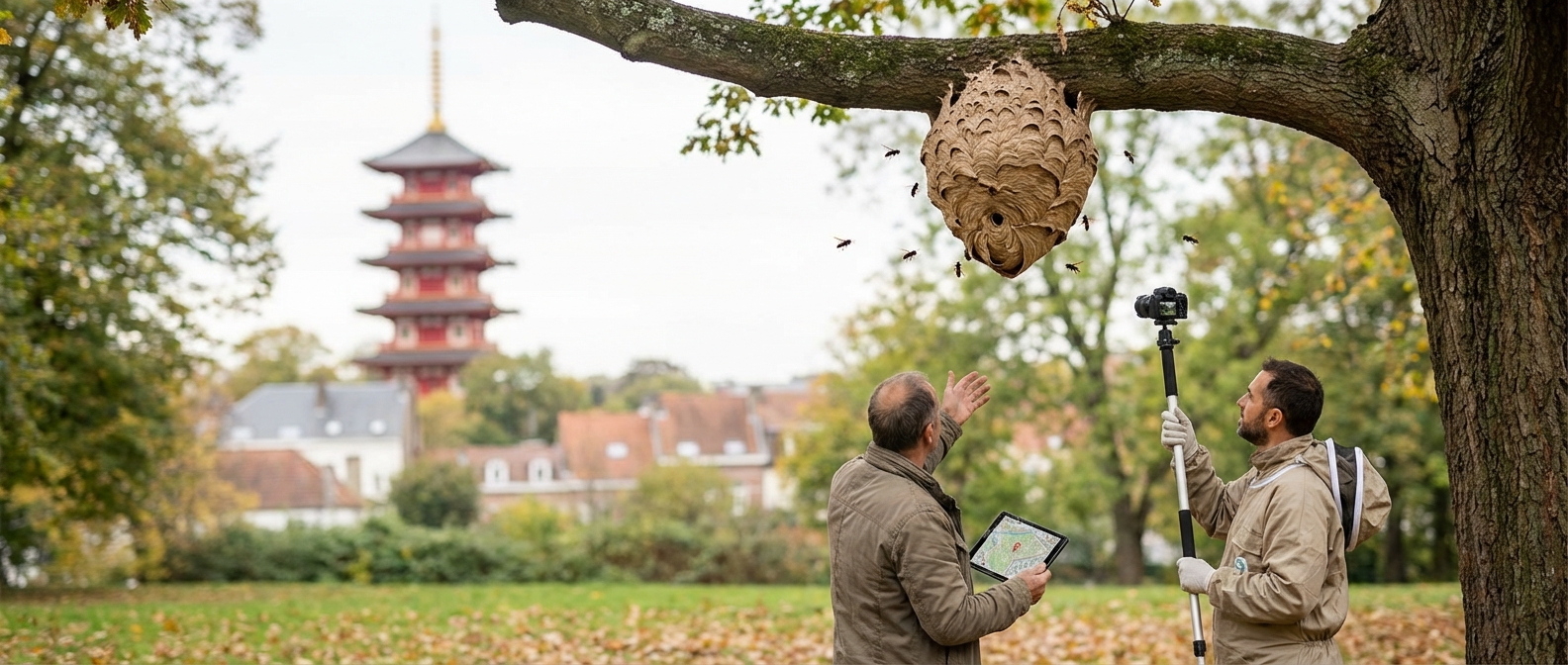
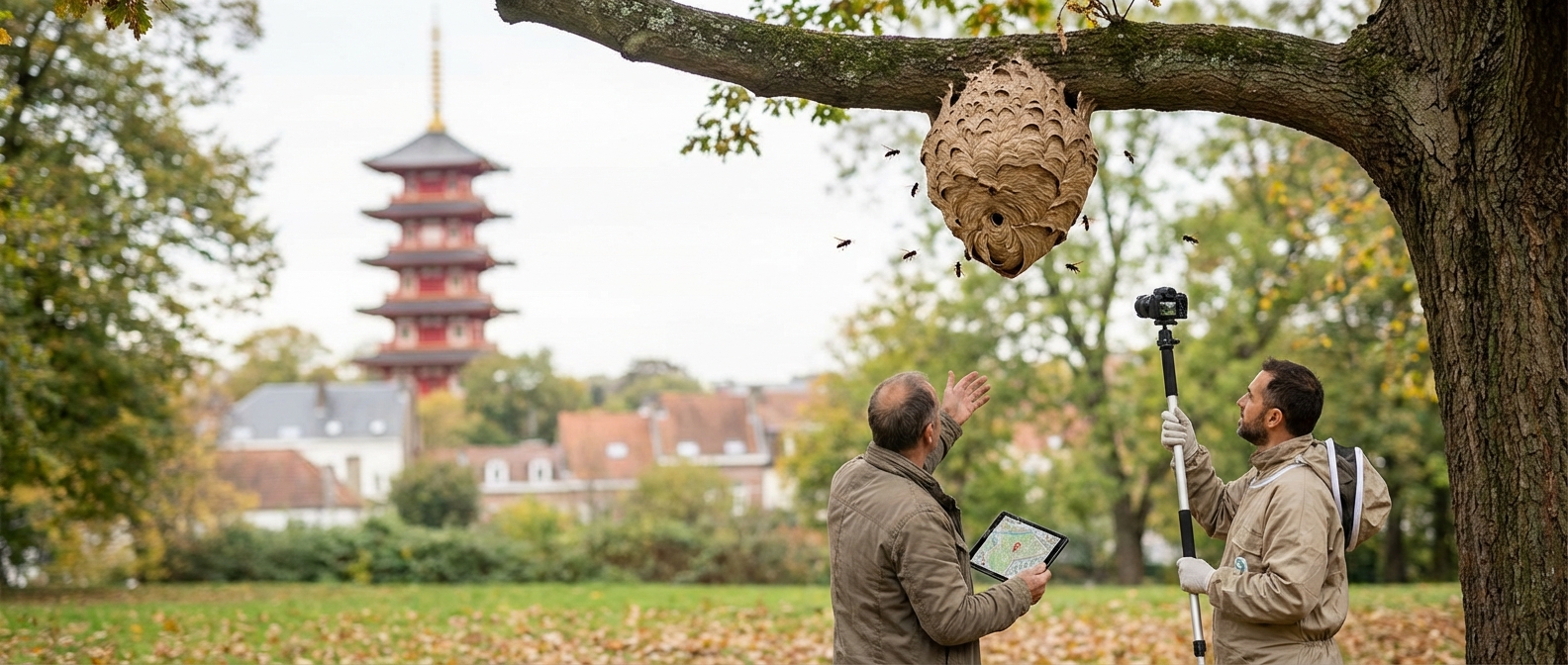
The area around the Japanese Tower is a good example. This park, with its tall trees and dense vegetation, attracts many pollinating insects. But the Asian hornet is a formidable predator of bees. It hovers in front of beehives or flowering areas and captures its prey in mid-air. A single nest can decimate entire bee colonies in a matter of weeks. Local beekeepers know this, and some have already lost hives.
The Araucaria station is also experiencing a resurgence. This residential area, with its private gardens and hedges, offers the founding queens discreet locations to set up their primary nests in spring. These small nests, about the size of a tennis ball, often go unnoticed under an awning, in a garden shed or behind a shutter. It's only in summer, when the colony grows and the nest reaches balloon size, that people realize the problem.
An important point: the hornet's nest in Laeken is not always visible. Unlike wasps, which often nest at human height, the Asian hornet often builds its secondary nest high up, sometimes more than 15 meters into the treetops. You can live for weeks next to an active nest without knowing it. It's by observing the flight trajectories, those regular back-and-forth movements in the same direction, that you eventually spot the source.
The risk for residents? It's real, but it needs to be qualified. The Asian hornet is no more aggressive than the European hornet, as long as you don't go near its nest. The danger arises when someone trims a hedge, climbs onto a roof or shakes a tree without knowing that a nest is there. The colony then reacts violently, with dozens of hornets attacking simultaneously. For allergy sufferers, a single sting can cause anaphylactic shock. And even without an allergy, several simultaneous stings require medical attention.
That's why you should never attempt to destroy a nest yourself. Not with water, fire or commercial insecticide sprays. More on this later.
Why is Laeken a favoured area for Vespa velutina?
72 hectares. This is the approximate surface area of accessible green spaces within the Laeken perimeter. Royal parks, private gardens, squares, lines of trees along the boulevard Houba de Strooper: this green mosaic creates an almost continuous ecological corridor. For the Vespa velutina, it's a perfect playground.
Laeken's parks are home to a biodiversity that attracts Asian hornets like a magnet. Lime trees, chestnut trees, fruit trees: these species produce nectar and attract the pollinating insects on which the hornet feeds. Neighborhood vegetable gardens, open compost bins, fruit trees left unharvested at the end of summer - all these provide a permanent larder. An adult Asian hornet also consumes ripe fruit for its sugar. Pears and apples that fall to the ground in September are a feast for them.
Boulevard Houba de Strooper plays a special role in this dynamic. This tree-lined axis functions as a veritable travel corridor for insects. Founding queens, which emerge from hibernation between February and April, follow these green corridors to find a nesting site. They look for a sheltered spot close to a food source. The old houses of Laeken, with their ventilated attics, wooden cornices and multi-cornered roofs, tick all the boxes.
There's also a factor that's often underestimated: urban heat. Laeken, like the rest of Brussels, suffers from the heat island effect. Temperatures there are on average 2 to 3 degrees higher than in rural areas. For a species of subtropical origin like the Vespa velutina, Those few extra degrees make all the difference. Colonies start up earlier in the spring, produce more workers, and queens have a better winter survival rate.
We're often asked whether the Brussels fire department responds to hornet nests. The answer is nuanced. The Brussels fire department can intervene in certain emergency situations, but their primary mission is not insect extermination. In the case of an Asian hornet nest, they generally refer the matter to specialized professionals. And that's logical: destroying a nest of Vespa velutina nigrithorax requires specific equipment, knowledge of the species' behavior and an intervention adapted to the location of the nest (high up, in a cavity, under a roof).
Another unique feature of Laeken is its proximity to the canal and wetlands. Water attracts hornets, who need it to build their nests (they chew wood and mix it with their saliva to make paper pulp). The banks of the canal, fountains in parks, even gutters that retain rainwater, all make it easier for hornets to settle in.
The result: Laeken combines all the right factors. Abundant greenery, old buildings, green corridors, urban warmth, water sources. It's no coincidence that hornet attacks in Laeken account for a growing proportion of our business every year.
Practical guide to reporting or destroying a hornet's nest in Laeken
You've spotted a nest, or suspect the presence of Asian hornets near you. Here's exactly what to do, step by step.
Step 1: Confirm identification. First of all, make sure it's the Asian hornet and not the European hornet (bigger, redder, less dark) or a large wasp. The Asian hornet has :
-
An all-black thorax
-
Dark abdomen with a single orange segment (the 4th)
-
Bicoloured legs: black at the base, yellow at the tips
-
Workers are about 2.5 to 3 cm tall
If in doubt, take a photo. Even if it's blurry, it will help the professionals to confirm the species.
Step 2: Don't touch anything. This is the most important piece of advice in this article. Destroying a hornet's nest is not a do-it-yourself project. A mature nest can contain between 1,500 and 6,000 individuals. Disrupting the colony without eliminating it completely exposes you to a massive attack and disperses the hornets, who will rebuild elsewhere. We've seen cases in the Mutsaard district, where homemade attempts have led to hospitalization.
Step 3: Report the nest. Several channels are available:
-
Contact Frelons.be directly. We're available 7 days a week, all year round. We're quick to respond in Laeken, and we know the specifics of the area.
-
Report sightings on the iNaturalist platform or via the «Vespa watch» application. These data will be used for scientific monitoring of the species in Belgium.
-
Notify your local authority. The City of Brussels has an environmental department that centralizes reports and can coordinate action.
Step 4: Secure the area while you wait. If the nest is in your garden or on your facade, keep a distance of at least 5 meters. Keep children and animals away. Don't make any sudden movements in the vicinity, no vibrations (lawnmowers, drills), no strong lights directed at the nest at night.
What happens when a professional destroys a hornet's nest: At Frelons.be, we use a specific biocide injected directly into the nest using a telescopic pole that can reach 40 meters. The product takes effect within a few hours and eliminates the entire colony. The nest is then removed whenever possible, to avoid attracting other pests. The procedure takes an average of 30 to 45 minutes, depending on accessibility.
For residents of the Mutsaard neighborhood and adjacent streets, here's an extra tip: keep an eye on your garden sheds and sheds from March onwards. This is the period when the founding queens are looking for a site for their primary nest. A small nest spotted early means one less colony for the summer. At this stage, intervention is quick, simple and inexpensive.
Another useful reflex: tell your neighbors. Asian hornets have a range of several hundred meters around their nest. If you see them regularly in your garden, the nest may very well be at a neighbor's, or in a tree in the street. Collective vigilance makes all the difference. Some neighborhoods in Laeken have already set up reporting groups via social networks. It's simple and it works.
One last thing: don't count on winter to solve the problem. Workers and males do indeed die at the first frost, but the newly fertilized queens hibernate. They hide in the ground, under bark or in woodpiles. The following spring, each one can found a new colony. That's why we stay active all year round: destroying a nest in autumn prevents the production of future queens.
Conclusion
Asian hornets in Laeken aren't going to disappear on their own. The species is well established, thriving in our neighborhoods, and each season brings its share of new nests. The good news is that we know how to deal with them effectively when we do it right.
Remember three things: learn to recognize the Vespa velutina nigrithorax, Never touch a nest yourself, and report it promptly. Whether you live near the Japanese Tower, along boulevard Houba de Strooper or in the Mutsaard district, Frelons.be is ready to help anywhere in Laeken, 365 days a year. One call is all it takes.
Frequently asked questions
Is it dangerous to have a hornet's nest at home in Laeken?
The Asian hornet is not naturally aggressive towards humans, unless you come within 5 meters of its nest. Danger arises when gardening (hedge trimming) or roofing work is carried out without spotting the nest. If threatened, the colony attacks in groups. In Laeken, the density of housing and gardens makes collective vigilance crucial to protect children and animals.
Do the Brussels fire department respond to hornet nests in Laeken?
The Brussels fire department concentrates on life-saving emergencies. In the event of an Asian hornet nest on private property, they generally refer residents to authorized professionals. Calling in a local specialist guarantees a precise intervention (injection of targeted biocide) and prevents the colony from spreading into the neighborhood.
Why are there so many Asian hornets around Heysel and the Atomium?
These areas combine large green spaces (Royal Parks) with mature trees that provide ideal nesting sites at height. The urban warmth of Brussels 1020 and the presence of numerous pollinating insects (food for the hornet) make Laeken a perfect environment for colony development.
How can I recognize an Asian hornet in my garden in Laeken?
The Asian hornet (Vespa velutina) can be distinguished by its very dark body (almost black), a single orange segment on the abdomen and, above all, its legs with bright yellow tips (as if it were wearing socks). It is slightly smaller than the European Hornet. If you see one near the Japanese Tower or the Mutsaard district, it's probably this invasive species.
 French
  English
  Dutch
Dutch
Hello, I am in Brussels. Sorry to write to you but I think there's an Asian hornet queen trying to make a colony under my wood table in the terrace. I know this species is bad for biodiversity and I guess if it is a queen the overall positive impact of killing it is worth trying.