
Allergy to wasp stings: how to recognize it and take action?
Contents
A wasp sting hurts. Everyone knows that. But between the classic pain that passes in a few hours and a real allergic reaction, there's a gap that many people don't know how to identify. And that's where it gets dangerous.
Things to remember
-
This comprehensive guide explains venom allergy in simple terms, distinguishing between normal reactions and life-threatening emergencies.
-
It provides unique expertise on the distinction between species (wasps vs. Asian hornets) and proposes an immediate action protocol for the general public, while highlighting the constant threat posed by hornets.
-
How can you tell if you're allergic to a wasp sting?
-
Step-by-step guide
Every summer in Belgium and France, thousands of people are stung without knowing they are allergic to the venom. Some discover their allergy to a wasp sting at the worst possible moment: in the middle of anaphylactic shock, without knowing what to do. This guide is here to help you avoid that. Together, we'll look at how to distinguish a commonplace reaction from a life-threatening emergency, what to do immediately, and why the Asian hornet complicates matters still further.
At Frelons.be, we work all year round to destroy Asian hornet & wasp nests. We regularly see people panicking after a sting, not knowing whether to call for help or just ice it. Here's what you really need to know.
How can you tell if you're allergic to a wasp sting?
First thing to understand: everyone reacts to a wasp sting. Redness, swelling around the sting, sharp pain for one to two hours. This is normal. This is what we call a local reaction, and it doesn't mean you're allergic.
The time to start worrying is when the reaction goes beyond the injection site. Swelling that extends over more than 10 centimetres around the injection site, and lasts for more than 24 hours, is already an extensive local reaction. Not yet a serious allergy, but a warning signal. The next injection could trigger something more serious.
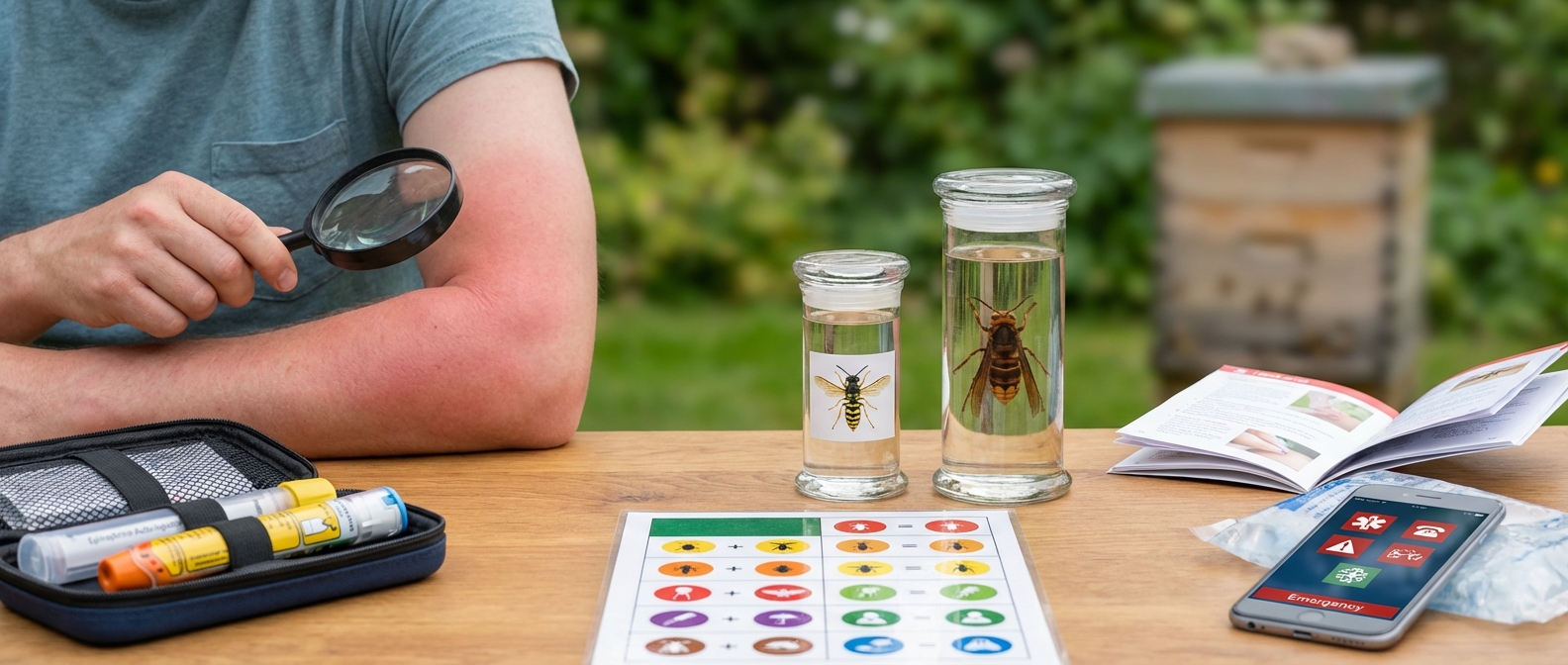
The real symptoms of allergy to wasp venom usually appear within 5 to 30 minutes of the sting. And they're not limited to the affected area. Here's what to look out for:
-
Generalized hives These are red, itchy patches that appear far from the sting, on the torso, arms and legs. This is a sign that the immune system is going into overdrive.
-
Facial swelling Lips, eyelids, tongue. When it affects the throat, breathing can become difficult very quickly.
-
Breathing difficulties Oppression, wheezing, feeling that the air can't get through.
-
Dizziness and drop in blood pressure the person becomes pale, feels weak, may lose consciousness.
-
Nausea, vomiting, abdominal pain digestive symptoms not always associated with insect bites, but part of the allergic picture.
An essential point: you may well have been stung several times in your life without any problems, and develop an allergy to a wasp sting from one day to the next. The immune system gradually becomes sensitized. The first sting that provokes a reaction is often the most surprising, precisely because you thought you weren't allergic.
How long does a wasp sting allergy last? The acute reaction itself can last from a few minutes to several hours. But the allergy itself lasts. Once sensitized, you're at risk for every new sting. And statistically, reactions tend to worsen from one sting to the next in around 60% of allergy sufferers.
If you've ever experienced generalized hives or facial swelling after a bee or wasp sting, consult an allergist. A simple blood test (specific IgE) and skin tests can confirm the diagnosis. Don't remain in doubt.
What to do in case of a sting if you're allergic: a step-by-step guide
You've just been stung and you know you're allergic. Or you see someone with the symptoms described above. Every minute counts. Here's exactly what to do.
Step 1: Use the adrenaline pen. If you have an adrenaline auto-injector (such as EpiPen or Jext), this is the first step. It is inserted into the outer thigh, through the clothing if necessary. Adrenalin works in a matter of seconds: it raises blood pressure, opens airways and slows the allergic reaction. Never hesitate to use it. Even when in doubt. An adrenaline pen injected «for nothing» only causes the heart to beat fast for a few minutes. A anaphylactic shock can kill in less than 15 minutes.
Step 2: Call 112. Even after the adrenaline shot. Always. The pen's effect lasts about 15 to 20 minutes, and the allergic reaction may return afterwards (this is called a biphasic reaction). The person must be monitored in hospital for at least 6 hours after anaphylactic shock. When you call 15, say clearly: «Insect bite with severe allergic reaction». They'll know what to do.
Step 3: Lay the person down. Legs up if conscious and not vomiting. If she has difficulty breathing, a sitting position is preferable. Above all, don't make her stand up or walk: any physical effort accelerates the diffusion of venom into the bloodstream.
Step 4: Remove the stinger if it's a bee. Wasps don't usually leave their stingers behind, but bees do. If you see a small black spot in the skin, scrape it off with your fingernail or the edge of a bank card. Don't pinch with your fingers, as you'll squeeze the venom sac and inject more venom.
Step 5: Do not give antihistamines instead of adrenaline. Anti-allergy tablets take 30 to 45 minutes to take effect. In the case of anaphylactic shock, this is far too slow. Adrenaline is the only first-line treatment. Point.
What if the person doesn't have an adrenaline pen? Call 112 immediately. Describe the symptoms precisely. Keep the person lying down, calm, and watch their breathing. If they lose consciousness and stop breathing, start cardiac massage while you wait for help.
A word about treatment of allergy to bites long-term: desensitization (venom immunotherapy) works very well. It protects more than 95% of treated patients, and usually lasts 5 years. If you are allergic, talk to your doctor. It's the only treatment that tackles the cause, not just the symptoms. In the meantime, always keep your epinephrine pen with you. Always. Even for a barbecue with friends.
Are you allergic to all types of wasps and hornets?
A question we get asked a lot at Frelons.be: «I'm allergic to wasps, do I risk the same thing with an Asian hornet?» The short answer: probably yes, but not to 100%.
Wasps, European hornets, Asian hornets, bees and bumblebees all belong to the order of the Hymenoptera. Their venoms contain common proteins, notably phospholipase and hyaluronidase. This is known as the’cross-allergy your immune system, sensitized to wasp venom, may react to the venom of another hymenoptera because it recognizes similar molecules.
Studies show that around 50% of people allergic to wasp venom also test positive for bee venom. This doesn't necessarily mean they'll go into anaphylactic shock with every bee sting, but the risk is there. With hornets, the rate of cross-allergy is even higher, since hornets are biologically very close to wasps (same family, Vespidae).
Visit Asian hornet venom deserves special attention. Not because it's more «toxic» than the European Hornet (that's a persistent myth), but for two very concrete reasons. Firstly, the Asian Hornet injects a greater volume of venom with each sting, simply because its stinger is longer. Secondly, and this is the real problem, Asian hornets are much more aggressive when you approach their nest. Where a lone wasp stings once and then leaves, an Asian hornet nest can dispatch dozens of individuals in a matter of seconds. Receiving 5 or 10 simultaneous stings, even if you're not allergic, can provoke a serious toxic reaction.
For allergy sufferers, coming across an Asian hornet nest is a real danger. And these nests are sometimes very well hidden: in a hedge, under a garden shed, in a tree. They are increasingly found in urban and suburban areas. That's why we work all year round at Frelons.be, even in winter, to locate and destroy nests before the following season.
When should you be concerned about a bee or wasp sting if you don't know your allergic status? As soon as the reaction goes beyond the local area. If you see hives appearing on your body, if your face swells, if your breathing changes: this is an emergency. It doesn't matter whether you've been stung by a wasp, bee or hornet.
A final point that's often overlooked: Hymenoptera venom doesn't just cause immediate allergies. Some people develop delayed reactions, appearing 4 to 48 hours after the bite. Fever, joint pain, rash. It's rarer, but it does happen. If you have any unusual symptoms in the days following a sting, seek medical advice.
Conclusion
Recognizing an allergy to a wasp sting means knowing the difference between temporary pain and life-threatening symptoms. Generalized hives, facial swelling, difficulty in breathing: these symptoms are non-negotiable and require an immediate reaction.
If you're allergic, get a prescription for an adrenaline pen and keep it handy at all times. Talk to your doctor about desensitization. And if you spot a nest of Asian hornets near you, don't try anything on your own. Contact Frelons.be: we intervene quickly, all year round, to eliminate the threat before it becomes a medical problem.
Frequently asked questions
How do I know if I'm having a severe allergic reaction to a wasp sting?
If you experience facial swelling, difficulty breathing or hives away from the sting, you're having an allergic reaction that requires immediate help.
How do you treat a wasp sting if you're allergic?
Wash the affected area with soap and water to avoid infection. Apply a hydrocortisone ointment or antihistamine ointment to relieve itching and reduce swelling. Place a cold compress on the bite for 10 to 15 minutes to reduce pain and inflammation.
Can you become allergic to wasps overnight?
Yes, the immune system can become sensitized after several stings with no prior problems, so the allergic reaction may appear suddenly.
Is Asian hornet venom more dangerous for allergy sufferers?
The venom is similar to that of the wasp, but the Asian hornet injects a larger quantity and can sting in groups, increasing the risk of toxic shock.
Is there a definitive treatment for allergy to wasp and hornet venom?
Yes, desensitization (immunotherapy) performed by an allergist protects more than 95% of patients over the long term after a protocol lasting several years.
 French
  English
  Dutch
Dutch
0 Comments