
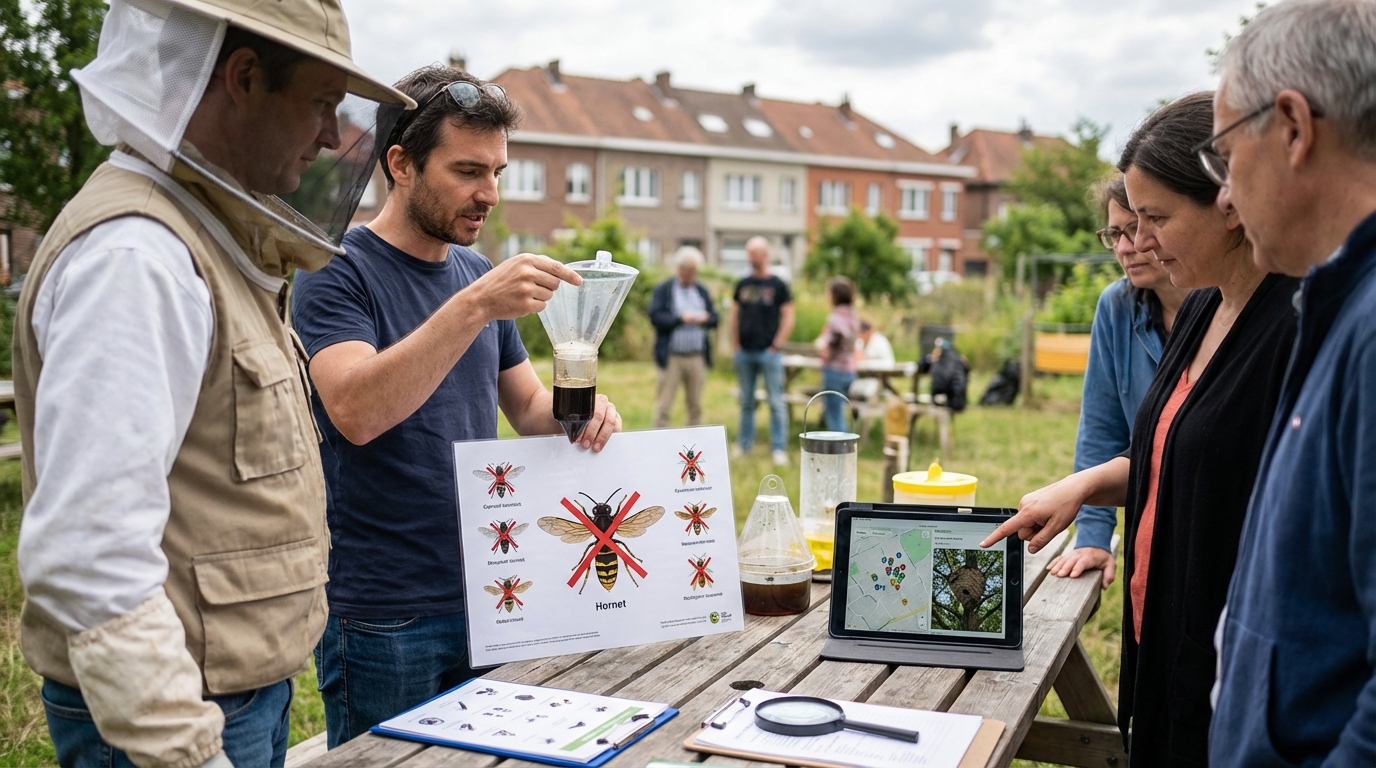
Asian hornets in Haren: detection and local intervention
Contents
-
Recognizing the Asian hornet in Haren: characteristics and dangers
-
Procedure for reporting and destroying hornet nests in Haren
Last summer, a neighbor on rue de Verdun showed me a photo taken in his garden. A dark, yellow-legged insect parked in front of his hive. He thought it was a large bumblebee. It was an Asian hornet. In Haren, this is no longer an isolated case: reports have been multiplying since 2021, and the neighborhood has become one of the Brussels Region's hotspots for Vespa velutina.
Things to remember
-
This article takes an ultra-local approach to the Haren district (1130)
-
It differentiates itself from general guides by highlighting local citizen initiatives, the crucial role of the Vespa Hunter 1130 and local research groups.
-
The aim is to turn Haren residents into vigilant actors capable of protecting local biodiversity all year round.
-
Characteristics and dangers of Asian hornets
The problem is that many residents of 1130 still don't know what to do about a hornet's nest in Haren. Who should I call? Should you intervene yourself? And above all, how do you distinguish this hornet from the harmless species you come across every day? That's what this article is all about: giving you the practical keys to detecting, reporting and taking part in the fight against Asian hornets in Haren, all year round.
You don't have to be a beekeeper or entomologist. Just an attentive resident, ready to protect his or her patch of greenery and local biodiversity.
Recognizing the Asian hornet in Haren: characteristics and dangers
First thing you need to know: the Asian Hornet is not the «big hornet» you sometimes see circling your lamp in summer. That's the European Hornet, Vespa crabro. It's bigger, brighter, and frankly a lot less problematic. The difference between the European and Asian hornets is clear when you know what to look for.
Vespa velutina, The Asian Hornet measures between 2.5 and 3 cm. Its body is predominantly dark, almost black, with a single orange segment clearly visible on the abdomen. Legs? Yellow at the tips. This is the detail that first catches the eye. The European Hornet, on the other hand, has a yellow abdomen with brown stripes and entirely brown legs. Size-wise, the European Hornet is often more imposing, which misleads many people. «Bigger» does not mean «more dangerous».
To identify the Asian Hornet in Haren, observe its behavior. It's a methodical predator: it hovers in front of hives, waits for a bee to emerge, captures it in mid-flight, and takes it away with it. A European hornet doesn't do this. If you see an insect hovering in front of a hive or watering hole in your garden, chances are it's him.
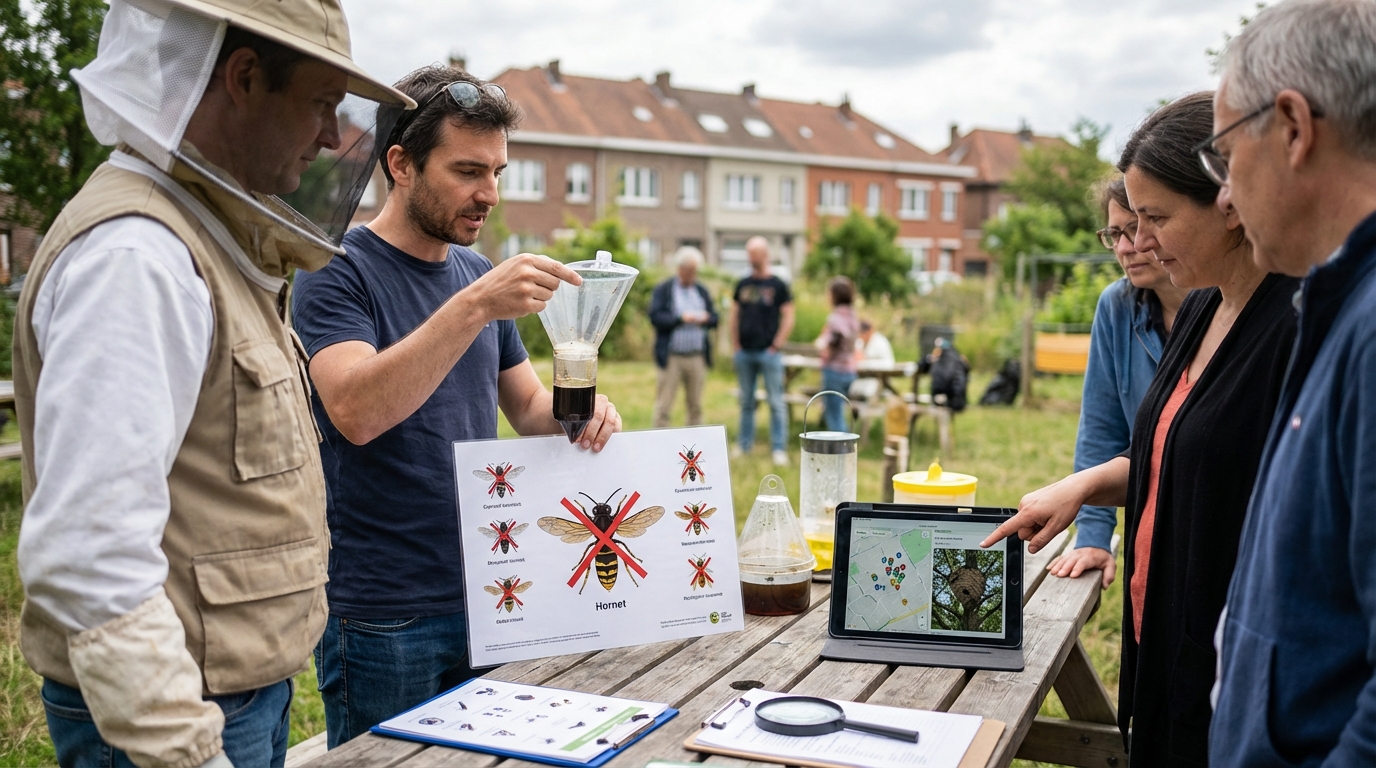
Is it dangerous to be stung by an Asian hornet? Let's be clear: an isolated sting is no more dangerous than a wasp sting for a non-allergic person. It hurts, it swells, but it passes. The real risk is for people allergic to hymenoptera venom, and in cases of multiple stings, particularly if you unknowingly disturb a nest. An Asian hornet nest can contain several thousand individuals by the end of the season. This is a real danger.
In Haren, nests are often found high up in the trees, under roofs and sometimes in dense hedges. Some smaller, primary nests appear as early as spring in garden sheds, electricity meters and bird boxes. They are about the size of a tennis ball at this stage. This is the ideal time to spot them, because in summer, when the secondary nest reaches the size of a soccer (or even larger), intervention becomes much more complex.
What attracts Asian hornets to our gardens in the 1130s? Sources of protein (insects, meat left out in the open during a barbecue), ripe fruit that has fallen to the ground, and, of course, beehives. If you have an apple or plum tree, keep a close eye on the area in August and September. Hornets come in droves to feed.
A final point that often comes up: why shouldn't you kill a lone Asian Hornet? The answer is nuanced. Crushing an individual does nothing for the colony, and in the spring, a killed founding queen will simply be replaced by another in the area. What really counts is locating the nest and reporting it. That's where professional destruction comes in.
Procedure for reporting and destroying hornet nests in Haren
You've spotted an Asian hornet in your garden or, better still, you've located a nest. What should you do now? Above all, don't try to destroy it yourself. No boiling water, no fire, no insecticide spray from the supermarket. These methods are ineffective and dangerous: they irritate the colony without eliminating it, and you risk dozens of stings.
In Haren, the local reference for reporting a hornet's nest is Vespa Hunter 1130. This group of specialized volunteers specifically covers the 1130 zip code and is part of the wider Asian Hornet monitoring network in the Brussels region. Their role: to confirm identification, locate the nest precisely, and coordinate its destruction with equipped operators.
If you are in Haren, here's how to get started:
-
Take a picture of the insect or nest. Even when blurred, it helps to confirm the species. A frontal shot showing yellow legs and dark abdomen is ideal.
-
Report via the iNaturalist platform or the vespawatch.be website. Your observation will be validated by experts.
-
Don't touch anything. Keep your distance (at least 5 meters from a visible nest) and keep children and animals away.
-
Wait for it to take over. Depending on the season and the size of the nest, intervention can be rapid or require planning. Destruction of hornet nests in the 1130 area is often paid for by the local authority, subject to certain conditions.
What about the Brussels fire department? This is a frequently asked question. The fire department does not intervene to neutralize wasps and hornets. The SIAMU (Service d'Incendie et d'Aide Médicale Urgente - Fire and Emergency Medical Service) generally redirects to authorized operators. The Brussels fire department no longer has the time to deal with these non-urgent requests.
An important point: the speed with which you report changes everything. A nest spotted in June with 50 individuals is a simple operation. The same nest, ignored until September, means 2,000 hornets and a much heavier operation. Every week counts.
If you're a homeowner with a nest on your property, you're legally obliged to have it destroyed. The good news: you don't have to look for a service provider in the dark. The reporting network puts you directly in touch with the right people.
Prevention and spring trapping: working together in 1130
Waiting for a nest to appear before reacting is already being late. The real battle against the Asian hornet takes place between February and May, when the founding queens emerge from hibernation and look for a place to build their primary nest.
Trapping Asian hornets in spring is the most effective way of reducing the number of colonies in a given area. The principle: capture queens before they start a new colony. One queen trapped in March means potentially 2,000 fewer hornets nesting in the autumn. The calculation is simple.
Caution: spring trapping must remain targeted and temporary. Leaving a trap out all year means killing dozens of non-target insects for nothing. Remove it at the end of May, when the foundation period is over.
In Haren, the local group organizes annual information and trap distribution sessions. This is an opportunity to meet other local residents involved in the issue, and to learn how to do the right thing. These citizen initiatives make a real difference: the denser the surveillance network, the earlier nests are spotted.
The beekeepers of 1130 are on the front line. Some have lost up to 30% of their colonies to predation by Vespa velutina. Installing muzzles (protective grids in front of hive entrances) helps limit the damage, but it's not enough if nests proliferate in the neighborhood. Protecting bees in Haren requires collective action.
A few simple steps to limit the attractiveness of your garden:
-
Pick up fruit that has fallen to the ground, especially in late summer.
-
Cover garbage cans and compost.
-
Inspect your garden sheds, nesting boxes and counters as early as March for any primary nests.
-
If you have hives, talk to your neighbors. Surveillance works best when everyone knows what to look for.
The local Haren group doesn't stop at trapping. Volunteers criss-cross the neighborhood in summer to locate hornet flight paths and trace nests. It's a painstaking job, sometimes taking several hours of observation to locate a single nest. If you have the time and patience, join them. Every extra pair of eyes increases the chances of detecting a nest before it becomes a major problem.
Frelons.be remains active on this issue all year round. The Asian hornet never takes a vacation: in winter, we prepare for the trapping season; in spring, we trap; in summer, we track down nests; in autumn, we destroy mature colonies. It's a cycle, and every phase counts.
Conclusion
Asian hornets in Haren are not inevitable. The district is fortunate to have a structured local network, with Vespa Hunter 1130 as a bridgehead, committed beekeepers and increasingly vigilant residents. Your role in this? Keep an eye out, report what you see, and take part in spring trapping if you can.
A spotted hornet means a report. One report means one nest located. One destroyed nest means thousands of bees saved. The chain is short, and every link counts. If you live in the 1130 area, join the local group or contact us on hornets.be: we'll guide you step by step.
Frequently asked questions
What should I do if I find a nest in Haren?
Never attempt to destroy it yourself, and keep a safe distance of at least 5 metres. Take a photo of the nest or insect and report it directly to Vespa Hunter 1130 or vespawatch.be.
Can I call the Brussels fire department to destroy a nest in Haren?
No, the fire department no longer responds to this type of non-emergency request. Online reporting will put you in touch with the operators who are authorized and properly equipped for this task.
How can I prevent the appearance of nests in Haren?
The best method is to take part in temporary trapping of queen beetles in spring (from February to the end of May). In summer, remember to pick up any fruit that has fallen to the ground, and keep your garbage cans or compost well covered.
How to recognize an Asian hornet?
It has a predominantly dark body with a single orange segment on the abdomen, and its legs have yellow tips. It is also slightly smaller and less light-colored than the classic European hornet.
 French
  English
  Dutch
Dutch
0 Comments