
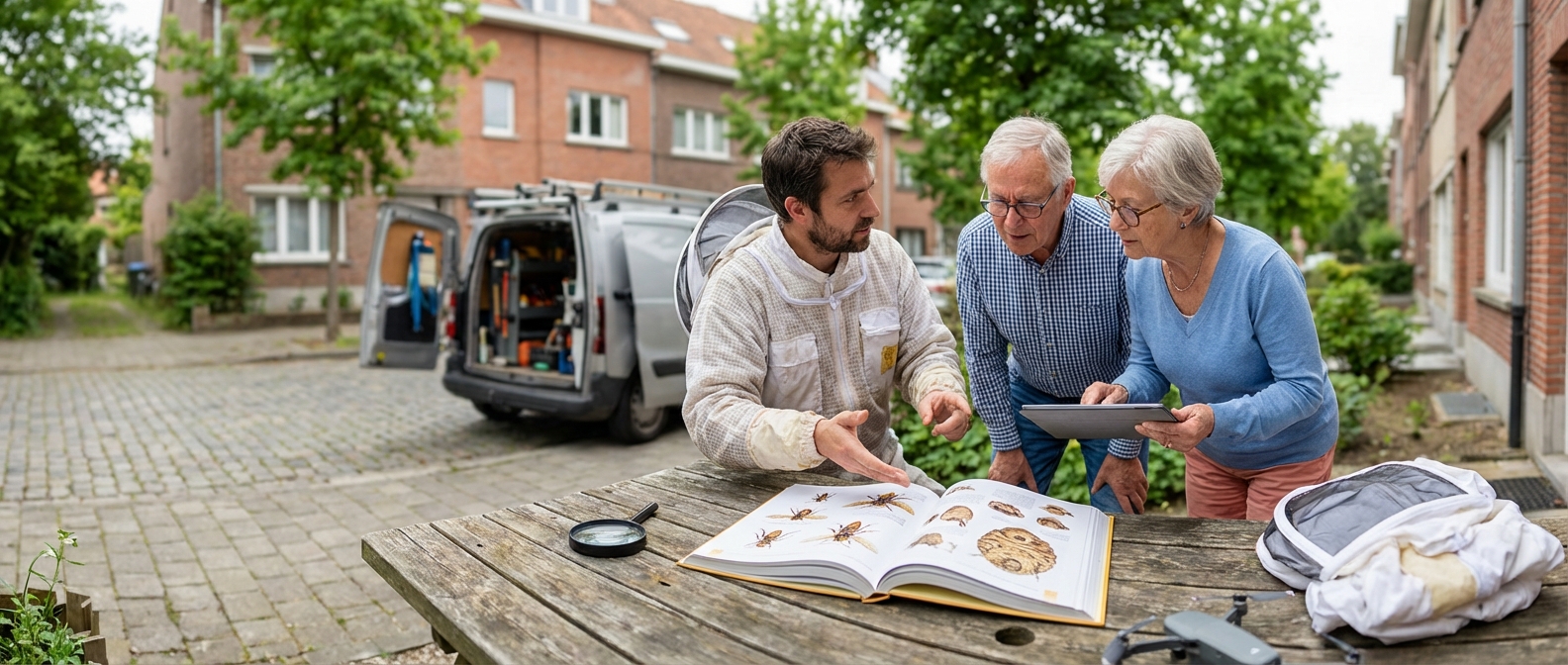
Asian hornets in Evere: What to do and who to contact
Contents
-
Understanding the progression of the Asian hornet in Evere's neighborhoods
-
Professional intervention: why choose a local expert in Evere?
Last summer, a resident of Rue de Paris in Evere called us on a Sunday morning. Voice tense. He'd just spotted a nest as big as a football under the overhang of his roof. His children had been playing in the garden ten minutes earlier. We're getting calls like this more and more often, and not just in the green areas of the commune.
Things to remember
-
A narrative and practical guide based on field expertise in Evere
-
Unlike cold institutional sites, we humanize the intervention by telling the story of our daily lives in Everest's neighborhoods, while explaining the new 2024 standards to reassure and guide residents with a local approach.
-
Understanding the progression of the Asian hornet in Evere's neighborhoods
-
What should I do if I discover a nest in Evere?
Asian hornets in Evere are no longer a hypothesis or an isolated incident. It's a reality that's settling in, neighborhood by neighborhood. Since the first confirmed sightings in the Brussels region around 2024, the progression has been steady. And Evere, with its parks, shared gardens and proximity to semi-natural areas, ticks all the boxes to attract Vespa velutina.
We wrote this guide based on our experience in the field. Not from an office. We tell you how to recognize the bug, what to do if you come across a nest, and why calling in a local professional really makes a difference. Because there's a world of difference between a generic Google article and someone who knows your street.
Understanding the progression of the Asian hornet in Evere's neighborhoods
First, a figure: in the Brussels region, the number of reports of Vespa velutina nests has tripled in two years. Evere is no exception to this trend. In fact, the municipality is particularly exposed, and there are specific reasons for this.
Look at a map of Evere. There's the Moeraske, a nature reserve wedged between railroad lines and housing. It's a rich ecosystem, full of pollinating insects, just what the Asian hornet is looking for to feed. The wild bees, hoverflies and butterflies that populate the Moeraske represent an open-air larder for Vespa velutina. The problem is that this predation directly threatens biodiversity in Brussels, which is already fragile in an urban environment.
But the Moeraske is not the only hot spot. Private gardens in the Tornooiveld district, mature trees along Avenue Henri Conscience and hedges in housing estates near the cemetery are all places where nests can be found. The Asian hornet is not limited to «natural» areas. They adapt. They build their nests in attics, under cornices and in cedar hedges. We've found them in garden sheds, in outdoor gas meters, once even in an unused mailbox.
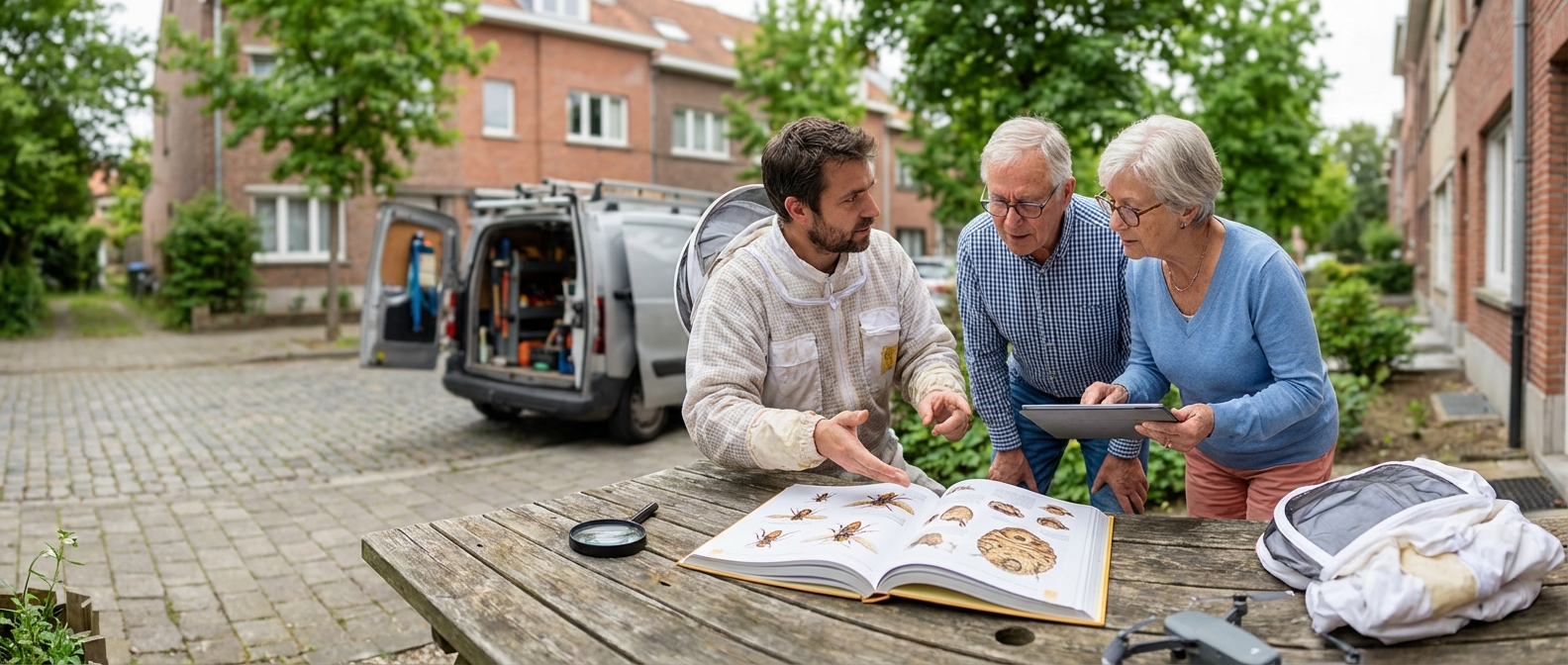
How to recognize an Asian hornet? It's the question we're most often asked. Here's what clearly distinguishes it from our European hornet and classic wasps:
-
His body is mostly dark, almost black, with a single, clearly visible orange abdominal segment.
-
His paws are yellow at the ends, as if he were wearing socks. That's the detail that can't be mistaken.
-
It is smaller than the European Hornet (about 3 cm vs. 3.5 cm for the Common Hornet). Many people think the opposite.
-
Its flight is rapid and nervous, often hovering in front of hives or flowers.
The European hornet, on the other hand, is redder, bigger and, frankly, less aggressive. Don't confuse them. Killing a European Hornet would be a mistake: it's useful and protected. The Asian Hornet, on the other hand, is an invasive species. Each founding queen can give birth to a colony of 2,000 to 3,000 individuals in a single season. And each colony potentially produces dozens of new queens in the autumn.
Where are there the most Asian hornets in Belgium today? Hainaut and the province of Liège were the first to be affected. Brussels is catching up fast. Evere, with its mosaic of connected gardens and green spaces, offers perfect corridors for the dispersal of the species. Primary nests appear as early as March-April (small, often at ground level), then colonies migrate to secondary nests in higher ground from June onwards. That's when they're usually spotted, when the nest is already the size of a watermelon.
The impact on biodiversity in Brussels is real and measured. A single nest of Asian hornets can decimate 30 to 40 % of an apiary in just a few weeks. Beekeepers in Evere and neighboring municipalities have been sounding the alarm for several seasons now. Wild pollinators have no one to defend them. The balance is shifting.
Step-by-step guide: what to do if you find a nest in Evere?
You've just spotted something suspicious in your garden or under your roof. Your first reaction will determine what happens next. So let's be very clear about what to do, and especially what not to do. not do.
Step 1: Don't touch anything. Seriously. No water jets, no sticks, no supermarket insecticide sprays. A disturbed Asian hornet nest means potentially hundreds of individuals in defense mode within a radius of several meters. Safety in the face of a hornet sting starts with keeping your distance. We're talking about at least five metres, more if the nest is large.
Is it dangerous to be stung by an Asian hornet? The sting itself is no more venomous than that of a wasp. The real danger lies in numbers. A single hornet sting is painful, but generally not serious (except for allergies). Twenty hornets attacking simultaneously because you've shaken their nest is a medical emergency. People allergic to Hymenoptera venom need to be particularly vigilant: a single sting can cause anaphylactic shock.
Step 2: Identify what you see. Take a photo from a distance, zooming in. Is the nest round, teardrop-shaped, with a side entrance? Are the insects circling it dark, with yellow legs? If so, there's a good chance it's Vespa velutina. If in doubt, a photo will suffice for a professional to confirm.
Step 3: Report the nest. There are two main channels in Evere:
-
Inaturalis or VespawatchThis is the regional organization that centralizes reports. You can contact them via their online form or by telephone. They keep a map of sightings and coordinate the fight against invasive species. By reporting an Asian hornet nest, you can also contribute to the scientific monitoring of the species.
-
The commune of Evere Your local environmental department can help you. Some communes in Brussels contribute to the partial financing of nest destruction. Contact the Evere municipal administration to find out what assistance is currently available.
Step 4: Contact a pest control professional. We'll come back to this in the next section, but remember this: destroying a hornet's nest is not a DIY job. Even with the best of intentions. The Brussels fire department no longer systematically responds to wasp and hornet nests. They redirect to specialized companies. This is the reality on the ground.
What should you do if you see an isolated Asian hornet with no visible nest? Don't kill it. It may seem counter-intuitive, but crushing an isolated hornet does nothing to help the colony. Worse still, a crushed hornet releases an alarm pheromone that can attract other hornets. Instead, note the location, time and direction of its flight. Asian hornets fly in a straight line towards their nest. By observing several individuals, you can triangulate the position of the nest. This is how our technicians proceed when the nest is not visible.
One last point on safety. If you are stung, watch for symptoms for at least an hour. Localized swelling, intense pain: it's normal, it passes. Breathing difficulties, facial swelling, dizziness, generalized malaise: call 112 immediately. Don't take any chances, especially if you've never been stung before and don't know your allergic reaction.
Professional intervention: why choose a local expert in Evere?
We'll be honest: you'll find dozens of online ads for hornet nest removal in Evere. National platforms, franchises, self-employed contractors who do it at weekends. The problem is, destroying a Vespa velutina nest can't be improvised.
At Hornets.be, Insect control in Brussels is our daily business. We've been working in Evere for years, and not just on hornets: wasps, flies, bees, anything that makes life impossible for residents. This versatility is precisely our strength. We know the buildings, roof types and garden layouts specific to each Everest neighborhood. When we receive an emergency call about hornets in Evere, we already know what to expect before we even get there.
In concrete terms, a hornet's nest removal operation in Evere is as follows:
-
Remote diagnostics You send us a photo, we confirm the species and assess the situation. Free, fast, often within the hour.
-
Planning The first step is to set a time, ideally at the end of the day or early in the morning, when the hornets are all in the nest. For emergency situations (nest near a school or crèche, allergic person in the home), we intervene the same day.
-
Intervention Our technicians arrive equipped with full-body suits, telescopic poles (for nests at heights of up to 15-20 metres) and approved biocides. The nest is treated, then removed. The entire colony is neutralized.
-
Follow-up We go back if necessary. Some secondary nests may appear nearby. Check.
The question of the price of an exterminator always comes up. And so it should. Let's be clear: the price of destroying a hornet's nest varies according to the height, accessibility and size of the nest. For a nest less than 10 metres away, you should expect to pay between 90 and 150 euros. A nest perched 20 meters up in a tree, requiring a gondola or special equipment, can be very expensive. We always give you a firm price before we intervene. No surprises on the bill.
Why a local wasp and hornet exterminator in Evere rather than a large-scale company? Three simple reasons:
-
Response time. We're just a few minutes from Evere. When it's urgent, it counts. A national platform will subcontract, look for an available provider, call back, confirm. We pick up the phone and come to you.
-
Local knowledge. Apartment blocks in the Helmet district, terraced houses on the Chaussée de Louvain, detached houses with gardens on the Moeraske: each configuration requires a different approach. We know them.
-
Follow-up. If the problem returns the following season, you have our number. We know your file. No need to explain it all over again.
An important point that many people are unaware of: insect control in Brussels is regulated. The products used must be approved, and the technicians trained and certified. At hornets.be, we scrupulously respect these standards. It's not just a question of legality, it's a question of efficiency and safety for you, your neighbors and the environment. An incorrectly dosed or applied treatment can contaminate a garden, a vegetable patch or a watering hole. That's not something to play with.
We also regularly receive calls about classic wasp nests in Evere. Confusion between wasps, European hornets and Asian hornets is common. No judgment: it's our job to tell the difference, not yours. Call us, describe what you see or send us a photo. We'll tell you exactly what you're dealing with and the best course of action.
Conclusion
The Asian hornet has settled in Evere. It's not an exaggeration or alarmism, it's an observation we've made in the field, intervention after intervention. Since the first alerts in 2024 in the Brussels region, the situation has evolved rapidly. Today, every resident of Evere may be concerned, whether his or her garden overlooks the Moeraske or a concrete parking lot.
Remember: never touch a nest yourself, report it, then call in a professional. If you are looking for a rapid intervention for the destruction of a hornet's nest in Evere, Hornets.be (sub-brand of Pest Patrol) is at your disposal. One call, one photo, and we'll take care of the rest. Your peace of mind is our business.
Frequently asked questions
What should I do if I discover a nest in my garden in Evere?
Keep a safe distance of 5 meters, do not attempt to destroy it yourself, and contact an expert immediately.
Why is the Asian hornet on the rise in the 1140 region?
Green areas such as the Moeraske and Parc du Bon Pasteur provide ideal pantries and dispersal corridors.
Do the Brussels fire department respond to hornet nests?
No, the fire department no longer systematically comes to your site, and now refers you to specialized companies like ours.
Do I have to report the presence of a nest to the municipality?
Yes, you can notify Evere's environmental services or use Vespawatch to contribute to the scientific monitoring of the species.
How much does it cost to destroy a nest in Evere?
You can expect to pay between €90 and €150 for an accessible nest. Prices vary according to height (pole or gondola required).
 French
  English
  Dutch
Dutch
0 Comments