
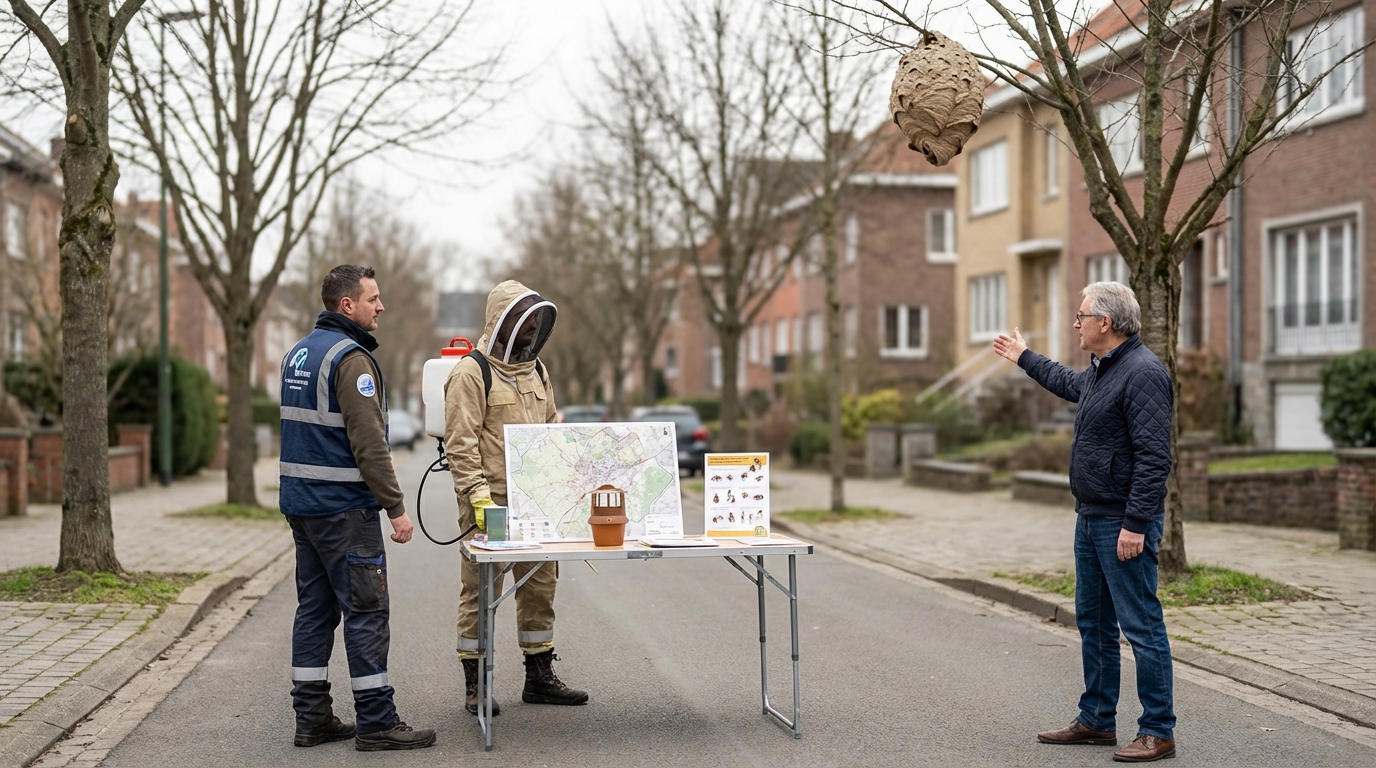
Asian hornets in Woluwe-Saint-Lambert: The complete guide
Contents
-
Understanding the proliferation of Asian hornets in Woluwe-Saint-Lambert
-
Reporting and destroying a nest: a practical guide for Woluwe residents
-
Year-round action: trapping and prevention in our neighborhoods
Last summer, a neighbor in the Tomberg neighborhood sent me a blurry photo of an insect sitting on his laurel hedge. «That's an Asian hornet, isn't it?» Yes, it was. And it wasn't an isolated case: reports of Asian hornets in Woluwe-Saint-Lambert have exploded in recent years, as in the rest of Brussels. The problem is that many people don't know what to do when they come across one. Worse still, some try to deal with them on their own.
Things to remember
-
This article stands out for its deep local roots in Woluwe-Saint-Lambert, combining technical expertise with geographical knowledge of the neighborhoods (Tomberg, Roodebeek).
-
It offers a unique hybrid solution: understanding the role of the authorities while valuing rapid private intervention for optimum security all year round.
-
Understanding the proliferation of Asian hornets in Woluwe-Saint-Lambert
-
Practical guide for Woluwéens
This article isn't just another copy-and-paste of general recommendations. We're going to talk specifics: which neighborhoods are the most affected, how to report them to your local council, when to call in a private professional rather than wait for the council to intervene, and above all, how to take preventive action all year round. Because, yes, the fight against the Asian hornet is not limited to the summer.
Whether you live near Roodebeek Park, along Avenue de Broqueville or in the residential streets around Woluwe Shopping Center, this guide is for you. Let's get started.
Understanding the proliferation of Asian hornets in Woluwe-Saint-Lambert
The Asian hornet is well and truly present in Belgium. It's no longer a hypothesis or a remote risk. Since the first confirmed sightings on Belgian territory in 2016, the species Vespa velutina has gradually colonized the entire Brussels region. Woluwe-Saint-Lambert, with its many gardens, tree-lined parks and green areas along the Woluwe River, offers particularly favorable conditions for this species.
Why here? Asian hornets love semi-urban environments. In Woluwe-Saint-Lambert, they find exactly what they need: mature trees to hang their nests high up (often over 10 meters), water sources, and above all an abundance of domestic and wild bees on which they feed. Local apiaries are paying the price. A single Asian hornet nest can decimate a bee colony in a matter of weeks. Local biodiversity is taking a big hit.

Recognizing an Asian hornet is the first step. And it's not as easy as you might think. Many people still confuse the Asian hornet with the European hornet, which is much larger and less aggressive towards bees. Here are the visual cues that can't be mistaken:
-
The Asian hornet is smaller than the European hornet (around 3 cm for workers).
-
His body is mostly dark, almost black, with a single orange abdominal segment.
-
Its legs are yellow tips, a very characteristic detail.
-
The head is black from the top, with a orange face.
The European hornet, on the other hand, has a yellow abdomen with black stripes and a reddish thorax. If you see a large yellow and red insect flying around your patio lamp at night, it's probably a European. The Asian hornet, on the other hand, is rarely attracted by artificial light.
One thing many people don't know: you shouldn't kill a lone Asian Hornet for no reason. Crushing a worker is of no use against the colony. It's the nest that needs to be targeted. And when a hornet is crushed, it releases an alarm pheromone that can attract other hornets. Not ideal if the nest is nearby.
The residential areas around Tomberg and Roodebeek are particularly concerned. These areas combine large private gardens, dense hedges and deciduous trees to provide perfect nesting sites. Primary nests (small, spring nests) are often found under roof overhangs, in garden sheds or hedges. Secondary nests (summer nests) can reach the size of a football, or even larger, and perch in treetops. At this stage, they are home to hundreds, sometimes thousands, of individuals.
And the question everyone asks: what scent does the Asian Hornet hate? We read a lot about cloves, burnt coffee and citronella essential oils. Let's be honest: none of these repellents has been scientifically proven to keep Asian hornets away from a garden for long. They may annoy a few insects from time to time, but they're no substitute for a real prevention and intervention strategy.
Reporting and destroying a nest: a practical guide for Woluwe residents
You've spotted dark insects coming and going in your garden, or worse, you see a grayish structure hanging from the top of your lime tree. What can you do about it?
First thing's first, don't touch anything. No water hoses, no smoke, no sticks. A disturbed Asian hornet nest means a coordinated attack by dozens of individuals in a matter of seconds. Multiple stings can cause severe allergic reactions, even in people who have never had a problem with wasps.
The commune of Woluwe-Saint-Lambert has set up a reporting system. You can contact the commune's environment department to report the presence of a nest. There is also a national platform iNaturalist and the vespawatch.be which centralize sightings of Asian hornets in Belgium. Your report helps scientists map the progress of the species. It's useful, but it doesn't solve your immediate problem.
Because here's the thing: municipal procedures take time. Between reporting, validation, intervention planning and team availability, it can take several days, sometimes more than a week. During this time, the nest grows, the colony strengthens, and the risk to your family and neighbors increases.
This is where a private service specializing in the destruction of hornet nests in Woluwe makes all the difference. At Frelons.be, we intervene quickly, often within 24 to 48 hours of your call. Our technicians are equipped to work at height, with full protective suits and appropriate biocides. We don't leave active nests lying around.
How does a typical intervention work? Here's how it works:
-
On-site assessment This involves precisely locating the nest, assessing its size, accessibility and the risks to the immediate environment (children, animals, neighbors).
-
Securing the perimeter A safety zone is defined. Asian hornets can attack within a radius of several meters around the nest.
-
Nest treatment Insecticide: injection of an insecticide directly into the nest using a telescopic pole or gondola, depending on the height. Nest activity ceases within a few hours.
-
Removal or neutralization Depending on its location, the nest is removed or left in place after treatment (a nest treated high up no longer presents a danger).
An important detail for the residents of Woluwe-Saint-Lambert: some Brussels communes cover all or part of the cost of destroying Asian hornet nests. Contact your commune's environment department to find out whether partial reimbursement is possible. Conditions vary from year to year.
And if you're not sure it's an Asian hornet? Send us a photo. We'll identify the species free of charge and let you know right away whether an intervention is necessary. Too many people hesitate, wait, and end up in September with a nest 60 cm in diameter above their terrace. At that point, intervention is more complex and more costly.
A final point on garden safety: if you have children playing outside, or pets, don't take any chances. A dog approaching a nest on the ground (it happens, especially in low bushes) can receive dozens of stings in a matter of seconds. The consequences can be fatal for a small animal.
Year-round action: trapping and prevention in our neighborhoods
90% some people think that the Asian hornet is a summer problem. But it's not. The life cycle of Vespa velutina starts well before the summer months, and it's precisely in spring that the fight is most effective.
Between February and April, the founding queens emerge from hibernation. Each queen that survives the winter will found a new colony. A single founding queen potentially means a nest of 2,000 to 3,000 individuals by the end of summer. Trapping foundresses in spring is therefore the most cost-effective prevention method available. Capturing a queen in March means one less nest in July.
How to trap effectively? Selective traps based on dark beer, white wine and blackcurrant syrup give good results. White wine has the advantage of repelling honey bees (they don't like alcohol), making the trap more selective. Place your traps from mid-February in sheltered areas of your garden: near hedges, under eaves, close to watering holes.
But be careful: trapping done badly can do more harm than good. A non-selective trap will capture useful insects, butterflies and pollinating flies. That's why we recommend models with calibrated openings that let small insects out. And you should never leave a trap active beyond May: after this period, the foundresses have already established their nests and trapping loses its interest.
For a truly effective long-term Asian hornet control program in Brussels, you need to combine several approaches. Spring trapping is one piece of the puzzle. Regular surveillance of your property is another. Get into the habit of observing your trees in autumn, when the leaves are falling: it's often at this time that nests that were invisible all summer, hidden in the foliage, are discovered.
In the neighborhoods of Woluwe-Saint-Lambert, an interesting dynamic can be observed. Gardens connected by hedges and green corridors form corridors that hornets use to move around and hunt. The areas around Roodebeek park, along the Promenade Verte and the back gardens of the houses on Avenue Hymans are areas where constant vigilance is required.
Local biodiversity suffers directly from the presence of the Asian hornet. Wild bees, already weakened by pesticides and habitat loss, are under enormous additional pressure. Woluwe beekeepers see this every year: colony losses are increasing in areas where Asian hornets are well established. Protecting our gardens also means protecting the entire ecosystem.
At Frelons.be, we don't just work from June to September. We support residents all year round. Trapping advice in spring, property inspections before summer, nest destruction during the active season, and residual nest detection in autumn and winter. This global approach is what makes the difference between suffering the problem and controlling it.
A simple gesture that everyone can make: talk to your neighbors. If a nest is spotted early, it can be easily dealt with. Collective surveillance, street by street, neighborhood by neighborhood, remains the best safety net. Some streets in Woluwe-Saint-Lambert have already set up WhatsApp groups to share sightings. It's basic, but it works.
Conclusion
Asian hornets in Woluwe-Saint-Lambert are not inevitable. With the right reflexes (rapid reporting, spring trapping, professional intervention without delay), we can considerably limit their impact on our daily lives and on the biodiversity of our neighborhoods.
Don't let doubts creep in. If you see a suspicious hornet or a nest in your garden, contact Frelons.be. We'll get back to you quickly, identify the problem and intervene as soon as possible, summer or winter. Your safety and that of your loved ones is our priority.
Frequently asked questions
Does the municipality of Woluwe-Saint-Lambert intervene?
Ask your local council for more information. Each commune has its own policy. Woluwe-Saint-Lambert's intentions for 2026 are not yet known.
What should I do if I see an Asian hornet in Woluwe-Saint-Lambert?
Contact your local health department, report it and contact a professional to neutralize it.
Is the Asian hornet present in Woluwe-Saint-Lambert?
The Asian hornet (Vespa Velutina Nigrithorax) has been an invasive species in Belgium since 2010. The Brussels region was affected in 2018 and the first nest was spotted in Auderghem in 2019.
How much does an intervention in Woluwe-Saint-Lambert cost?
An intervention in Woluwe-Saint-Lambert varies between €80 and €200, depending on the difficulty of accessing the nest.
 French
  English
  Dutch
Dutch
Hello,
I would like to know how to get Asian hornet traps to put in my garden?
Sincerely
Benoit Marchal