
Asian hornet nest removal in Koekelberg : Guide
Contents
-
Understanding the Asian hornet cycle and its risks in Koekelberg
-
Report a nest and choose a local professional at the best price
Last summer, a shopkeeper on Avenue de la Liberté called us on a Saturday morning. Tense voice, rapid delivery: «There's something huge under my cornice, it's been buzzing for three days and my customers don't dare come in anymore.» A nest of Asian hornets, as big as a basketball, four meters above the sidewalk. Right in Koekelberg.
Things to remember
-
An immersive account of a real-life insect control operation in Koekelberg (1081)
-
We anchor the content in the daily lives of Koekelbergers, citing local landmarks such as the Basilica and Elisabeth Park, to offer a practical and reassuring guide to the invasion.
-
Understanding the Asian hornet cycle and its risks in Koekelberg
-
Step-by-step guide to pest control in Koekelberg
This kind of situation is becoming increasingly common in 1081. Asian hornets in Koekelberg are no longer a curiosity: they're a reality, affecting gardens, terraces, flat roofs and even the area around Parc Elisabeth. And when a nest is established, it doesn't go away on its own. It grows. Fast.
This guide is here to give you the keys: understanding what you're up against, knowing how a hornet's nest removal operation in Koekelberg works, and above all, finding the right professional without getting fleeced. Let's get started.
Understanding the Asian hornet cycle and its risks in Koekelberg
Vespa Velutina. That's its scientific name, and it's best to know it so as not to confuse it with our European hornet, which is far less problematic. The Asian hornet is smaller than its European cousin (around 3 cm), darker too, with characteristic yellow legs and an almost black abdomen marked by a thin orange stripe. If you see it circling your jam jars or beehives, there's no doubt about it.
The life cycle of the Asian hornet explains why the problem explodes every year between July and November. It all starts in spring. A founding queen, who has survived the winter hiding in a woodpile, attic or wall crack, emerges from her torpor as soon as temperatures rise above 13°C. It builds a small primary nest, often the size of a tennis ball, in a sheltered spot: under an awning, in a garden shed, sometimes even in a hedge in Elisabeth Park. It's at this stage that spring trapping is most effective, because one captured queen means an entire colony will never see the light of day.
But if no one intervenes, the colony grows. Within a few weeks, the first workers take over. The nest can then be moved to higher ground: tree tops, under roofs, building facades. In Koekelberg, nests are regularly found in the plane trees along Avenue Léon Théodor, or clinging to structures around the Koekelberg Basilica. At the height of summer, a colony easily numbers 1,500 to 2,000 individuals. In autumn, there can be as many as 6,000.
The danger of the Asian hornet in Koekelberg is twofold. Firstly, for humans: a sting is painful, more so than that of a wasp, and the venom can cause severe allergic reactions. Is it dangerous to be stung by an Asian hornet? Yes, especially if you're allergic or if you receive several stings. Asian hornets are not spontaneously aggressive when foraging, but get within five meters of their nest and it's a different story: they attack in groups to defend the colony. That's why you should never attempt to destroy a nest yourself.
The other danger, less visible but just as serious, concerns biodiversity. Vespa Velutina is a formidable predator of bees. A single colony can decimate entire hives in a matter of weeks. Koekelberg beekeepers, grouped around the Koekelbees initiative, have been sounding the alarm for several years. When you consider that an Asian hornet can capture between 25 and 50 bees a day, the math is pretty simple.
And why shouldn't you kill a lone Asian Hornet you come across in your garden? Because swatting one every now and then does absolutely nothing to help the colony. Worse still, a stressed hornet releases warning pheromones that can attract other hornets. The only approach that works is to locate the nest and call in a professional for a proper disinsectisation.
Step-by-step guide to pest control in Koekelberg
Tuesday, 7:30 a.m., rue Émile Sergijsels. A report had been received the day before: a secondary nest under the eaves of an adjoining house, some six metres high. Neighbors were seeing hornets coming and going incessantly from their terrace. Here's how a pest control service works in 1081.
Step 1: On-site diagnosis. Before touching anything, we observe. The size of the nest, its exact position, the flow of hornets in and out, possible access routes. We also check the immediate environment: is there a school nearby? A shop? Passers-by? In Koekelberg, the streets are often narrow and the houses close together, which sometimes complicates access but also limits the area to be secured. This diagnosis takes between 10 and 20 minutes, and conditions everything else.
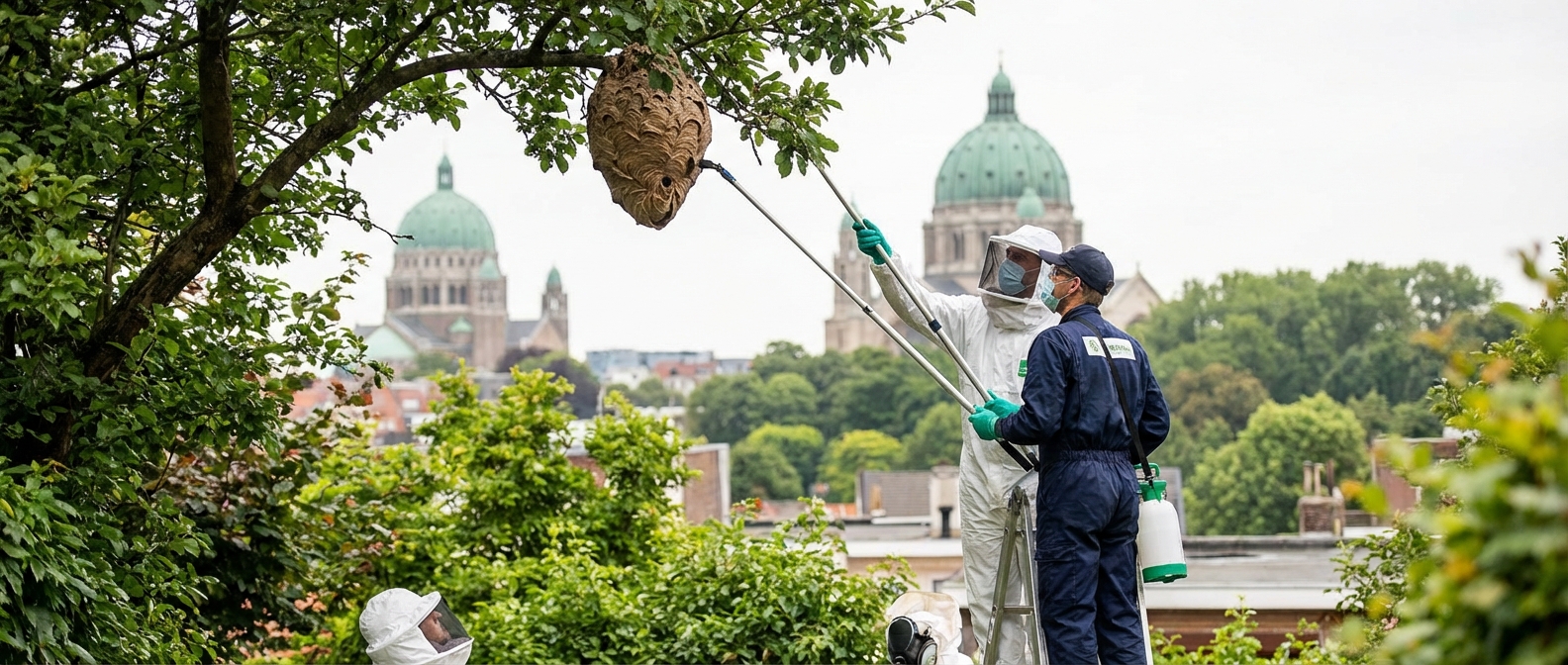
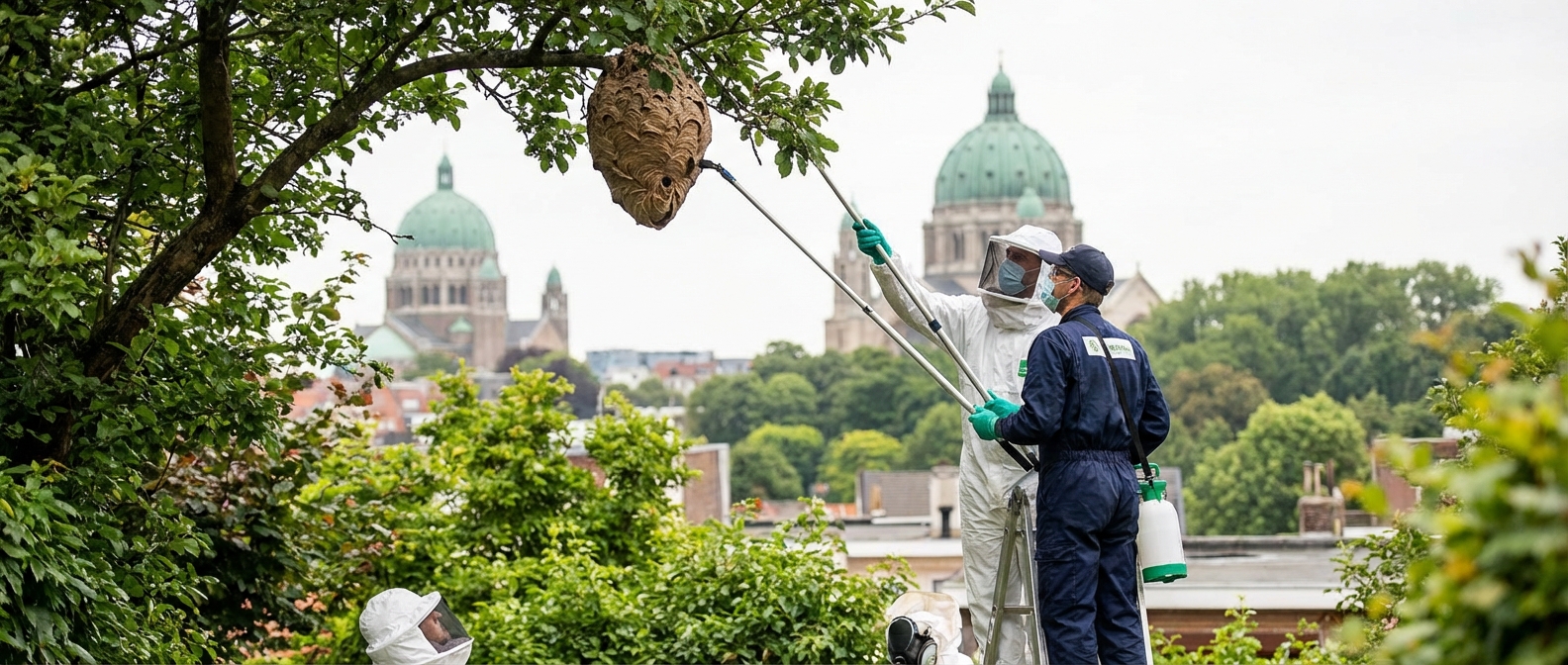
Step 2: Protection and equipment. Protection and equipment against hornets is not a detail, it's basic. We wear a thick, sting-resistant, full-body suit, with reinforced gloves and a face veil. Asian hornets can sting through jeans, so tinkering is out of the question. We then mark out a safety perimeter for any Koekelberg residents who might pass through the area. If the nest is high up, we use a telescopic pole or, in some cases, a cherry picker.
Stage 3: Neutralizing the nest. This is the heart of the operation. A biocide is injected directly into the nest using a pole fitted with a special nozzle. The product takes effect within a few minutes on the hornets inside. We don't pull out the nest straight away: we need to give the workers who were in flight time to return and come into contact with the product. That's why we often come back 24 to 48 hours later to remove the nest and check that there's no more activity.
Step 4: Removal and cleaning. Once the nest has been neutralized, a few days later, we unhook it and take it away. There's no question of leaving it in place, even if it's empty: this reassures residents and avoids any confusion if another nest appears later in the neighborhood.
The whole operation takes an average of 45 minutes to an hour and a half, depending on accessibility. In the case of the nest on Rue Sergijsels, we completed the job in exactly one hour. The neighbors were on their doorsteps, relieved. One of them told us he hadn't opened his window in two weeks.
An important point: what should you do if you see an Asian hornet, but haven't spotted the nest? Don't try to follow it by running through the streets. Simply note the direction in which it flies, the time of day and the precise location. A professional will be able to trace the nest based on this information. Hornets follow fairly straight trajectories between their nest and their hunting grounds, which makes it easier to locate them.
Report a nest and choose a local professional at the best price
Have you spotted a hornet's nest or suspicious comings and goings in your neighborhood? The first thing to do: report the hornet in Koekelberg. There are several channels available. You can contact your commune directly, which normally has a protocol for this type of situation. There's also the iNaturalist platform or the Vespa-Watch monitoring network, where you can post a photo for identification confirmation. If you're not sure whether you can distinguish an Asian hornet from a European hornet or a large wasp, take a photo from a distance (don't go near the nest) and send it to an insect killer in Brussels. We regularly receive photos of bumblebees or hoverflies, and this is perfectly normal: better a false report than a real nest ignored.
Now, the question that comes up with every call: how much does it cost to destroy an Asian hornet nest? Let's be clear. In the Brussels region, you can expect to pay between 80 and 180 euros for a standard job. The price of destroying a hornet's nest depends essentially on the height and accessibility of the nest. A nest three meters away in a hedge is quick and inexpensive. A twelve-meter nest in a tree in the Parc Elisabeth, requiring a cherry picker, is bound to be a bit of a climb.
Beware of quotes of 300 or 400 euros for an accessible nest. Some service providers take advantage of urgency and fear to inflate their prices. Conversely, an abnormally low price (40 euros) may conceal a botched job: no return to check neutralization, no nest removal, unsuitable product.
How do you choose the right professional? A few simple criteria:
-
He is trained and insured. Ask for his registration number
-
He makes a diagnosis before giving a firm price.
-
It guarantees a post-procedure inspection.
-
He knows the terrain. A Brussels-based exterminator who regularly works in the 1081 area will know how to deal with local constraints: narrow streets, adjoining facades, proximity to public spaces.
-
He answers your questions without rushing you. A good professional takes the time to explain what he's going to do and why.
At Frelons.be, we work all year round in Koekelberg and throughout the Brussels region. All year round, because the Asian hornet doesn't follow a strict timetable: founding queens can be active as early as February if the winter is mild, and residual nests are still a problem in December. You can't close up store in October and wait for spring.
One last piece of advice for the safety of Koekelberg residents: tell everyone you know. Tell your neighbors if you spot hornets. If you spot a nest early, it's smaller, less dangerous and less expensive to deal with. Shopkeepers around Place Simonis, families visiting Parc Elisabeth, local beekeepers: it's in everyone's interest to be vigilant. The Asian hornet is a collective problem, and so must the response.
Conclusion
Asian hornets in Koekelberg are not inevitable. A nest spotted quickly, an effective report, a competent professional: that's all it takes to regain control of your garden, terrace or business. Don't wait until the nest reaches the size of a football before taking action.
If you have any doubts, contact Frelons.be. We'll get back to you promptly, come to Koekelberg to assess the situation, and give you a fair price before we intervene. Your peace of mind is our business.
Frequently asked questions
Are there Asian hornets in Koekelberg?
Yes, like everywhere else in Brussels, the commune is no exception.
What to do if you see an Asian hornet in Koekelberg?
here are several ways of doing this. You can contact your commune directly, which usually has a protocol for this type of situation. There's also the iNaturalist platform and the Vespa-Watch monitoring network, where you can post a photo for identification confirmation.
Is it dangerous to be stung by an Asian hornet?
Stings generally cause a simple local reaction (swelling, itching) which is not dangerous, except in the case of stings in certain areas of the body, such as the eyes, or multiple stings, or if you are allergic.
How much does it cost to remove an Asian hornet nest in Koekelberg?
In general, the cost of eliminating a nest ranges from €80 to €200 inc. tax, with an average price of €110 inc. tax.
 French
  English
  Dutch
Dutch
0 Comments