
Bumblebees on roofs: A practical guide to management and legislation
Contents
-
Identifying the bumblebees under your roof: species and life cycle
-
Bumblebee nest and legislation: what is permitted or prohibited for the owner
-
Concrete solutions and prevention: how to manage cohabitation or relocation
A dull buzzing above your head, incessant buzzing back and forth under the roof tiles as soon as the sun heats up: you probably have a bumblebee nest under your roof. Your first instinct is to worry. Second instinct, Google. Some sites tell you to destroy everything, while others threaten to fine you if you touch the nest. Who's to be trusted?
Things to remember
-
This expert guide sets itself apart by tackling the ethical and legal dilemma head-on
-
Unlike conventional insect control sites, we integrate the latest scientific recommendations on Bombus hypnorum (tree bumblebee) and precisely detail the legal framework for pollinator protection to offer a safe and responsible solution.
-
Species concerned and life cycle
-
What the owner may or may not do
The reality is more nuanced, and above all more reassuring, than we often read. Bumblebees are not wasps. They're not aggressive, their colony is temporary, and in 90 % of cases, the best strategy is patience. But you still have legitimate questions: is it dangerous? Do you have the right to intervene? And if so, what can you do without destroying a pollinator essential to your garden?
This guide will answer all these questions in no uncertain terms. We'll talk identification, precise legal frameworks and concrete solutions. No panic, no unnecessary jargon: just what you need to know to make the right decision.
Identifying the bumblebees under your roof: species and life cycle
Before you do anything, you need to know what you're dealing with. A bumblebee on a roof is not a carpenter bee (which digs into wood), it's not a wasp (which can become a real nuisance in August), and it's definitely not an Asian hornet. Confusion is common, and often leads to unnecessary or even illegal intervention.
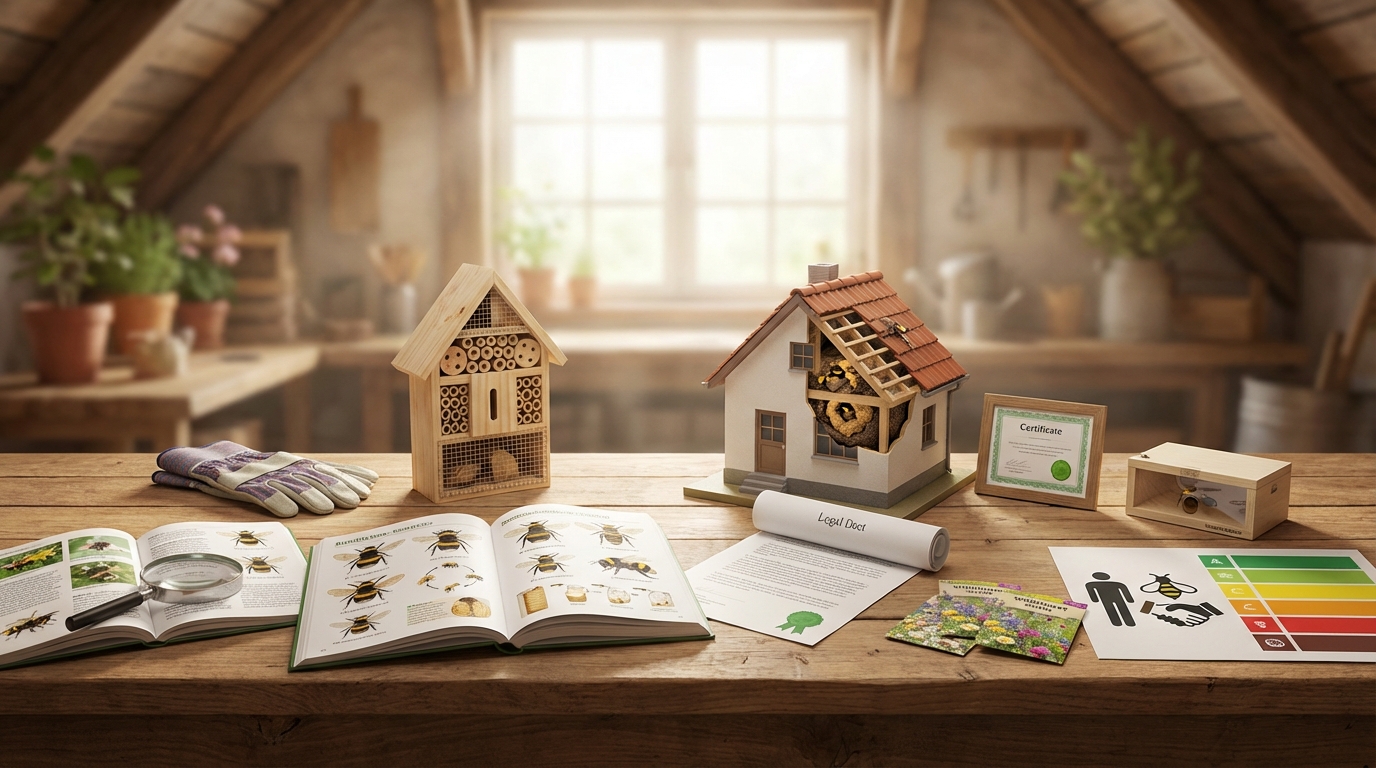
The species most often found under a roof in France is Bombus hypnorum, the tree bumblebee. It's a stocky hymenoptera, with a reddish-brown thorax and black abdomen terminated by a conspicuous white tuft. If you see hairy insects of this description hovering around your attic or roller shutter box, it's probably him. A study published in Journal of Hymenoptera Research (2016) confirms that Bombus hypnorum is one of the few bumblebee species to regularly colonize built structures, precisely because it nests naturally in tree cavities. For them, your roof is a five-star hollow tree.
How can you be sure of identification? Some reliable clues:
-
Size: A bumblebee measures between 15 and 22 mm. It's bigger and rounder than a honeybee.
-
Noise : a low, steady hum, not the high-pitched whirr of a wasp.
-
Behavior: Bumblebees fly in a slightly «heavy», non-aggressive manner. They don't hover around your plate on the terrace.
-
The entry point : a hole of a few centimetres under a ridge tile, a gap in siding, a slot in a shutter box. Unlike rodents, bumblebees don't enlarge openings.
Now, the life cycle. This is the key to understanding why patience is often the best option. In spring, a bumblebee queen emerges from hibernation and seeks out a nesting site. She founds her colony on her own: she lays eggs, feeds the first larvae and builds the wax cells. Gradually, the workers take over. The colony reaches its peak in summer, with typically 50 to 400 individuals, depending on the species. This is a far cry from the tens of thousands in a beehive.
And here's the crucial point: at the end of summer, the colony produces new queens and males. They leave the nest to mate. The new, fertilized queens leave to seek shelter for the winter. And the rest of the colony? They die. All of them. The nest is naturally abandoned between late August and October. No one will return to live there the following year: bumblebees almost never re-use an old nest.
In other words, a bumblebee nest under your roof is a temporary tenant. Four or five months, no more. This fact completely changes the equation when you're wondering what to do about a bumblebee nest.
Bumblebee nest and legislation: what is permitted or prohibited for the owner
Here we enter a subject that many pest control websites prefer to ignore. And for good reason: the law is not always compatible with their business model.
In Belgium, the protection of pollinators is a strict regional responsibility that places bumblebees under a robust legal shield. Whether through the Nature Conservation Act in Wallonia or the’Nature prescription In Brussels, legislation formally prohibits the capture, killing or intentional disturbance of these insects, as well as the degradation of their nesting sites. Unlike other countries, Belgium protects the genus Bombus (bumblebees) at regional level. So the question is no longer whether the species is protected, but whether it's an offence to touch a nest.
The challenge for the general public lies in identification: several bumblebee species are listed as «threatened» or «declining» on the IUCN Red Lists and Belgian regional inventories. While the tree bumblebee (Bombus hypnorum) is common, other species nesting in the ground or in cavities are on borrowed time. The major problem is that, in the absence of entomological expertise, any uncontrolled destruction of a nest exposes you to a real legal and financial risk. In Belgium, administrative fines for damage to protected biodiversity can be particularly heavy for private individuals.
The Belgian strategy, reinforced by initiatives such as the Maya Plan in Wallonia or the climate-biodiversity action plans in Brussels, systematically advocate cohabitation or non-lethal solutions. Emergency services (fire departments) have been instructed not to intervene in bumblebee nests, except in cases of imminent mortal danger (proven anaphylactic shock). Some local authorities go even further, warning citizens to strictly prohibit any chemical intervention. In practical terms, if a nest bothers you, the law requires you to consult an expert or let the natural cycle come to an end in autumn.
In concrete terms, what does this mean for you as an owner?
-
The destruction of a bumblebee nest is not automatically authorized. Unlike wasp or Asian hornet nests (invasive species), there is no general framework for freely destroying a bumblebee nest.
-
Authorized intervention must be proportionate. If the nest represents a proven danger (documented severe allergy of a household member, for example), a professional can intervene. But «it bothers me» is not a sufficient reason under the regulations.
-
Serious pest control companies will not destroy a bumblebee nest. If a service provider offers to spray an insecticide without even checking the species, run away. It's a sign of incompetence, and a potential offence.
An often overlooked point: using insecticides on pollinators can also expose you to prosecution under the regulations on plant protection products and biocides. European Regulation (EU) No. 528/2012 strictly regulates the use of biocides, and their application on non-target species is punishable.
So, is it dangerous to have a bumblebee nest in your home? Objectively, the risk is low. Bumblebees rarely sting. Their stinger is smooth (unlike the bee's), which means that can bumblebee sting several times, but in practice they almost never do unless you directly crush an individual or block the entrance to the nest. For a non-allergic person, a bumblebee sting is less painful than a wasp sting. The real danger is only for those suffering from allergies to hymenoptera venom, in which case intervention is medically justified.
Concrete solutions and prevention: how to manage cohabitation or relocation
You now know that you have bumblebees, that the law prevents you from eliminating them without good reason, and that the colony will disappear on its own within a few months. The practical question remains: how do you live with it, and how can you prevent it from happening again?
Option 1: cohabitation (recommended in 80 % of cases). It's the simplest and most respectful solution for pollination in your environment. The bumblebees under your roof work for you: they pollinate your vegetable garden, your fruit trees and your flowers. A colony of Bombus hypnorum can visit thousands of flowers a day. It's a free ecosystem service that many people pay dearly for by buying pollination hives.
So that cohabitation goes smoothly:
-
Never block the nest entrance. Bumblebees trapped inside will look for another way out, potentially into your home. This is the best way to create a problem where none existed before.
-
Avoid strong vibrations in the immediate vicinity of the nest (roofing work, drills). Postpone work until autumn if possible.
-
Tell the kids: we're watching, not bothering. Bumblebees aren't interested in us.
Option 2: gently scare away the bumblebees. Some gentle pest management methods work to make the site less attractive without killing the occupants. Light smoke (not chemical smoke, a simple beekeeper's smoker) can induce bumblebees to move, but results are random. Bumblebees are tenacious. Citronella essential oil placed near the nest entrance has shown a moderate repellent effect in some field observations, without any solid scientific study to date. Honestly, these methods work one time out of three.
Option 3: relocate a bumblebee nest. It can be done, but it's tricky. Moving a nest means doing it at night (when the whole colony has returned), transporting it at least 3 kilometers from the original site (otherwise the workers will return to the old location), and reinstalling it in a protected, stable spot. This is a job for an experienced beekeeper or wildlife specialist, not a do-it-yourselfer. Contact your local town hall or naturalist association: many offer this service free of charge or at cost price.
Option 4: Call in a natural insect control professional. If the situation really demands it (severe allergy, nest in a critical ventilation duct), a certified professional can intervene. Demand that he formally identify the species before taking any action. A good professional will propose removal first, not destruction. Natural pest control companies use mechanical methods (gentle suction, relocation) rather than chemical ones.
For long-term prevention and protection of your roof:
-
Inspect your attic in March, before the founding queens arrive. Seal any openings larger than 10 mm with fine mesh or putty.
-
Check the joints between the ridge tiles and the rest of the roof. This is the number-one point of entry.
-
Roller shutter housings are a favorite spot: a simple seal of expanding foam over cracks is often all that's needed.
-
Always wait until the end of the season (November) to plug a hole that has served as a nest entrance. If you do so while the colony is active, you create a death trap for protected insects.
One last point that deserves to be made clear: the carpenter bee (Xylocopa violacea), sometimes mistaken for a large black bumblebee, is a different case. It drills into the wood to lay its eggs. If you see perfectly round holes of around 10 to 12 mm in your beams or siding, this is not a classic bumblebee. Carpenter bees are solitary, they don't form colonies, and structural damage is generally superficial. The strategy is different: preventive wood treatment and filling in of galleries in autumn.
Conclusion
A bumblebee on a roof is rarely an emergency. It's a pollinator that has found temporary shelter and will leave on its own before winter sets in. In the vast majority of situations, the best thing to do is let the colony complete its cycle, then secure access for the following season.
If you're in a particular situation (allergy, critical location), call in a professional who practices removal rather than destruction. Check his references, ask him what species he has identified, and bear in mind that the law protects these insects for a good reason: without them, there's no pollination, and without pollination, there's no fruit in your garden.
Do you have any doubts about the species in your home? Take a clear photo and send it to your local naturalist association. They'll get back to you within 24 to 48 hours. It's free, it's reliable, and it'll save you unnecessary work.
Frequently asked questions
How to get rid of a bumblebee nest under the roof?
So what should you do if you see a bumblebee nest and it's bothering you? The answer is simple: there's nothing you can do! However, if the nest and its colony are really bothering you, don't hesitate to call a company specializing in the recovery of flying insect nests.
How to scare off a bumblebee?
Some gentle pest management methods work to make the site less attractive without killing the occupants. Light smoke (not chemical smoke, a simple beekeeper's smoker) can induce bumblebees to move, but results are random.
Is it dangerous to have a bumblebee nest?
Bumblebees are not naturally dangerous, as they are not aggressive and only seek pollen from flowers. The danger of a bumblebee nest is comparable to that of a bee nest.
Do bumblebees make nests?
Yes, they found nests.
 French
  English
  Dutch
Dutch
0 Comments