

Asian hornet in Ganshoren: everything you need to know about the intervention
Contents
-
Story of an intervention in Ganshoren: identifying a hornet's nest
-
Guide to reporting and destroying a hornet's nest in Ganshoren
In mid-September, a resident of Avenue Charles-Quint called us. He had noticed a suspicious coming and going at the top of his lime tree, some ten meters above the ground. Insects «bigger than wasps» were circling relentlessly around a grayish mass. His seven-year-old daughter plays in the garden every afternoon. He wants to know what it is, and especially what to do about it.
Things to remember
-
We tell the story of a real intervention in a Ganshoren garden to humanize the subject, while explaining technically why the geographical configuration of the commune (green mesh) favors their installation.
-
The article mixes local stories and safety tips to set it apart from conventional administrative sites.
-
Identifying a hornet's nest
-
Why do Asian hornets like Ganshoren so much?
The Asian hornet, Vespa velutina, has been present in Belgium for several years now. In Ganshoren, a green commune wedged between the Parc Roi Baudouin and the Parc de Jette, reports are multiplying. This is no coincidence: the layout of the area provides colonies with everything they need to thrive. And when a nest settles close to a house, you have to act fast, but not just like that.
This article recounts a concrete intervention in a garden in Ganshoren, explains why the municipality is particularly at risk, and details the steps involved in reporting and destroying a nest in complete safety. No unnecessary jargon, just concrete facts.
Story of an intervention in Ganshoren: identifying a hornet's nest
When we arrive, the owner is waiting for us in front of his gate. Nervous, but calm. He's got the right reflex: don't try to get near the nest, don't spray anything on it. It's often said, yet many people still try to deal with the problem themselves with insecticide spray from the supermarket. A bad idea. An Asian hornet nest can contain several hundred individuals, sometimes more than a thousand at the end of the season. Disturbing them without the proper equipment means risking a mass attack.
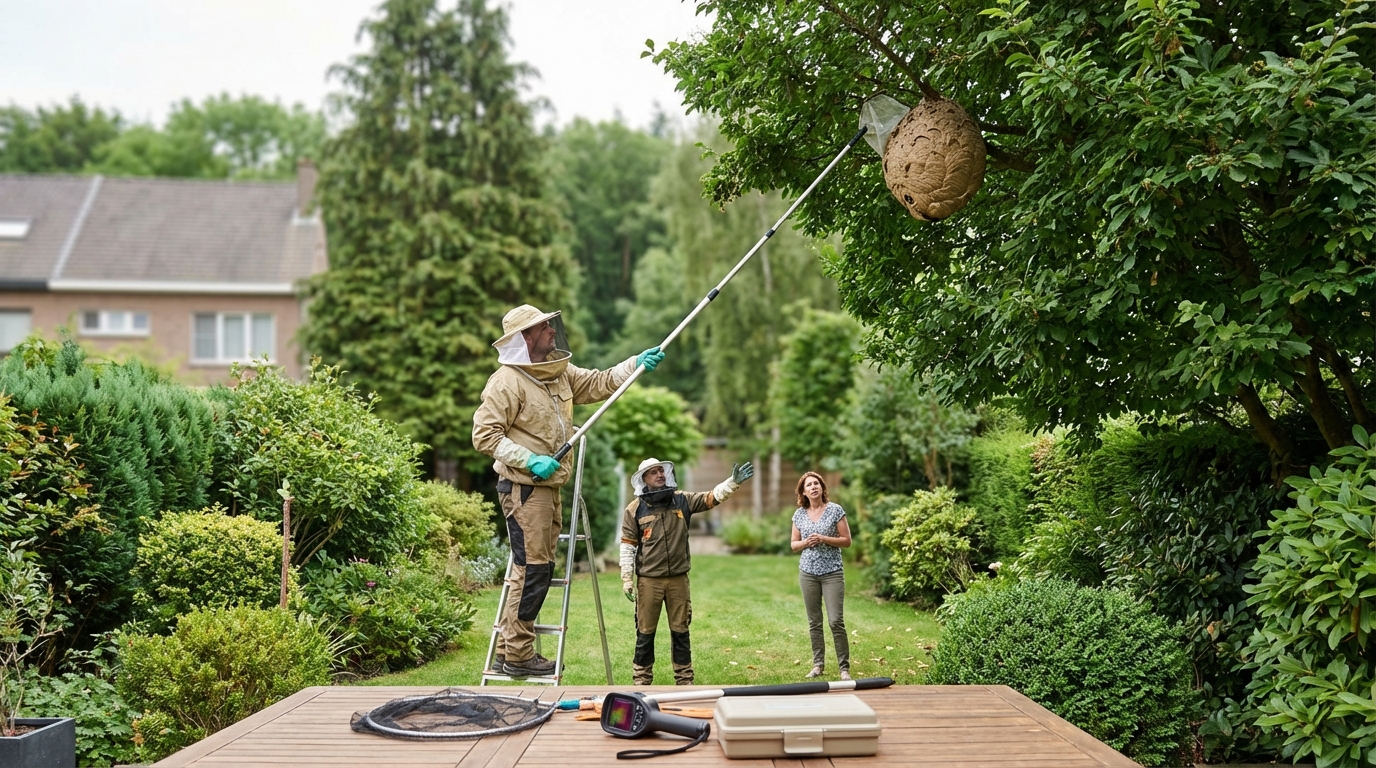
First step: identifying the nest. From the ground, observe the structure with binoculars. Teardrop shape, side entrance, cardboard texture. It's definitely a Vespa velutina, The difference is in the details. The difference is in the details: Asian hornets generally build their nests high up (treetops, under roofs), while European hornets prefer cavities. Flight behavior is also revealing. Asian hornets hover in front of the nest entrance. They can be seen «hovering» for a few seconds before swooping in.
Identifying an Asian hornet nest requires a trained eye. In the field, we regularly come across nests mistaken for those of Saxon wasps or even magpies. Size helps: in September, a mature nest of Vespa velutina in 1083 easily reaches 40 to 60 centimetres in diameter. The one on Avenue Charles-Quint was around 50 centimetres. Nice size.
Our Vespa Hunter team in Ganshoren works with a telescopic pole equipped with an injection system. We don't cut into the nest in broad daylight, and we don't set it on fire (yes, some people still think about that). The protocol is simple and tried and tested: injection of a biocide directly inside the nest, at the end of the day when most of the workers have returned. The operation takes around twenty minutes. The next day, we return to remove the neutralized nest.
The Asian hornet's behavior during the operation is predictable if you know what you're doing. Sitters come out in droves, circling the nest, but our full-body suit and working distance (the pole is up to 25 meters long) limit the risks. The owner and his family stay inside, shutters closed. No show, no hero: just method.
An important point: why shouldn't you kill a lone Asian hornet passing through your garden? Because crushing a single worker is of no use against the colony. Above all, a crushed hornet releases an alarm pheromone that can attract other hornets. The real battle is the nest. Always the nest.
Why do Asian hornets like Ganshoren so much?
300 meters. This is the maximum distance an Asian hornet will travel on average to hunt, according to data from the Centre wallon de recherches agronomiques. In other words, it needs an accessible larder, nearby water and high ground on which to build. Ganshoren ticks all the boxes.
The municipality is part of what's known as the Brussels Green Network, a network of parks, private gardens, wooded slopes and green corridors that crosses the region. In Ganshoren, this network is particularly dense. The Parc Roi Baudouin to the north, the Parc de la Jeunesse, the gardens of the four-façade houses along Avenue Van Overbeke and Rue au Bois: all these form a continuous ecological corridor. For an Asian hornet, it's an open-air buffet.
Biodiversity in Ganshoren is rich, and that's precisely the problem. The livelier an environment, the more it attracts predators. Asian hornets feed mainly on bees (up to 80% of their protein diet in some studies), but also on wasps, flies and butterflies. Ganshoren's gardens, with their living hedges, fruit trees and vegetable gardens, are teeming with pollinating insects. Every hobby beehive in a back garden is a three-star restaurant for insects. Vespa velutina.
The proliferation of the Asian hornet in green urban areas comes as no surprise when you understand its biology. In spring, a founding queen seeks temporary shelter (an awning, a dense bush, a bird's nest box) to start a primary nest. If she survives, the colony moves in summer to a secondary nest, often high up in a deciduous tree. Ganshoren's lime, oak and poplar trees offer exactly this type of support.
Another underestimated factor is water. Asian hornets need water to build their nests (they chew wood and mix it with their saliva to make cardboard paste). The ponds in the King Baudouin Park, stormwater basins and garden ponds all make it easy for them to settle in. Ganshoren isn't just green, it's wet. An ideal combination.
The question often arises: is the Asian hornet really present in Belgium, or is it just a media phenomenon? The figures speak for themselves. In 2023, the Vespa-Watch platform recorded hundreds of reports in the Brussels region alone. Ganshoren, with its 1083 zip code, is one of the communes where sightings are recurrent. This is not alarmism, it's an observation that our Vespa Hunter interventions in 1083 confirm every season.
Local biodiversity suffers directly from this presence. Local beekeepers are losing colonies. Pollinating insects, already weakened by pesticides and urbanization, are under additional pressure. Protecting Ganshoren from the proliferation of the hornet is not just a question of safety for local residents, it's also a concrete ecological issue.
Guide to reporting and destroying a hornet's nest in Ganshoren
Have you spotted a suspicious nest in your garden, under your roof or in a tree on your street? Here's exactly what to do, step by step.
1. Don't touch anything. Seriously. No water jets, no sticks, no smoke. Stay at least five metres away, and keep children and pets at a distance. A disturbed nest can trigger a massive defensive reaction in seconds.
2. Take a photo if it's safe to do so. From a window, with a zoom. This helps enormously with remote identification. We regularly receive reports that turn out to be wasp nests or even mistletoe balls. Even a blurred photo saves time.
3. Make a report. Several options are available. The platform Vespa-Watch (vespawatch.be) allows you to report a sighting with photo and geolocation. This is a scientific tool managed by INBO (Flemish Institute for Nature and Forest Research), which feeds into the national mapping system. You can also contact an authorized operator such as Vespa Hunter directly to report the nest and ensure rapid intervention in Ganshoren.
4. The question of cost. Does it pay to have an Asian hornet nest removed? The answer depends on the situation. In the Brussels region, certain operations are subsidized under the "Plan de lutte contre Vespa velutina. Nest destruction costs vary according to the height, accessibility and size of the nest. For a nest less than 10 meters away, you should expect to pay between 75 and 150 euros. Higher up, with a cherry picker or long pole, the price can go up. At Frelons.be, we give you a clear price before we intervene, with no surprises.
5. Who to contact in the event of an Asian hornet outbreak? Not the fire department, except in a life-threatening emergency (allergic reaction, nest in a school). The Brussels fire department refers you to specialized operators for hornet nest destruction in Ganshoren. Your local council can also refer you, but the quickest way is to contact an approved professional directly. We intervene all year round, because Asian hornets are not limited to summer: the founding queens emerge as early as spring, and the last workers can be active until December if the autumn is mild.
6. After the operation. Once the nest has been neutralized and removed, we check that there is no secondary nest nearby. This is often the case: a colony disturbed at the start of the season may have set up a second nest a few dozen metres away. Neighbors are also advised to remain vigilant. Asian hornets in Ganshoren do not respect plot boundaries.
A final point on the safety of residents. Asian hornet stings are no more dangerous than wasp stings for a non-allergic person. The real risk lies in numbers. A grouped attack (ten, twenty, thirty stings) can provoke a toxic reaction even in someone who has never had an allergy. That's why we insist on not disturbing a nest yourself. Whatever the cost of hornet eradication, it's always cheaper than a trip to the emergency room.
Conclusion
The Asian hornet is now part of the landscape in Ganshoren. Denying it or waiting for it to «go away» is not an option. Each untreated nest means one more queen who will survive the winter and set up a new colony the following spring.
If you spot a nest or suspicious behavior in your garden, on your facade or in a tree on your street, don't take any chances. Report it, call in a professional and tell your neighbors. The fight against Vespa velutina in 1083 is a collective effort. At Frelons.be, that's what we're here for, all year round.
Frequently asked questions
Why not kill an Asian hornet?
This can be dangerous and risky. If you don't know if you're allergic, don't take any chances.
Does it pay to have an Asian hornet nest removed?
Destruction costs vary enormously depending on the accessibility of the nest. In most cases, it costs between 70 and 150 euros for a standard intervention by a professional insect killer.
Is the Asian hornet present in Ganshoren?
The Asian hornet (Vespa Velutina Nigrithorax) has been an invasive species in Belgium since 2010. The Brussels region was affected in 2018 and the first nest was spotted in Auderghem in 2019.
Who to contact in the event of an Asian hornet outbreak?
Contact your local authority to find out how to proceed and whether it will cover the cost of destroying the nest. Then contact a professional.
 French
  English
  Dutch
Dutch
0 Comments