
Asian hornets in Jette: everything you need to know to take effective action
Contents
Last summer, a resident of Rue Léon Theodor discovered a grayish ball hanging under the eaves of her roof. She thought it was a classic wasp nest. Wrong. It was an Asian hornet's nest, as big as a football, with hundreds of individuals inside. And this kind of scenario has been multiplying in Jette in recent years.
Things to remember
-
An ultra-local guide focused on Jette (King Baudouin Park, residential neighborhoods) that answers precisely the ‘how much, how, why’ questions.’
-
The article sets itself apart by offering a clear roadmap for residents, covering everything from detection to professional neutralization, available all year round.
-
Why are they there?
-
How to identify an Asian hornet nest in Jette?
If you live in the commune, whether you have a garden near the Parc Roi Baudouin or an apartment with a terrace on the Dieleghem side, this subject concerns you directly. Asian hornets are not just a «country» problem. They're here, in Brussels, and Jette is one of the communes affected. This article gives you the keys to recognizing them, knowing what to do when faced with a nest, and above all who to contact for rapid intervention, whatever the season.
The Asian hornet situation in Jette: why are they here?
In 2016, the first official report of Vespa velutina in Belgium came from the province of Hainaut. Since then, the species has spread northwards, and Brussels has not been spared. Asian hornets in Jette are no longer a hypothesis: it's a fact that the commune itself relays in its communications to local residents.
Why Jette in particular? Several factors come into play. Firstly, the municipality has a substantial green heritage. The Parc Roi Baudouin, with its wooded areas and wetlands, offers an ideal habitat for colony founders in spring. They find water, insects to hunt and structures (hollow trees, dense hedges) to set up their primary nests from March-April onwards. The residential areas around the park, with their gardens, cedar hedges and garden sheds, complete the picture: a perfect playground for these opportunistic insects.
What attracts the Asian hornet is quite simple: food. And in Jette, there's plenty of it. Private orchards, hives belonging to amateur beekeepers (there are several in the commune), poorly closed garbage cans in summer, fruit that has fallen to the ground. Asian hornets are formidable predators of bees, and can decimate an entire hive in a matter of weeks. A single worker can capture between 25 and 50 bees a day. Do the math for a colony of several hundred.
The impact on biodiversity in Brussels is real and documented. Honey bees are the first victims, but not the only ones. Syrphid flies, butterflies and other pollinators are also affected. For a municipality like Jette, which invests in greening and ecological preservation projects, the Asian hornet represents a direct threat to these efforts.
An important point: contrary to what we sometimes read, the Asian hornet doesn't really have an effective natural enemy in our latitudes. In Asia, local bees have developed defense strategies (they form a «heat ball» around the intruder to kill it). Our European bees don't have such a response. Some birds, such as shrikes and bee-eaters, occasionally attack hornets, but this is not enough to regulate populations. The only effective response is rapid, targeted human intervention.
Another detail that often comes as a surprise: Asian hornets also come out in the evening. Unlike European wasps, which return to their nests at dusk, Vespa velutina remains active well into the night, attracted by artificial lights. If you see large insects circling around your patio lamp in the evening between July and November, it's worth taking a closer look.
How to identify an Asian hornet nest in Jette?
Every year, residents of Jette report nests that turn out to be either common wasp or European hornet nests. There's no need to be ashamed: confusion is common. But knowing the difference means you don't panic for nothing, and especially you don't miss out on a real Asian hornet's nest.
Let's start with the insect itself. The Vespa velutina is smaller than the European hornet: around 2.5 to 3 cm for a worker, compared with 3.5 cm for its local cousin. Color is the most reliable criterion. The Asian Hornet is predominantly dark, almost black, with an orange stripe on the abdomen and yellow legs at the tips. The European Hornet, on the other hand, is much more yellow, with russet tints on the thorax. If the insect you see looks like a large yellow and red wasp, it's probably a European hornet, which is harmless to bees and protected.
To identify an Asian Hornet with certainty, look at the legs. This is the detail that stands out: black legs with bright yellow tips. No other hornet in Belgium has this characteristic.
Let's move on to the nest. Here, there are two phases in the year. In spring (March to June), the foundress builds a primary nest, often the size of a tennis ball to an orange. It's found in sheltered places: under an awning, in a garden shed, under a gutter, sometimes even in an unused mailbox. These primary nests are easy to miss because they are small and unobtrusive.
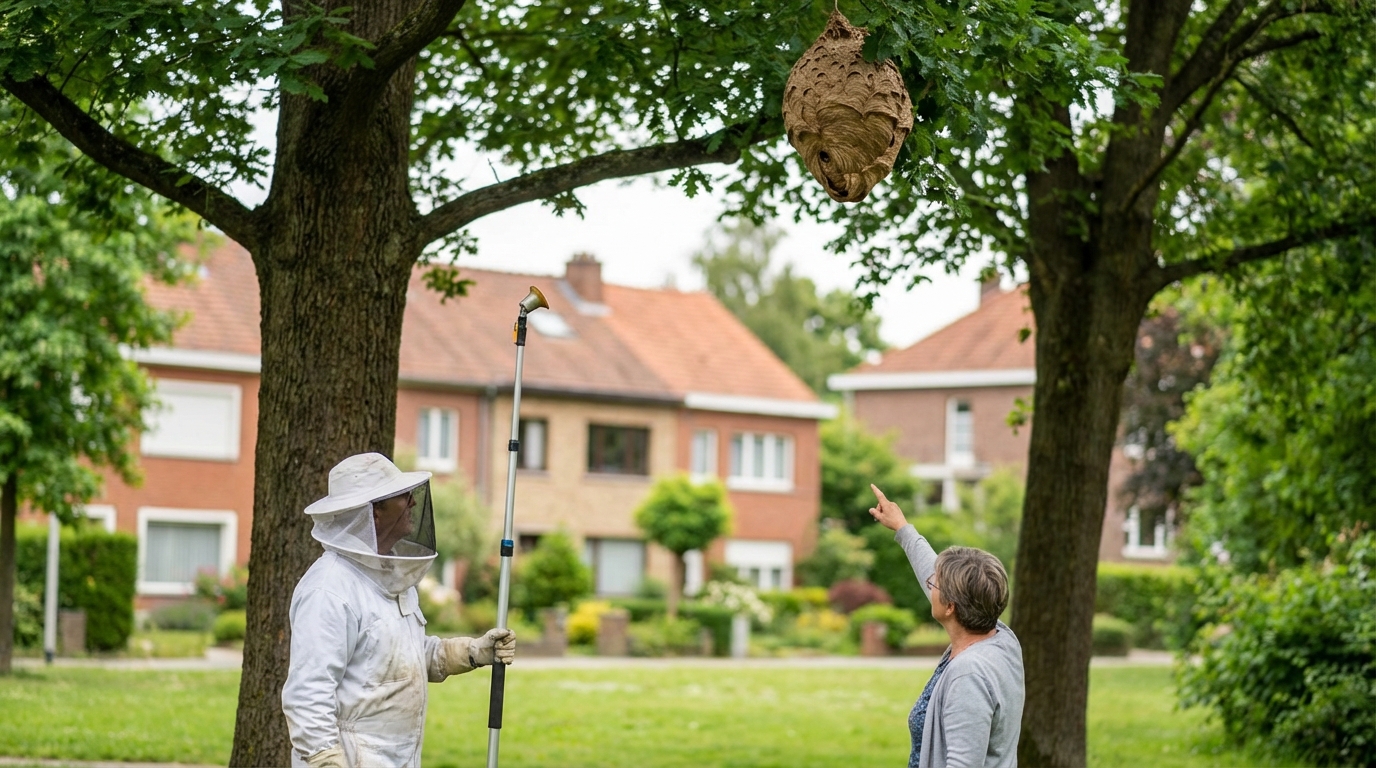
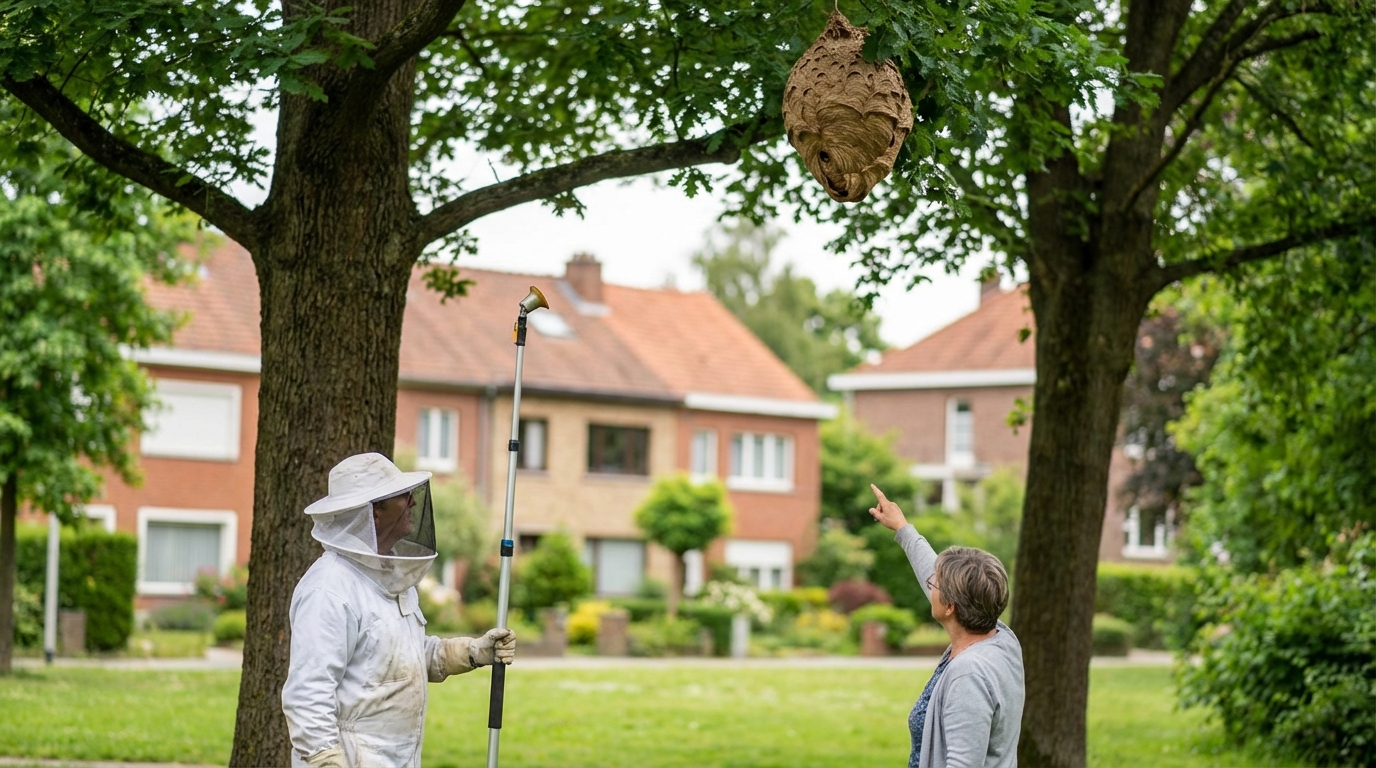
From summer onwards, the colony often moves to a secondary, much larger nest. You can't miss this one: it can be 80 cm in diameter or more. It's usually located high up in a tree (often more than 10 meters away), but not always. In Jette, nests have been found in hedges, under roofs and in garages. The secondary nest is pear- or balloon-shaped, with a lateral opening (not underneath, as with wasps). Its texture is papier-mâché, grey-beige, with striations.
If you spot a hornet's nest in Jette, the golden rule is: don't touch anything. Don't try to destroy it yourself, no matter how small. A primary nest already contains a foundress capable of stinging, and a secondary nest can house between 1,000 and 2,000 individuals. Each hornet can sting several times, and a group attack requires hospitalization in 3 to 5 % cases.
A practical tip: if in doubt, take a photo of the insect or nest with your phone (keeping your distance, at least 5 meters for an active nest) and send it to a professional or to the reporting platform. This is the surest way to obtain reliable identification without taking risks.
And no, you shouldn't kill an isolated Asian hornet thinking you've solved the problem. A single worker does not represent a major danger, and crushing her will not change the colony's situation. The important thing is to locate the nest and have it neutralized.
Procedure and neutralization of an Asian hornet nest in Jette
You've spotted a suspicious nest in your garden, on your facade, or in a nearby tree. Here's exactly what to do, step by step.
Step 1: Report the nest. In Brussels, you can report a nest via the Renature or directly to your local council. The commune of Jette also relays reports via its channels (website, counter). Reporting a nest in Brussels is free and takes just two minutes. Your report feeds a map that helps track the species' progress and prioritize interventions.
Step 2: Call in a professional exterminator in Jette. It's the only sensible option. Destroying a hornet's nest in Jette requires special equipment (full-body sting-proof suit, telescopic pole, suitable biocide) and real expertise. A professional knows how to approach the nest, when to intervene, and how to ensure that the colony is completely neutralized.
At Frelons.be, we work all year round. This is a very important point. Many people think that Asian hornets are only a problem in summer. False. Foundresses hibernate as early as November in protected nooks and crannies (woodpiles, attics, wall cracks) and start a new cycle the following spring. An intervention in autumn or winter on a nest that is still active, or the early detection of a primary nest in April, can prevent a colony of 2,000 individuals in August.
Step 3: Secure the area. Keep children and pets at a distance while you wait for intervention. Close the windows on the nest side. Do not attempt to smoke, spray or shake the nest. It sounds obvious, but every year people get stung trying «home-made solutions» found on the Internet.
The cost of destroying a hornet's nest in Jette varies according to height and accessibility. For a nest that can be reached without a bucket, you should expect to pay between 80 and 150 euros. For a high nest requiring special equipment, the price can rise. Some communes in Brussels cover part of the cost: contact the Jette local authority to find out what assistance is available at the time of your application.
A serious exterminator in Jette doesn't just spray a product and leave. He checks that nest activity has ceased, removes the nest where possible, and gives you advice to limit the risk of re-installation the following year. For example: trim dense hedges in autumn, inspect garden sheds in spring, set selective traps in March-April to capture foundresses before they create a colony.
The safety of local residents is what guides every intervention. A nest near a school, playground or busy passageway will be treated as a priority. If you live near Parc Roi Baudouin or in a neighborhood where children play outdoors, don't wait «to see if the nest grows». The earlier you take action, the simpler and cheaper it is, and the less risk there is for everyone.
Conclusion
Asian hornets in Jette are not a fatality. It's a serious problem, yes, but one that can be managed when every resident plays his or her part: observe, report, and let the professionals do the rest. You don't need to become an entomologist. Just know how to recognize a dark insect with yellow legs and pick up the phone.
If you have any doubts about a nest or observe unusual hornet activity in your home, contact Frelons.be. We work in Jette and throughout the Brussels region, all year round, including weekends. The biodiversity of your community depends on it, and so does your peace and quiet.
Frequently asked questions
Why not kill an Asian hornet?
For safety reasons, we advise against killing Asian hornets. What's more, they release a pheromone that warns of aggression. The colony may attack in groups.
Do Asian hornets come out at night?
Asian hornets are only active during the day. Unlike European hornets, Asian hornets are 100% diurnal insects. At the end of the day, they return to their nest, where they spend the night sleeping. They have no night-time activity and are not attracted by artificial light.
What attracts the Asian hornet?
Certain plants in the garden are particularly attractive to Asian hornets. What do they like best of all? Sugar. And many plants produce it naturally, via their sap or nectar.
What is the Asian Hornet's natural enemy?
This is the use of the Janzé black hen. Used for years in orchards and in the agricultural world in general, this breed of hen has a number of advantages against flying insects, and therefore naturally against Asian hornets.
 French
  English
  Dutch
Dutch
0 Comments