
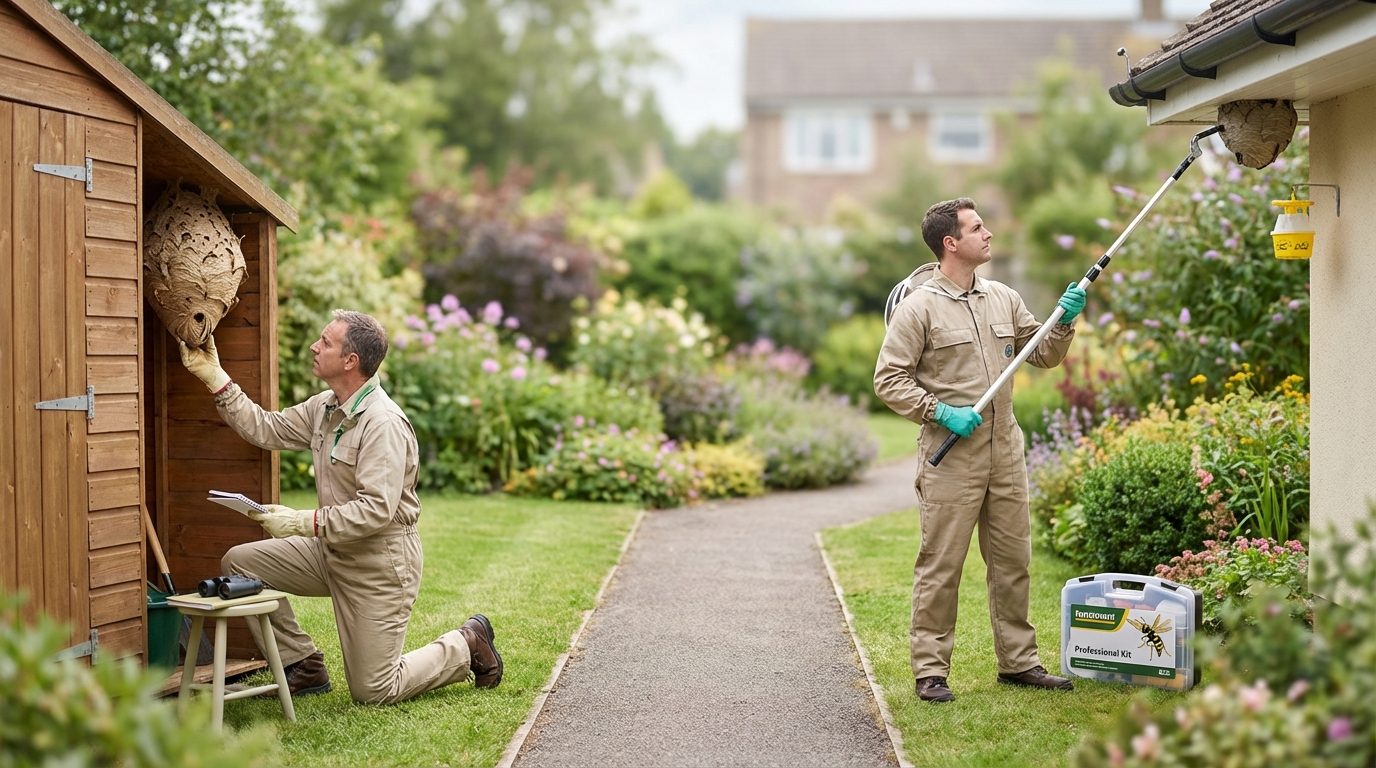
Wasp nest in the garden: Should you intervene or leave it?
Contents
-
Keep or destroy: the advantages and disadvantages of a wasp nest
-
Dangerousness criteria: when does intervention become mandatory?
-
Pre-purchase recommendations: choosing between insecticides and professionals
You've just spotted a suspicious coming and going near the garden shed, under the terrace or in a corner of the garden. A wasp nest. Your first instinct is to get rid of it. And that's understandable, especially when you've got children playing outside or eating on the terrace every evening. But is this really the right reaction every time?
Things to remember
-
A balanced approach to home safety and ecology
-
We help the gardener to assess whether the presence of the nest is a threat or an asset for biodiversity, while stressing the need for surveillance in the face of the Asian hornet.
-
The advantages and disadvantages of a wasp nest
-
When does surgery become compulsory?
The answer is not as clear-cut as you might think. Depending on its location and size, a wasp nest in the garden can be a discreet ally for your vegetable garden, or a real source of danger. It all depends on the context. And that's exactly what we're going to break down here: the situations where it's best to let nature take its course, those where you need to act quickly, and how to do so without putting yourself in danger.
Here's an important point: at Frelons.be, we take action all year round against the Asian hornet, and we regularly see individuals who confuse common wasps with hornets. This confusion can be costly. So before rushing out to buy a can of insecticide, take five minutes to read the following.
Keep or destroy: the advantages and disadvantages of a wasp nest
A wasp in the garden is annoying. Ten wasps around your plate in the middle of a barbecue can be a real nuisance. But if you take a step back, the wasp is far from being the enemy you imagine.
When it comes to biodiversity in the garden, wasps are formidable natural predators. They hunt caterpillars, flies, aphids and larvae of all kinds. A single nest can eliminate thousands of insect pests over the course of a season. If you have a vegetable garden, this is a free biological control service. Better than any chemical treatment. To a lesser extent, wasps also help with pollination. Less effective than bees, of course, but they contribute all the same.
So why get rid of it? The reasons are concrete. Firstly, the risk of stings. A wasp stings when it feels threatened, and unlike a bee, it can sting several times. When the nest is close to a transit area, there's a real risk of provoking a defensive reaction from the group. For a healthy adult, a wasp sting is painful but not serious. For a person allergic to the venom, it's a potential medical emergency.
There's also noise pollution. An active nest in the middle of summer is a buzzing noise. No need to lose sleep if the nest is at the bottom of the garden, but if it's in a window frame or under a shutter, it quickly becomes unbearable. And when there are too many wasps in your garden, outdoor meals become a constant battle. Wasps are attracted to sugar, meat, ripe fruit: anything you put on the table in summer.
So, keep or destroy? If the nest is far from the house, in a little-frequented area, the answer is clearly «leave alone». A wasp nest has a limited life cycle: the colony dies naturally in autumn, at the first frosts. Only the young queens survive to found new colonies the following spring. The nest will not be used again the following year. So be patient.
On the other hand, if wasps are constantly hovering around your parasol, or if the nest is in the immediate vicinity of the terrace, cohabitation becomes complicated. This is where you need to weigh up the pros and cons with a clear head, not with fear in your stomach.
Dangerousness criteria: when does intervention become mandatory?
Not all nests are created equal. A small nest the size of a tennis ball in April is not the same story as one 40 cm in diameter in August, teeming with hundreds of workers. Here are the concrete criteria for assessing whether you need to take action.
Nest location is the number one factor. A nest in a tree at the bottom of the plot? Leave it alone. A nest in the ground, near a crosswalk or playground? That's a different matter. Is it possible to leave a wasp nest in the ground? Yes, if no one steps on it and the area can be marked out. No, if it's in the middle of the lawn where children run around barefoot. Proximity to the house is crucial: a nest under the roof, in a roller shutter box or in a cavity wall requires intervention, because the wasps will enter the house sooner or later.
People at risk in the household. If someone in the family is allergic to wasp venom, even a distant nest represents a danger. A severe allergic reaction (anaphylactic shock) can occur within minutes. In this case, there's no debate: the nest is removed, end of story. And don't forget pets, the elderly and toddlers who can't yet avoid insects.
Nest size and activity. In spring, a nascent nest with a single founding queen can be easily removed (and this is the best time to destroy a wasp nest, when the colony is still small). At the height of summer, a mature nest can house between 2,000 and 5,000 individuals. Activity is intense, wasps are more aggressive, and any amateur attempt becomes risky.
The type of insect. And that's where we come to a crucial point. Why do you have so many wasps in your garden? Sometimes they're not common wasps. Asian hornets, Vespa velutina, is now well established in Belgium and France. It often builds nests high up (treetops, under roofs), but can also be found lower down. Its presence is a serious threat to bees, whose colonies it decimates. If you identify an Asian hornet nest, intervention is compulsory: this is an invasive species, and its proliferation endangers the pollinators on which our gardens depend.
How to tell the difference? The Asian hornet is darker than the wasp, with an orange stripe on the abdomen and yellow-tipped legs. Its nest is often teardrop-shaped, with a side entrance. If in doubt, take a photo and send it to a professional. At Frelons.be, we identify the species before any intervention, precisely to avoid destroying a nest of useful insects for no reason.
To sum up: if the nest is small and far away, and nobody is allergic to it, keep an eye on it without touching it. If the nest's location poses a daily safety problem, or if it's an Asian hornet, act without delay.
Pre-purchase recommendations: choosing between insecticides and professionals
You've decided to intervene. Now there's the question of how. There are two options: do it yourself with commercial insecticides, or call in an expert. Both cost money, but the risks are not the same.
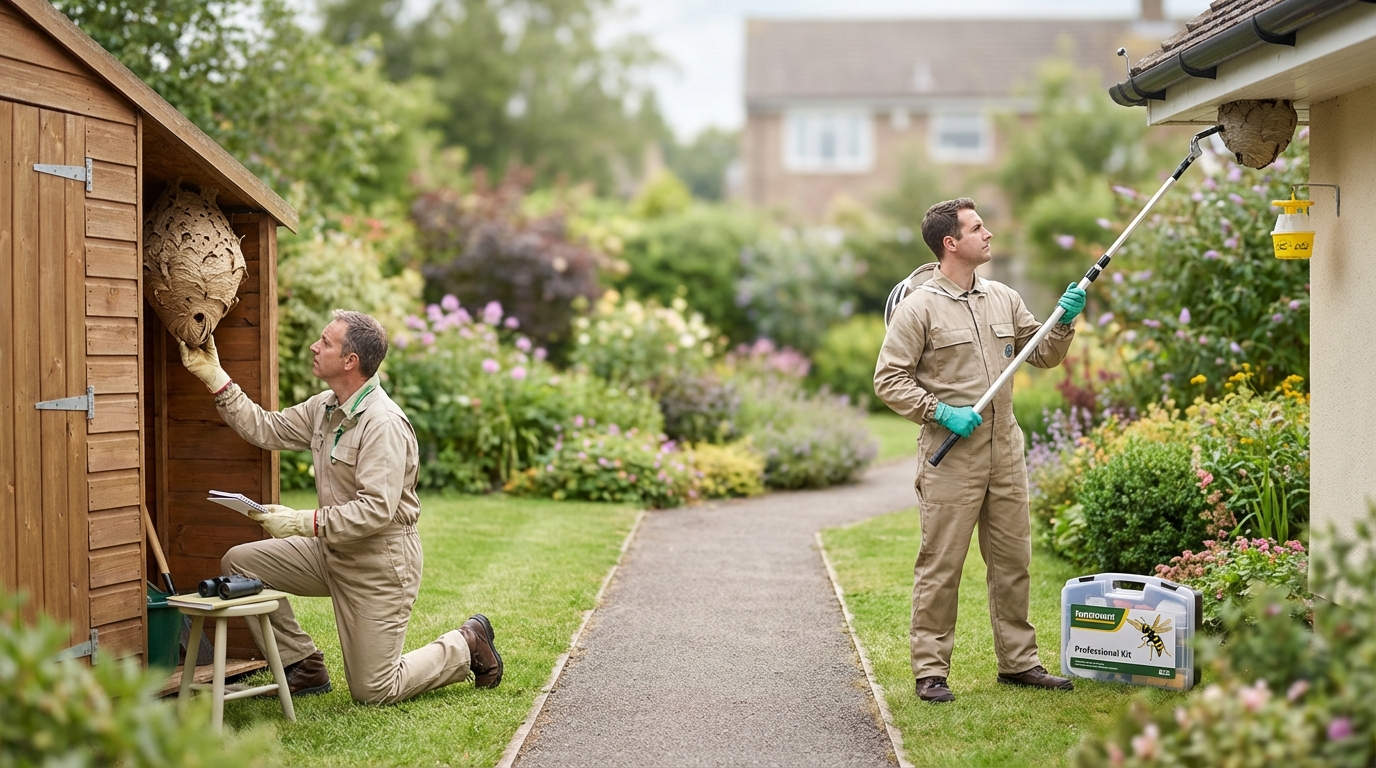
Insecticide products in supermarkets. Specific wasp spray cans with a range of 3 to 6 meters are available. Average price: between 8 and 15 euros. They may work on a small, accessible nest at the start of the season. But let's be honest: to kill wasps in the garden with this type of product, you need to target the nest entrance, ideally at dusk when all the workers have returned. One failed attempt, and you've got an angry swarm charging at you. Without a protective suit, this is a scenario you don't want to live through.
Powdered insecticides (permethrin-based, for example) are more effective on underground nests. They are applied at the entrance to the nest, and the wasps carry them inside by stepping on them. Results in 24 to 48 hours. It's less spectacular than an aerosol, but safer if you keep your distance after application. But beware: these products are not selective. They also kill any beneficial insects passing by, and contaminate the soil. For your garden's biodiversity, it's a compromise.
Call in a professional. The price of nest destruction varies according to region, accessibility and nest size. On average, you should expect to pay between 80 and 200 euros. It may seem expensive for «a few wasps», but the safety of the operation is priceless. A professional arrives fully equipped: full-body suit, appropriate biocidal product, height-access equipment if necessary. The job rarely takes more than an hour, including the nest.
When should you clearly call in an expert rather than go it alone? Here are the situations where there's no need to hesitate:
-
The nest is high up (roof, tree over 3 metres high)
-
The nest is more than 20 cm in diameter
-
If you suspect an Asian hornet nest
-
A person allergic to venom lives in the household
-
The nest is in a confined area (attic, shutter box, cavity wall).
A detail that's often overlooked: some communes or inter-communal organizations offer free or subsidized services, especially for the Asian hornet. Check with your local council before pulling out your credit card.
What about the «home remedies» you find on the Internet? Boiling water, smoke, putting a plastic bag over the nest at night... Forget it. These methods are dangerous, ineffective and expose you to multiple stings. Every year, we see people in emergency rooms after trying to get rid of wasps in their garden using DIY techniques. It's not excessive caution, it's common sense.
One last point: if you choose a professional, check that he or she is authorized to use biocides and provides you with a certificate of intervention. At Frelons.be, we intervene all year round, including in winter for residual Asian hornet nests. Because the fight against this invasive species doesn't stop in the summer.
Conclusion
A wasp nest in the garden doesn't have to be a catastrophe. Sometimes, it's even a boon for your vegetable garden and local biodiversity. The real question is not «should we destroy this nest?», but «does this nest represent a concrete danger to my family?».»
If the answer is no, let the colony live until autumn. If the answer is yes, or if you have the slightest doubt about the species (common wasp or Asian hornet), contact a professional. It's quicker, safer and often less expensive than the damage caused by a botched job.
Need advice or intervention? At Frelons.be, we're available all year round. Send us a photo of the nest, and we'll tell you within a few hours whether it's a wasp, hornet or something else, and advise you on the best course of action.
Frequently asked questions
When is the best time to destroy a wasp nest?
If you want to remove a bee-eater safely, it's best to act in winter when there's no movement around the nest.
How to get rid of a wasp nest in the garden?
The best solution is to call in an expert.
Is it possible to leave a wasp nest in the ground?
Yes, if the wasps pose no danger to you and don't bother you.
Why are there so many wasps in my garden?
Wasps are attracted to food and drink: they are particularly fond of meat and sweets. Make your garden as unattractive as possible to wasps by covering your food or putting it indoors.
 French
  English
  Dutch
Dutch
0 Comments