

A wasp nest in a roller shutter: What should you do, and how should you handle it?
Contents
A faint buzzing in the morning, a few insects flitting back and forth around the window—and then one day you roll up the shutter and, surprise: a swarm of wasps bursts out of the box. Sound familiar? A wasp nest in a roller shutter is one of the most common issues we encounter in residential pest control between June and September.
Things to remember
-
An in-depth analysis explaining the biological appeal of shutter boxes to hymenopterans, combined with a rigorous safety protocol to assess the need for professional intervention
-
Why do wasps nest in the shutter box?
-
Health risks and damage to the mechanism
-
How to Safely Remove a Wasp Nest
The problem is that this location is full of unpleasant surprises. You can’t see a thing, you can barely hear anything, and by the time you finally figure out what’s going on, the colony already numbers several hundred. Worse yet: the nest is right above your head, at window level, in a spot you handle every day.
In this article, I’ll explain why these insects love your shutter box, what real risks you face (both to your health and to your woodwork), and, most importantly, how to assess the situation before deciding whether you can handle it on your own or if you should call a pro. I don’t want to overreact, but I also don’t want to downplay the issue.
Why do wasps nest in the shutter box?
Put yourself in the shoes of a queen wasp for a second this spring. She’s just emerged from hibernation, she’s alone, and she’s looking for a place to establish her colony. Her criteria? A dry shelter, protected from the wind and rain, safe from predators, with a stable temperature. A roller shutter box checks absolutely all the boxes. It’s almost too good to be true for her.
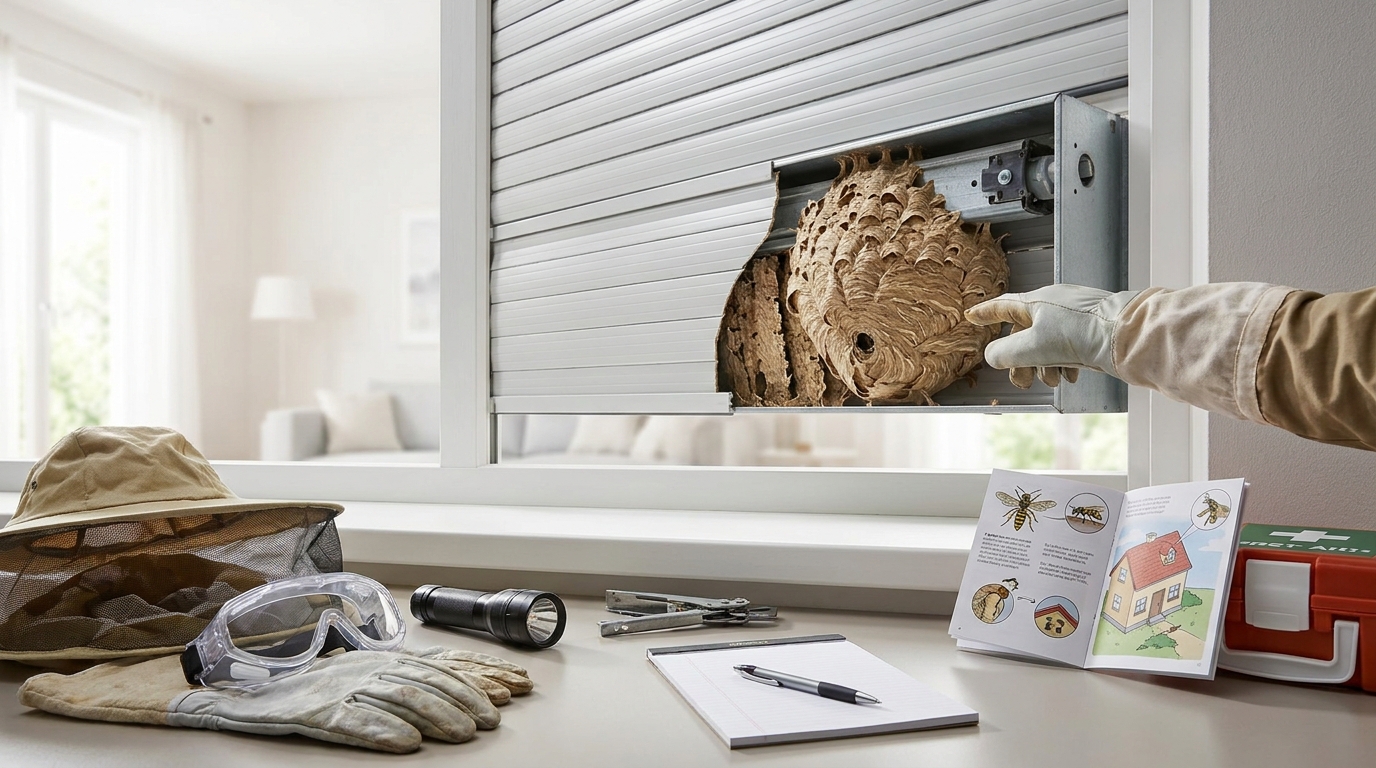
The species most commonly found in these situations is Vespula germanica, the German wasp, closely followed by Vespula vulgaris. These two are formidable opportunists. They don’t necessarily build their nests high up in a tree—they look for enclosed cavities. A shutter box, a hole in a wall, a disused electric meter. Anything that resembles a small, sheltered cave will do.
What makes the hive so attractive is what biologists call an ideal ecological niche. The size is perfect for starting a colony, the space fills up as the nest grows, and above all, there’s that famous thermal insulation. Modern cabinets are often filled with insulating foam or contain an air gap designed to trap the home’s heat. As a result, the temperature inside remains mild even on cool nights early in the season. A wasp nest inside a roller shutter therefore develops faster and lasts longer than a nest exposed to the elements.
There’s also the issue of building materials. Wasps build their nests from chewed wood fibers—a kind of papier-mâché. And they often find what they need right near your home: structural lumber, patio furniture, and weathered boards. The box then becomes a perfect logistical base, just a stone’s throw away from materials and food sources (your trash cans, your patio dining area, fruit that has fallen to the ground).
One final point that explains why we often wait too long to take action: access. Wasps enter and exit through the slits in the side panels or through the strap opening. A small gap of just a few millimeters is enough. You can’t see the nest; it grows out of sight, and you don’t notice the air traffic until the colony is already well established. That’s why a wasp in a roller shutter often goes unnoticed until mid-summer.
The Dangers: Health Risks and Damage to the Mechanism
Is it really dangerous to leave a wasp nest in a shutter? Yes, and for two reasons at once. Let's start with the most serious one: your health.
German wasps are defensive insects. As long as they aren’t disturbed, they go about their business. The problem is that roller shutters are operated daily. Every time the shutter is raised or lowered, the box vibrates, putting the colony on alert. And when a wasp feels threatened, it releases an alarm pheromone that triggers a collective response. This is the dreaded scenario of multiple stings: instead of a single sting, you end up with ten or twenty in a matter of seconds.
For a person without an allergy, a single sting is painful but harmless. The real danger is an anaphylactic reaction in sensitized individuals. According to data from ANSES and allergy centers, approximately 3 to 5 % of the adult population is allergic to hymenoptera venom, and wasp and hornet stings are responsible for several deaths from anaphylactic shock each year in France. The more stings there are, the greater the dose of venom injected—a real risk even for someone who isn’t allergic. If a nest is located near a child’s bedroom, caution is essential.
Let’s move on to property damage, which is often underestimated. A nest that grows larger eventually fills the entire space inside the housing. It presses against the shutter panel, the roll-up shaft, and the motor tube. In practical terms, this can cause the roller shutter motor to jam: the shutter curtain won’t go back up, or it forces against the nest’s structure until the mechanism burns out. I’ve seen electric motors fail simply because they’d been straining for weeks against a hardened mass of nest material.
And even after the nest has been treated, the problem isn’t over. Nest debris (dried papier-mâché, dead larvae, and worker carcasses) remains stuck in the mechanism. These residues attract other pests, including moths, dust mites, and sometimes dermestid beetles, which feed on the carcasses. They can also jam the track or throw the roller blind out of balance. A thorough cleaning of the box after service is therefore not a luxury—it is an essential step to restore the shutter to normal operation.
In short, between health risks and mechanical risks, letting the situation drag on almost always costs more than taking swift action.
Field Guide: How to Safely Remove a Wasp Nest
The first question you should ask yourself is: Is the nest small and new, or is it already well-developed? An early-season nest—about the size of a golf ball with just a few wasps—is still manageable. A nest that’s been there for weeks, with heavy traffic at the entrance to the nest box, requires professional pest control. Don’t try to be a hero in this type of situation.
If you do decide to remove a small nest yourself, protective gear is not optional. You’ll need thick clothing that fully covers your body, long gardening gloves, a hood or beekeeper’s veil, and full-face safety goggles. If even a single patch of skin is exposed, you’re putting yourself at risk. Wasps primarily target the face and hands.
The timing of the intervention is crucial. When should you destroy a wasp nest? The answer is clear: at dusk or early in the morning, when it’s cool. At these times, nearly the entire colony has returned to the nest and activity is at its lowest. The wasps are lethargic and less responsive, and you’ll minimize the number of wasps outside that are ready to attack you. Never attempt to remove a nest in the middle of the day under the sun—that’s the worst time to do it.
In terms of the product itself, powdered insecticide is significantly more effective than an aerosol for this type of cavity. Why? The powder settles at the entrance to the cavity and on the walls. The worker wasps carry it back to the center of the nest as they move about, gradually contaminating the entire colony, including the larvae and the queen. A simple spray insecticide kills the visible wasps but often misses the heart of the colony hidden deep inside. Spray the powder directly into the entrance hole, then step back and let it work for several days before checking to make sure there’s no activity.
That said, let’s be honest: destroying a wasp nest inside a roller shutter box is rarely a good idea to do on your own once the nest exceeds a certain size. The confined space, the height, the difficulty of access, and the risk of driving the colony into your home make this a tricky operation. A professional pest control technician has the right equipment (telescopic pole, professional powder dispenser, certified protective suit), can identify the species, pinpoint the nest’s exact location, and eliminate the colony without putting your family at risk. The cost of a service call generally ranges from 70 to 150 euros—a pittance compared to replacing a garage door opener or a trip to the emergency room.
One final tip: whatever you do, don’t block the entrance to the hive in an attempt to trap the wasps. They’ll look for another way out, and that way out will most likely be inside your house. Treat the hive first, then seal it off—never the other way around.
Conclusion
A wasp nest in the box of a shutter is never something to take lightly. The location is too attractive to these insects, too close to you, and too likely to damage your shutter mechanism for you to ignore the problem. The longer you wait, the larger the colony grows, and the riskier and more expensive the repair becomes.
Assess the size of the nest, work during the appropriate times (at night or in the early morning), and if you have even the slightest doubt about your safety, don’t hesitate for a second: call a pest control professional. At Pest Patrol, we handle this kind of situation almost every day during peak season, and believe me, a nest caught early can be taken care of in just a few minutes. Contact us for a quick assessment before the colony takes over the entire space.
Frequently asked questions
How can you tell if there's a nest inside the shutter box?
A buzzing sound coming from the trunk and wasps regularly entering through a crack or opening are the main signs. Sluggish operation, an unusual noise, or a jammed trunk lid may also indicate that the nest is interfering with the mechanism.
Can we continue to use the roller shutter?
It is best not to handle it any further. Every movement causes vibrations that could alert the colony and trigger an attack. Forcing the shutter open can also damage the apron, the winding shaft, or the motor.
Can wasps get into the house through the shutter?
Yes. They can enter through the strap slot, a crack, or an opening inside the box. Close the affected window and seal off the room if necessary. Do not open the box from the inside while the nest is active.
Should we block the opening of the box?
No. By blocking their exit to the outside, you risk driving the wasps back into the house. The entrance should only be sealed after the nest has been completely eliminated and you have verified that there is no further activity.
Do I need to take the shutter apart to remove the nest?
Not always. The treatment can often be applied through the external entry point. The box is opened after neutralization only if the nest needs to be removed, if debris is interfering with the mechanism, or if repairs are necessary.
How much does it cost to treat a nest in a roller shutter?
The cost generally ranges from €70 to €150, depending on the height, accessibility, and size of the nest. Cleaning the box or repairing the mechanism may be billed separately. Ask for a clear price quote before the service is performed.
 French
  English
  Dutch
Dutch
0 Comments