
Wasp Nest in Overijse: How Does the Removal Process Work?
Contents
A nest the size of a soccer ball under the eaves, a dozen wasps buzzing around the patio, and summer becoming unbearable. Sound familiar? In Overijse—and throughout the Druivestreek—this is a common occurrence from July through September. Calls are pouring in, and most people don’t know who to turn to anymore now that the fire department has stopped responding to these calls.
Things to remember
-
An ultra-local look at a typical response in Overijse, combining on-the-ground accounts from the Druivestreek with practical tips for distinguishing between species, while explaining why local firefighters no longer respond to calls
-
Understanding the Presence of Wasps and Hornets in Overijse
-
How Professional Nest Removal Works
-
Guide to Rates and Procedures for Residents of Overijse
Let's be clear: trying to destroy a nest yourself with a can of insecticide bought at the supermarket is the best way to end up in the emergency room. A wasp that feels threatened will sting, and it'll call in its friends. I've seen people get stung fifteen times in thirty seconds.
In this article, I’ll explain what a typical service call at your home in Overijse entails. What we do, what equipment we use, how much it costs, and why it’s better to call a wasp exterminator in Overijse than to wait for the problem to go away on its own. Because it won’t go away on its own.
Understanding the Presence of Wasps and Hornets in Overijse
Overijse is a region of vineyards and grape greenhouses. Lots of greenery, lots of fruit, and lots of sugar in the air in late summer. In other words, it’s an open-air buffet for wasps. That’s why the Druivestreek sees such a large number of these pests every year.
But not all wasps are alike, and that's where it gets interesting. There are mainly two species of wasps found in our gardens: the common wasp (Vespula vulgaris) and the German wasp. These are the ones that buzz around your glass of lemonade and your pastries. Small, yellow and black, and aggressive when you approach their nest. Then there are the hornets. First, the European hornet—larger, more imposing, but honestly much calmer than people think.
In fact, one question comes up all the time: Should we kill European hornets? No. Absolutely not. The European hornet is a natural predator; it eats flies, caterpillars, and other wasps. It only stings if directly attacked. Killing them for no reason means depriving yourself of a free ally. Unless the nest is right next to your front door, leave it alone.
The real problem today is the Asian hornet. In Overijse, as everywhere else in Belgium, its population is growing year by year. It’s easy to recognize: yellow legs, black thorax, and a single orange stripe on the abdomen. In Belgium, this Asian hornet attacks beehives and decimates bee populations. Its nests, often perched high up in trees, can grow to the size of a large gym bag. It’s a pest that should be reported, and destroying its nests requires real expertise.
When it comes to their life cycle, understanding their rhythm helps you take action at the right time. In the spring, a single queen establishes the nest. In the summer, the colony explodes in size and can number several hundred individuals. That’s when you see them everywhere. In the fall, the colony dies off; only the future queens survive to overwinter. In other words: the longer you wait, the bigger the nest gets, and the more difficult it becomes to deal with. Acting early makes the process much simpler.
How Professional Nest Removal Works
You call, we come. That's the short version. But between the call and the destroyed nest, quite a lot happens—and every step is important for your safety and ours.
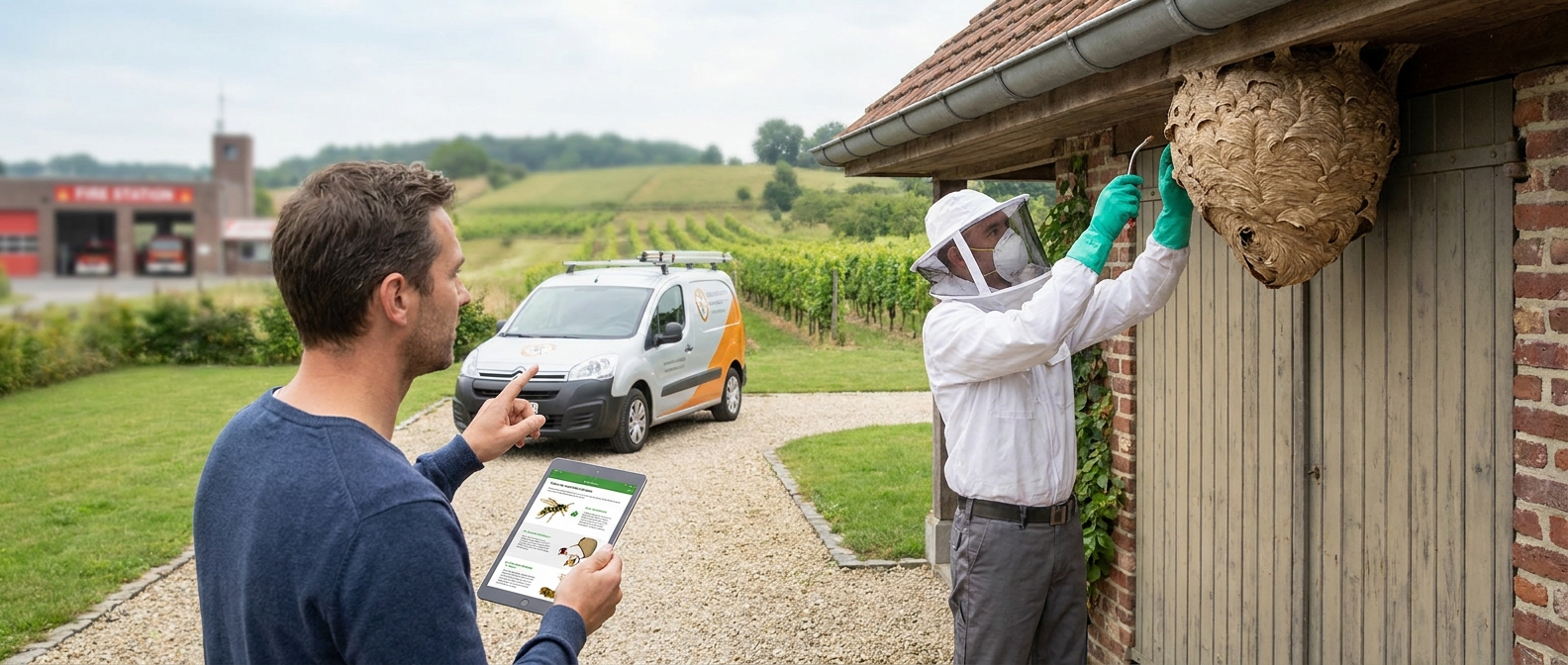
The first step on site is to identify the species and pinpoint the exact location of the nest. A wasp nest inside a shutter box is not handled the same way as an Asian hornet nest ten meters up in a linden tree. We observe the comings and goings, pinpoint the entrance, and assess the size of the colony. This on-site assessment determines everything else: the product, the technique, and the angle of approach.
Next, protective gear. And here, there can be no compromises. A thick, full-body suit specifically designed for wasps and hornets, with a protective face veil, reinforced gloves, and boots. It’s not the little beekeeper’s suit you see on TV. Asian hornets can sting through ordinary fabric—their stingers are long. The professional suit, on the other hand, can take the hit. That’s what lets you work calmly, even just a few centimeters away from an agitated colony.
The treatment itself depends on the situation. In most cases, a powdered insecticide is injected directly into the nest, at the source. The powder spreads, the workers carry it back to the heart of the colony, and everything dies within a few hours. For nests high up, we use a telescopic pole that allows us to reach eight to ten meters without climbing. For nests inside a wall or a chimney, we adapt our approach, sometimes using an endoscope to see what we’re doing.
Once the nest has been neutralized, remove everything that’s accessible. An empty nest left in place can attract other insects the following year, and no one wants to keep that “trophy” under their gutter. A good wasp exterminator in Overijse doesn’t just spray and leave—they make sure the colony is truly dead before considering the job done.
How should you react while waiting for help to arrive? It’s simple. Above all, do not block the entrance to the nest—this makes the wasps furious, and they’ll look for another way out… often into the house. Keep your distance, close any nearby windows, and keep children and pets away. The rest is up to us.
Guide to Rates and Procedures for Residents of Overijse
«But why don’t the firefighters come anymore?» That’s the first thing people ask me. The answer is administrative: the Flemish Brabant emergency services district, like most districts in Belgium, no longer handles wasp and hornet nests unless there is an immediate danger to a vulnerable person or a public place. The Overijse Fire Department focuses its resources on life-threatening emergencies. For a nest in your yard, you’ll need to hire a private professional. It’s been that way for several years now.
Let’s get to the thorny issue: the price. How much does wasp nest removal cost? For a standard service call in Overijse, you can generally expect to pay between 80 and 150 euros. The cost of removing a wasp nest depends on several factors: the height and accessibility of the nest, the species involved, and the urgency of the request. A nest that’s easily accessible under a deck will cost less than an Asian hornet nest that needs to be treated with a pole from the top of a tree.
Be wary of prices that are too low online. A true professional brings expensive equipment, a professional-grade suit, an approved product, and insurance. The price of wasp extermination reflects all of that. A «specialist» charging 40 euros is often just someone who sprays a can of insecticide and hopes it works. The result: the nest comes back, and you end up paying twice.
One plus: we’re available 7 days a week. Wasps don’t take weekends off, and a nest discovered on a Sunday morning can quickly ruin a family barbecue. Most service calls in Overijse are handled the same day—or even within hours of the call, if it’s urgent. Speed is what sets a local service apart from a big company that schedules you for three days later.
In practical terms, the process consists of three steps. You call and describe the situation (where the nest is located, its approximate size, and the species, if you know it). We’ll give you a price estimate over the phone and a time slot. We’ll come out, take care of the problem, and you’ll pay once the work is completed and inspected. No unpleasant surprises, no hidden fees.
One last thing about the Asian hornet: if you spot a nest, please report it. Its presence in Overijse and throughout the Druivestreek is being closely monitored because of the threat it poses to bees. A pest control professional experienced with this species will know how to handle it properly and, when necessary, pass the information on to the appropriate authorities.
Conclusion
A wasp or hornet nest won’t disappear on its own before fall, and by then it will have had time to grow and ruin your summer. The good news is that a professional can solve the problem in a single visit—cleanly and safely for you. Whether it’s a single wasp in Overijse or a nest of Asian hornets perched in a tree, there’s a quick, local solution.
Do you live in Overijse, Hoeilaart, or Huldenberg and have you spotted a nest? Don’t wait until it doubles in size. Contact Frelons.be for prompt service, 7 days a week, anywhere in the Druivestreek. We identify, secure, and remove the nest. You’ll have your garden back.
Frequently asked questions
Why don't the firefighters in Overijse respond to calls about wasp nests anymore?
The Flemish Brabant Emergency Services has revised its priorities to focus exclusively on life-threatening emergencies. In Overijse, firefighters no longer respond to reports of wasp and hornet nests on private property, except in cases of immediate danger (such as in a public place or where a vulnerable person is present). To remove a nest from your yard or under your roof, you must now hire a professional private pest control company.
How much does it cost to remove a wasp nest in Overijse?
The cost of removing a wasp nest in Overijse generally ranges from €80 to €150. This price varies depending on several factors:
Accessibility: A nest under an overhang or at the top of a tree requires more equipment than a nest under a deck.
The Species: Treating an Asian hornet nest requires specialized equipment.
Emergencies: Rapid response calls on weekends or holidays may affect the cost.
What should you do while waiting for the wasp exterminator to arrive?
If you've spotted a nest near your home in the Druivestreek, here are three safety precautions to take:
Never block the entrance to the nest: The wasps will get agitated and look for another way out, often into your house.
Keep your distance: Keep children and pets away, and close any nearby windows.
Don't try to destroy it yourself: Supermarket bombs cause massive damage and multiple injuries.
How can you identify the Asian hornet in Overijse?
The Asian hornet is an invasive and harmful species that is very common in the Overijse region. You can easily recognize it by the following characteristics:
It is darker than the European hornet.
Its thorax is entirely black.
Its legs have bright yellow tips (hence its nickname, the yellow-legged hornet).
Its abdomen has only one large orange ring toward the rear.
If you suspect their presence, their eradication requires urgent professional expertise to protect local beehives.
How long does it take to destroy a wasp nest?
Once our technician has injected the professional-grade powdered insecticide directly into the heart of the nest, the colony is usually eliminated within a few hours. Worker ants returning to the nest become coated with the powder and spread it to the rest of the colony. We’re available 7 days a week in Overijse and the surrounding areas (Hoeilaart, Huldenberg) to resolve your problem the same day.
 French
  English
  Dutch
Dutch
0 Comments