
Asian hornet in Vilvoorde: Intervention and reporting guide
Contents
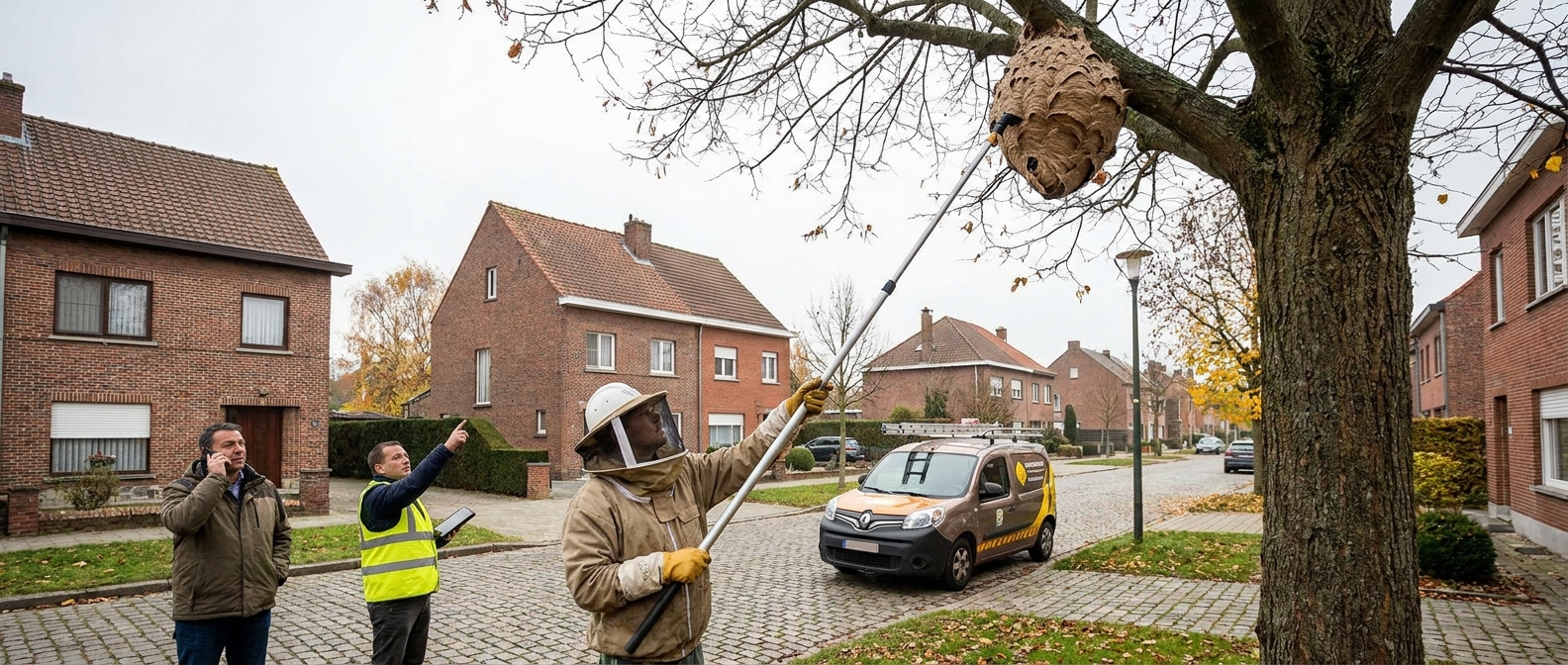
Last summer, a resident of Vilvoorde's Kassei district noticed an unusual influx of insects near his garden shed. Large, dark insects with a distinctive orange head. Within two weeks, the nest had grown to the size of a football. The Asian hornet, or Vespa velutina, is no longer a phenomenon confined to southern Belgium. It's well established in Vilvoorde, and every year the number of reports increases.
What to do when you discover a nest in your home or neighborhood? Who should I call first? How much does it cost? This guide answers these practical questions, with local contacts and procedures that really work for residents of the 1800 zip code.
Things to remember
-
The story of an ultra-local intervention in Vilvoorde combined with a practical guide
-
The article sets itself apart by humanizing technical intervention through a precise geographical focus (Vilvoorde neighborhoods) while centralizing official reporting links and private destruction solutions available 7/7.
-
Identifying and reporting an Asian hornet nest in Vilvoorde
-
Firefighters or private experts?
Identifying and reporting an Asian hornet nest in Vilvoorde
Before you pick up the phone, you need to be sure of what you're looking at. The Asian Hornet is quite easily distinguished from the European Hornet if you know what to look for. Its body is predominantly black, with a single orange segment on the abdomen. Its legs are yellow at the tips, earning it the nickname «Yellow-legged Hornet». The head is orange when viewed from the front. If the insect you're looking at is more reddish-brown with a yellow-striped abdomen, it's probably a European hornet, which is less of a problem.
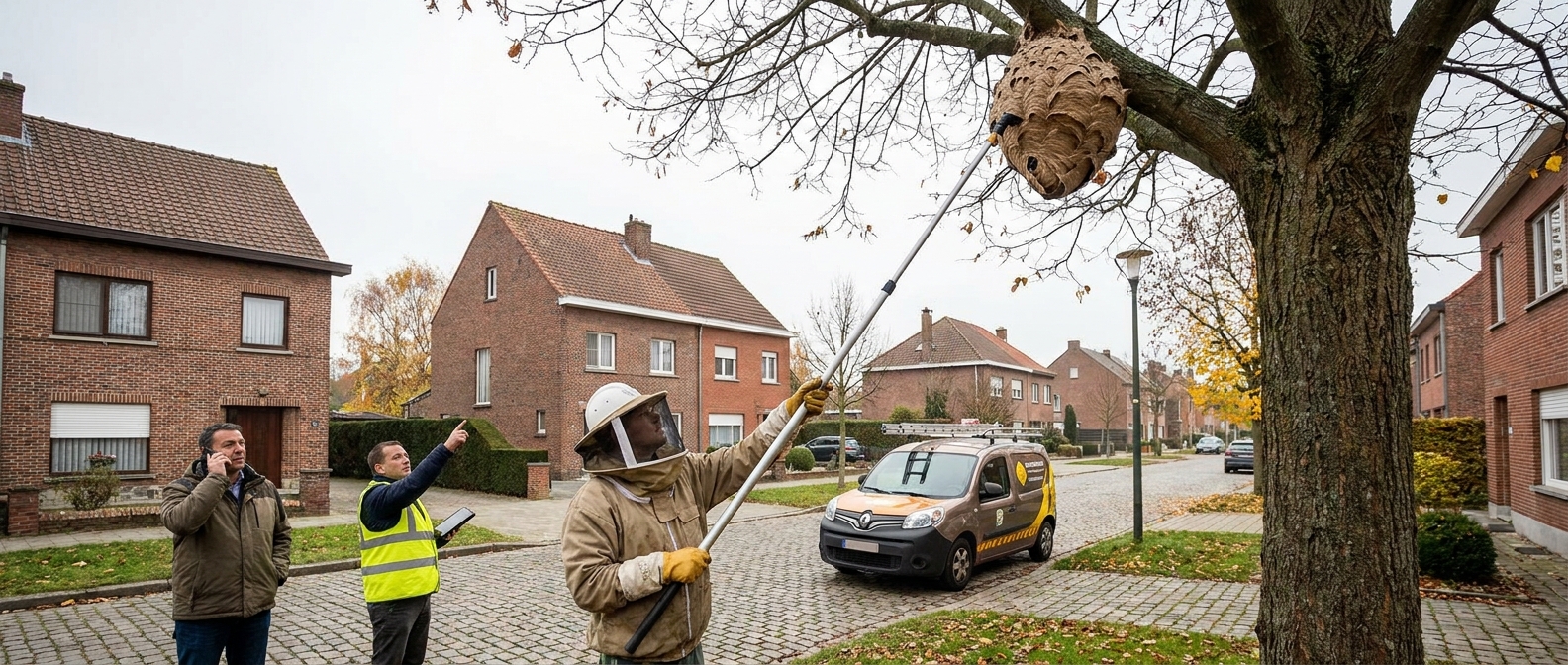
Recognizing the Asian hornet is one thing. Finding the nest is quite another. Primary nests, those that appear in spring, are often small (like a tennis ball) and hide in sheltered places: under an eaves, in a gas meter, behind a roller shutter. Secondary nests, on the other hand, appear in summer and can become enormous, sometimes 80 cm in diameter, often perched high in trees. In Vilvoorde, they are regularly found along the canal, in residential areas close to the Drie Fonteinen park, and also on the Koningslo side where the vegetation is dense.
As soon as you think you've spotted an Asian hornet or a nest, the first thing to do is report it via Vespa-Watch. This is the official platform in Belgium, managed by the Royal Institute of Natural Sciences. You take a photo (without getting too close, of course), upload it to the site or app, and experts validate the identification. It's free, fast, and feeds the national map of sightings of Vespa velutina in Vilvoorde and throughout Belgium.
Why report a hornet in Belgium via this platform rather than simply calling an exterminator? Because each report allows us to map the progress of the species and coordinate the destruction of the beetles. The municipality of Vilvoorde uses this data to prioritize interventions. Without a report, the nest remains invisible to the authorities.
An important point: never try to destroy a nest yourself. No fire, no boiling water, no commercial insecticide sprays. An Asian hornet nest can contain several hundred individuals, and a poorly managed attack can lead to aggressive swarming. Multiple stings are dangerous, even for non-allergic people. Every year in Belgium, people end up in emergency wards for trying to deal with the problem on their own.
If you're not sure of the species, take the photo anyway and report it. The experts at Vespa-Watch in Belgium usually respond within a few hours. Better a false report than an active nest that goes under the radar for an entire summer.
Nest removal in Vilvoorde: Firefighters or private experts?
It's the first question on everyone's mind: who to contact in the event of hornets? The answer depends on the situation and, let's be honest, your patience.
The Vilvoorde fire department (Flemish Brabant rescue zone) is involved in destroying Asian hornet nests. This has been part of their mission since the species was classified as invasive. To contact them, use the non-emergency number 1722 or directly via the rescue zone. The advantage: the intervention is often free or at reduced cost when it involves Vespa velutina. The drawback: delays. At the height of the season, between July and October, the Vilvoorde fire department is swamped with requests. You can expect to wait one or two weeks. For a nest high up in a tree at the bottom of the garden, that's fine. For a nest next to the front door or near a school, it's too long.
This is where a pest exterminator specializing in the 1800 area comes into its own. At hornets.be, we work 7 days a week, including weekends and public holidays. When a Schaarbeeklei resident calls us on a Saturday morning because he's got a nest under his terrace, we don't tell him to call back on Monday. We're on our way.
The destruction of a hornet's nest in Vilvoorde follows a precise protocol. The operator arrives in a full-body suit, precisely locates the nest, and injects a biocide directly inside. For high nests, telescopic poles are used, enabling the operator to reach up to 25 meters without the need for a gondola. The product takes effect within a few hours: hornets returning to the nest are also eliminated. We generally return within 48 hours to check that activity has ceased.
A question that often comes up: why not just kill the hornets one by one? Because there's no point. A queen lays up to 300 eggs a day at the height of the season. Eliminating a few workers doesn't change the dynamics of the nest. The only effective solution is to destroy the nest itself, targeting the entire colony.
Another point that people don't always realize is that a nest abandoned in autumn will not be reused the following year. Asian hornets build a new nest every spring. So if you discover an old, empty nest in winter, don't panic - it won't become active again. However, it does mean that a founding queen is roaming around somewhere in the area and will be looking for a new location from March-April onwards.
To put it simply: if the nest is accessible and the situation is not urgent, try the Vilvoorde fire department first. Dangerous nest, urgent situation or need for rapid intervention, call a private professional like hornets.be. Both options are legitimate, they just meet different needs.
Rates and security: Your year-round protection in Vilvoorde
How much does it cost to destroy a hornet's nest? Let's not beat around the bush. The price of destroying a hornet's nest varies according to several factors: the height of the nest, its accessibility, and the time of the intervention (a Sunday evening costs more than a Tuesday morning, logically). For a standard job in Vilvoorde, expect to pay between 90 and 150 euros. A very high nest, requiring special equipment, can cost up to 200 euros. At hornets.be in Vilvoorde, we announce the price before we intervene. No surprises on the bill.
Some municipalities in Belgium reimburse part or all of the cost of destroying Asian hornets. Contact the Vilvoorde environmental department to find out if such a scheme exists. Policy varies from year to year, but the trend is towards financial support given the scale of the problem.
On the question of safety, let's be clear. The Asian hornet is no more aggressive than the European hornet when left alone. The problem is proximity to a nest. At a distance of less than 5 meters, the nest's sentinels perceive any movement as a threat and go into defense mode. Stings are painful (much more so than a wasp) and the venom can cause severe reactions in allergy sufferers. Even in the absence of allergy, more than 10 simultaneous stings may require hospitalization.
Where exactly is the Asian hornet found in Vilvoorde? Just about everywhere, in fact. The areas most affected in recent years have been residential areas with mature gardens: Koningslo, the banks of the Zenne and the area around the railway station. Hornets are particularly fond of fruit trees and dense hedges. If you have an orchard or an open composter, you are statistically more exposed.
Frelons.be works in Vilvoorde all year round, not just in summer. In spring, we destroy the primary nests, those built by the founding queens between March and May. These small nests are easy to treat, and their early elimination prevents the formation of a colony of several thousand individuals in summer. Emergency hornet control in spring is ten times less complicated than in August.
In autumn and winter, we remain mobilized for late reports and monitoring. We also advise individuals on the use of selective traps, to be set up in February-March to capture founding queens before they create new nests. These traps do not replace professional intervention, but they do reduce the pressure locally.
One last practical tip: save the hornets.be number in your telephone. That way, the day you come across a nest, you won't have to waste time looking for someone to call. And if you're not sure about identification, just phone in a photo and we'll tell you in a few minutes whether it's an Asian hornet or something else.
Conclusion
The Asian hornet is now a reality in Vilvoorde, in every neighborhood. The good news is that solutions are available and accessible. Report every sighting on Vespa-Watch to feed the national monitoring system. For fast, safe pest control, contact hornets.be: we intervene in the 1800 area every day of the year, with a price announced in advance and a protocol that protects your family and neighbors. Don't wait for a nest to become unmanageable. The sooner we act, the easier it is.
Frequently asked questions
How to recognize an Asian Hornet from a European Hornet in Vilvoorde?
The Asian Hornet is predominantly black with a single orange segment on the abdomen and yellow-tipped legs, while the European Hornet is more reddish-brown with yellow stripes. From the front, the Asian Hornet also has a distinctive orange head.
Where do Asian hornet nests usually hide in Vilvoorde?
In spring, small primary nests hide under eaves, in meter boxes or shutters. In summer, secondary nests (up to 80 cm) develop high up in trees, particularly near the canal, the Drie Fonteinen park or in Koningslo.
How do I report an Asian hornet nest in Vilvoorde?
As soon as you spot a nest or a specimen, take a photo from a safe distance and upload it to the official Vespa-Watch platform. Experts will validate the identification within a few hours, enabling the municipality of Vilvoorde to map and prioritize interventions.
Should I call the Vilvoorde fire department or a private expert like hornets.be?
The fire department of the Flemish Brabant rescue zone responds, but can take up to one or two weeks in high season. For an urgent intervention or a dangerous nest, a private expert like hornets.be will eliminate the colony 7 days a week (including weekends) anywhere in the 1800 zip code.
How much does it cost to destroy a hornet's nest in Vilvoorde?
The price of a standard pest control service generally varies between 90 and 150 euros, and can rise to 200 euros for very high nests requiring 25-meter telescopic poles. Don't forget to contact the Vilvoorde environmental department, as some municipalities reimburse part of the cost.
What should I do if I find an empty hornet's nest in winter?
A nest abandoned in autumn will never be used again, so there's no need to panic if you discover it in winter. On the other hand, it indicates that a founding queen is overwintering nearby and will be looking for a new location in your neighborhood from March onwards.
 French
  English
  Dutch
Dutch
0 Comments