
Hornets in Overijse: What to do and who to call about a nest
Contents
-
Quick access: identification and safety reflexes at Overijse
-
Chronicle of an intervention: neutralizing a hornet's nest in Overijse
-
Practical guide: reporting, rates and local emergency contacts
Last summer, a resident of Jezus-Eik discovered a grayish ball the size of a soccer hanging under the eaves of his roof. At first, he thought it was a classic wasp nest. Except that the insects flying in and out were bigger, darker, with conspicuous yellow legs. It was an Asian hornet's nest, and it had been active for several weeks without anyone noticing.
Things to remember
-
This article immerses us in a real-life intervention in Overijse, transforming a concrete case into a practical guide.
-
It fills the gap in local information by combining safety advice, reporting procedures and technical expertise in the field.
-
identification and safety reflexes at Overijse
-
neutralizing a hornet's nest in Overijse
This kind of situation is becoming increasingly common in Overijse and neighboring municipalities. The Asian hornet has settled in Belgium, and has no intention of leaving. Faced with this situation, many people don't know what to do: can you destroy the nest yourself? Who should you warn? How much does it cost? This article gives you concrete answers, based on real-life experience in your local area, so you know exactly what to do if it happens to you.
Quick access: identification and safety reflexes at Overijse
First thing to do when you spot a large flying insect in your garden in Overijse: don't panic, just observe. Confusion between European hornets, Asian hornets and large wasps is extremely common. And the distinction counts, because the steps to be taken are not at all the same.
The Asian hornet (Vespa velutina) is easy to recognize once you know what to look for. Its body is predominantly black, with a single orange abdominal segment. Its legs are yellow at the tips, giving it a very different look from the European Hornet, which is more red and yellow with an orange head. The Asian hornet is also slightly smaller than its European cousin: around 2.5 to 3 cm for a worker. Another clue: they often hover in front of beehives, their favorite prey.
Is an Asian hornet sting dangerous? Let's be clear: for most people, a single hornet sting is no more serious than a wasp sting. It hurts, it swells, but it passes. The real danger of a hornet sting lies in two specific cases: people allergic to hymenoptera venom (and they don't always know it until the first severe reaction) and multiple stings. A disturbed nest can trigger a mass attack, and even in the absence of allergy, the massive injection of venom can cause shock. Cases of hospitalization after 10 to 15 simultaneous bites are documented every year in Belgium.
So, what should you do if you suspect the presence of a hornet in Overijse?
-
Keep your distance. If you spot a nest, move at least 5 metres away. Asian hornets are not aggressive by nature, but they do defend a perimeter around their nest. This perimeter varies according to the size of the colony.
-
Don't try anything yourself. No water jets, no sticks, no fire. Every year, people end up in emergency wards because they tried to deal with the problem on their own. The nest can contain several hundred individuals, sometimes more than a thousand at the end of the season.
-
Secure the area. Warn your neighbors, and keep children and pets away. If the nest is close to a high-traffic area (terrace, house entrance, playground), restrict access while waiting for intervention.
-
Note the exact location. Height, support (tree, roof, hedge, ground), approximate size. This information is invaluable for the professional who will intervene.
An often overlooked detail: why not kill a lone Asian Hornet by stomping it? When a hornet is crushed, it releases an alarm pheromone that can attract other hornets. If the nest is nearby, you run the risk of doing exactly what you wanted to avoid. It's better to let them go and look for where they've come from to locate the nest.
Some people also ask what scent the Asian Hornet hates. We read a lot about burnt coffee, cloves or citronella. Frankly, these repellents have no proven effect on an established colony. They may keep an isolated individual away from your dining table, but they'll never solve a nesting problem. The only reliable solution is professional destruction.
Chronicle of an intervention: neutralizing a hornet's nest in Overijse
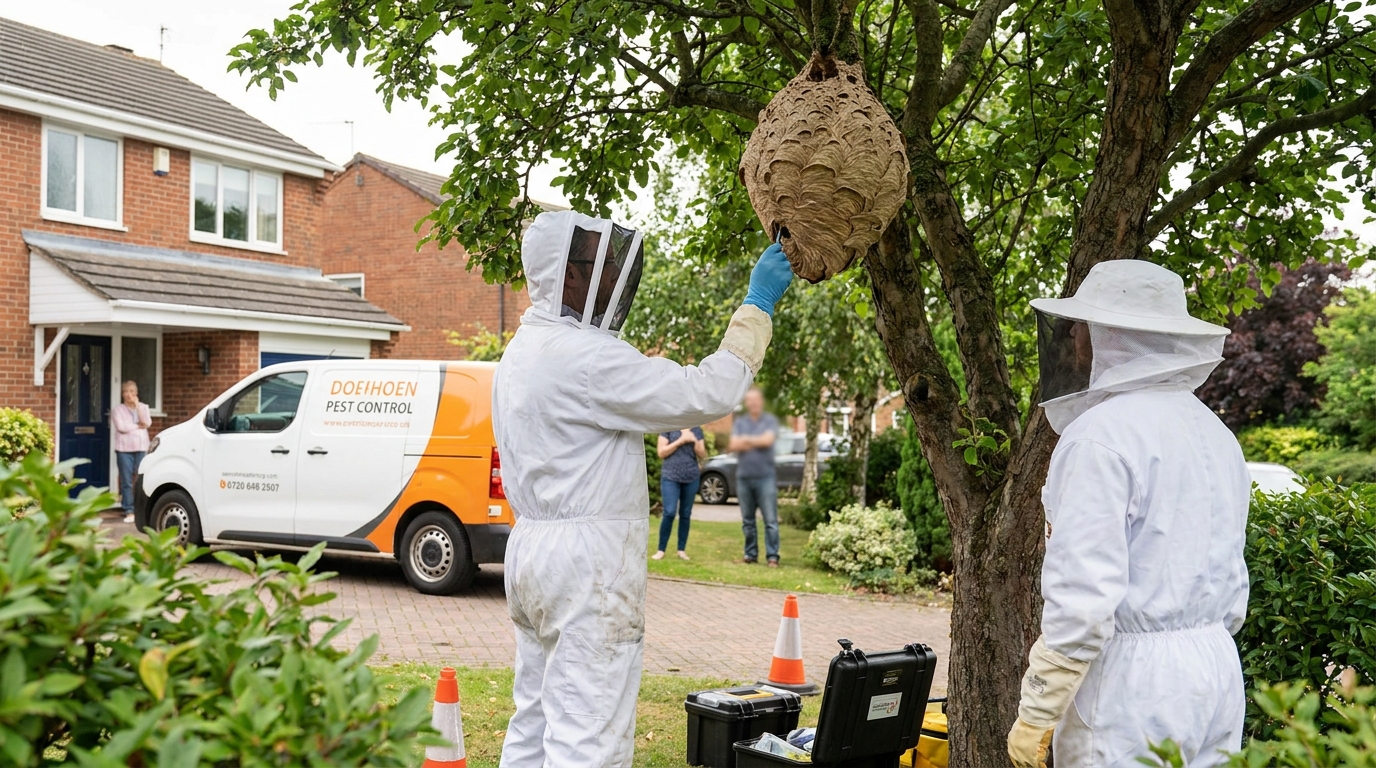
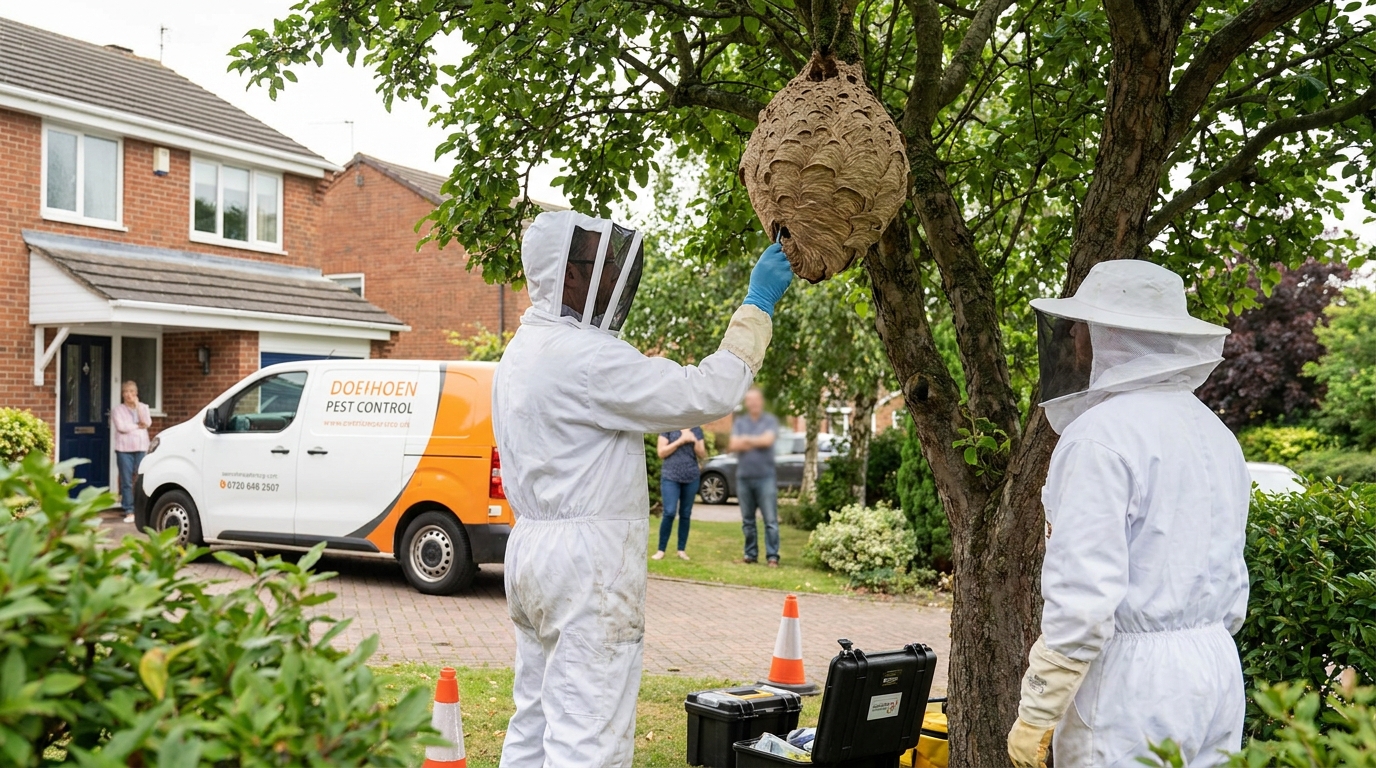
June 2024, residential area between Overijse and Hoeilaart. A couple contacted us after noticing a suspicious coming and going in their laurel hedge, about two meters high. At first they thought it was wasps, but on closer inspection (from a distance, in fact, and that's good), they recognized the characteristic yellow legs. An Asian hornet in Overijse, confirmed by photo.
The operation was scheduled for early the next morning. Why early? Because at dawn, almost the entire colony is still in the nest. Intervening in the middle of the day means running the risk of hundreds of workers flying back to a destroyed nest, creating a cloud of disorientated, aggressive insects for hours on end.
Our hornet exterminator arrived equipped with a full anti-sting suit (not just a beekeeper's veil, a real reinforced suit), a telescopic pole and a specific biocide approved in Belgium. The procedure for destroying a hornet's nest in Overijse follows a precise protocol:
-
On-site assessment. We check the size of the nest, its accessibility, and the presence of people or animals nearby. In this case, the nest was around 40 cm in diameter, corresponding to a colony of 300 to 500 individuals.
-
Product injection. The biocide is injected directly into the nest entrance via the percher. The product takes effect within a few minutes on any hornets present, and continues to work on those returning to the nest in the following hours.
-
Nest removal. Once the activity has stopped, the nest is unhooked and removed. This is a step that some service providers neglect, but it's essential: a nest left in place, even if treated, can attract other insects or worry residents unnecessarily.
-
48-hour check. We iron to ensure that no residual activity remains. Occasionally, a few workers who were in flight at the time of treatment will try to rebuild. It's rare, but it happens.
The whole operation, from the moment the exterminator got out of his vehicle to the removal of the nest, took around 45 minutes. The couple were able to enjoy their garden the following day without any risk.
What you need to understand is that destroying a hornet's nest in Overijse is not a trivial operation. Even a seemingly small nest can be home to a well-developed colony. Asian hornets sometimes build a primary nest (small, in spring) before migrating to a larger secondary nest in summer. If you find a nest the size of a tennis ball in April or May, it's the ideal time to intervene: the queen is often alone or with very few workers. The longer you wait, the more complex and costly it becomes.
A technical point that often comes up: is the treatment harmful to other insects, such as bees? The biocides used by a qualified hornet exterminator are targeted and applied directly to the nest. There is no dispersal into the environment, as with commercial insecticide sprays. This is one of the reasons why consumer products should never be used: they are less effective on hornets and much more harmful to other fauna.
Practical guide: reporting, rates and local emergency contacts
You've spotted an Asian hornet or a suspicious nest in your garden in Overijse, Jezus-Eik or Hoeilaart. Here's exactly what you need to do, step by step.
Report an Asian hornet in Belgium is a simple but important step. Every sighting counts for the monitoring of the species on the territory. You can report your sighting on the iNaturalist or via the vespawatch.be, managed by the Royal Belgian Institute of Natural Sciences. A photo is all that's needed, ideally with the insect visible in profile or from the front. Experts validate the identification within a few hours. Reporting does not automatically lead to action, but it does feed the national mapping system, and can trigger action if the nest is located.
For the commune of Overijse specifically, you can also contact the commune's environment department. Some municipalities in Brabant have a budget to contribute to the cost of destroying Asian hornet nests (not wasps or European hornets, only hornets). Vespa velutina). Please contact your local authority directly to find out whether Overijse currently offers a subsidized service.
What can we expect in terms of pricing? The cost of destroying a hornet's nest varies according to several factors: the height of the nest, its accessibility, and whether or not special equipment is required (cherry picker, high-rise ladder). For a nest less than 10 metres away, you should expect to pay between 80 and 150 euros on average. A high nest, in a tree 15 or 20 meters away, can cost 200 or 250 euros if a gondola is required. These prices generally include travel, treatment and removal of the nest.
Beware of scams. We regularly see online ads offering nest destruction at very low prices, then the rate explodes once on site with unexpected «extras». Here are a few tips to avoid this:
-
Ask for a fixed price or an estimate beforehand, not a vague range.
-
Check that the service provider is registered (Belgian company number).
-
Choose a pest control service in Overijse or Walloon/Flemish Brabant that knows the area and can intervene quickly.
-
Ask whether nest removal is included in the price. Some only do the chemical treatment and leave the structure in place.
The cost of destroying a wasp nest is generally similar, and sometimes a little less as colonies are often smaller and nests more accessible. But don't confuse the two: a wasp nest under a tile and an Asian hornet nest at the top of an oak tree are not the same job.
In case of emergency (multiple stings, allergic reaction, nest in a high-traffic area such as a school or crèche), call 112. The fire department can secure the area until a specialist can intervene. They no longer systematically destroy the nests themselves, but refer them to the appropriate professionals.
For Jezus-Eik residents faced with hornets, the situation is identical: same municipality, same contacts, same procedures. The proximity of the Forêt de Soignes makes this area particularly exposed. Asian hornets like wooded edges to build their secondary nests high up in trees. If you live on the edge of a forest, be particularly vigilant between June and November, when colonies are most active.
At Frelons.be, we work all year round in Overijse and surrounding areas. Even in winter, when colonies die off naturally, it can be useful to remove abandoned nests to avoid confusion the following spring, and to identify areas to monitor. Our team is familiar with the terrain and local conditions, and can be on site quickly.
Conclusion
A hornet's nest in Overijse can't be dealt with with a can of insecticide and a bit of courage. Identify the insect, secure the area, report the sighting on vespawatch.be and call in a professional to destroy it. It's the only way to protect your family, neighbors and local bees.
If you have any doubts about a nest or have spotted Asian hornets in your garden in Overijse, Jezus-Eik or Hoeilaart, contact Frelons.be. We'll assess the situation, give you a clear price and intervene quickly. No surprises, no unnecessary waiting.
Frequently asked questions
How can you tell an Asian Hornet from a European Hornet?
The Asian Hornet is darker, with an almost entirely black body, a single orange ring on the abdomen and bright yellow leg tips. The European Hornet is larger, with a reddish-yellow body and entirely brown legs.
Does the Overijse fire department intervene to destroy a hornet's nest?
As a general rule, no. Firefighters no longer systematically destroy hornet or wasp nests, except in cases of absolute emergency (immediate danger in a school or crèche). For private property, you need to call in a certified professional exterminator.
How much does it cost to destroy a hornet's nest in Overijse?
The average price varies between €80 and €150 for an accessible nest (in a hedge or garden shed). If the nest is located high up in a tree (secondary nest), the price may increase if the use of a cherry picker is essential.
Where can I report the presence of an Asian hornet in Belgium?
If you spot an individual or a nest in Overijse, Jezus-Eik or Hoeilaart, please report it on the official vespawatch.be platform. If possible, take a photo: this will enable scientists to map the invasion and monitor the species' evolution.
What should I do if I discover a hornet's nest in my garden?
Immediately move more than 5 metres away, and never attempt to destroy it yourself with a water jet or commercial product. Secure the area for children and pets, then contact a local professional for safe neutralization.
 French
  English
  Dutch
Dutch
0 Comments