
Asian Hornet in Beersel: complete guide and reporting
Contents
-
Understanding the presence of the Asian hornet in Beersel and the surrounding area
-
A practical guide to identifying and reporting a nest in your neighborhood
Last summer, a resident of Alsemberg called us on a Sunday morning. He had spotted a suspicious comer and go under his roof, on the garden side. When we arrived on the scene, we found an Asian hornet's nest the size of a basketball, tucked neatly between the rafters. This kind of scene is increasingly common in Beersel and neighboring communes in Flemish Brabant.
Things to remember
-
We're taking an ultra-local approach, recounting a typical intervention in the Beersel neighborhoods.
-
The article transforms an anxiety-provoking situation into a complete educational guide, explaining the life cycle of the hornet in the commune and the precise stages of neutralization carried out by our local teams to reassure residents.
-
Understanding the presence of the Asian hornet in Beersel and the surrounding area
-
A practical guide to identifying and reporting a nest in your neighborhood
The Asian hornet, or Vespa velutina, is no longer an exotic curiosity. It's a local reality. And when you come face to face with a nest at home, the first reaction is often panic. And so it should be. This guide is here to give you the right information: how to recognize the insect, what to do if you find a nest, and what to expect from our team at Frelons.be.
No unnecessary jargon, no alarmist rhetoric. Just what you need to know to react quickly and effectively.
Understanding the presence of the Asian hornet in Beersel and the surrounding area
Four Asian hornets captured and frozen in Beersel: you may have seen this news item on social networks or in the local press. This is not an anecdotal incident. It's a sign that Vespa velutina is well and truly established in the town, and returns every year.
To understand why Beersel is affected, you need to look at the map. The commune offers a perfect mix for the Asian hornet: wooded areas (the Hallerbos forest is not far away), gardens with fruit trees, waterways, and above all, direct proximity to Brussels, where the density of reported nests has exploded in recent seasons. The Asian hornet doesn't respect communal boundaries. They follow resources: water, food, shelter.
Its life cycle explains a lot. In spring, the founding queens emerge from hibernation and build a small primary nest, often in a garden shed, under an awning or in a hedge. The nest is the size of a tennis ball. Easy to miss. Yet this is the ideal time to intervene, because the colony is still tiny. Spring trapping, with selective traps set between February and May, can intercept these queens before they establish a viable colony.
If the queen is not captured, the colony grows throughout the summer. The primary nest is abandoned in favor of a secondary nest, often high up in a tree, under the roof or on the facade of a building. This secondary nest can be up to 80 cm in diameter and house several thousand individuals by autumn. It's usually at this stage that Beersel residents notice the problem: incessant insects coming and going, a dull buzzing sound, sometimes hornets circling around the garden table.
The Asian hornet in Beersel poses two major problems. The first is the pressure on bees. The region's beekeepers are well aware of this: Vespa velutina hovers in front of hives and captures foragers one by one. A single nearby nest can decimate an entire colony in a matter of weeks. The second problem is the risk to residents. The Asian hornet is no more aggressive than the common wasp when left alone, but it defends its nest with formidable intensity. Within five meters of an active nest, group attacks are possible, and multiple stings represent a real danger, especially for children, allergy sufferers or pets.
In Belgium, the presence of Vespa velutina is closely monitored by authorities and monitoring networks such as WASPP. The data show a steady progression year after year in Flemish Brabant. Beersel is not an isolated case, it's an active colonization front. And that's precisely why every resident's vigilance counts.
A practical guide to identifying and reporting a nest in your neighborhood
You've spotted a large, dark insect prowling around your garden in Beersel. Wasp, European hornet or Asian hornet? Confusion is common, and often delays reporting. Here's how to find out quickly.
To recognize the Asian Hornet, focus on three visual criteria. First, color: its thorax is entirely black or very dark brown, whereas the European Hornet has clearly visible reddish spots. Its legs are yellow at the tips, a detail that's easy to spot when it's sitting down. The abdomen is dark with a single orange segment, whereas the common wasp has alternating yellow and black stripes. In terms of size, the Asian hornet measures between 2.5 and 3 cm for the workers, slightly smaller than the European hornet.
The other clue is behavior. If you see an insect hovering in front of your beehives or a flower bed, almost motionless, it's most likely an Asian hornet. Wasps in Beersel don't fly like that. Neither do European hornets.
Let's move on to the nest. An Asian hornet's nest has a papier-mâché texture, like a wasp's, but its shape and size are different. The secondary nest, the one most often discovered in summer or autumn, is teardrop or balloon-shaped, with a small lateral opening (not underneath, as with the European hornet). Nests are often found high up, in a tree more than ten meters away, under a roof or against a wall. Some nests are also found lower down, in dense bushes or garden sheds, which makes them more dangerous because they can be found by surprise.
What should you do if you find a nest or a suspicious individual?
Rule number one: don't touch anything. Never try to destroy a nest yourself, whether with water, fire or commercial insecticide. Accidents happen every year in Belgium, and some end up in emergency wards. An active nest can contain hundreds of workers ready to defend their colony.
To report a hornet's nest in Beersel, you have several options:
-
The Vespawatch platform or observations.be: Belgium's official observation network. You can enter your sighting with a photo and location. Reports are verified by specialists.
-
Contact Hornets.be directly We operate in Beersel and the Brussels suburbs. One call or message is all it takes. Send us a photo if you can, and we'll tell you within minutes whether it's an Asian hornet.
-
Notify the commune of Beersel The environment department can relay information and direct you to the right people.
A few tips for useful reporting: take a clear photo (even on the phone, zooming in a little), note the exact location of the nest or sighting, and estimate the height if the nest is in a tree. These details save us precious time when we need to intervene.
An important point: report even if you're not sure. We'd rather check ten false alarms than miss a real nest. The Asian hornet is often spotted thanks to the vigilance of neighbors, walkers and local beekeepers. Every report counts in the mapping of the species in Belgium.
How to destroy a pest with Frelons.be
Last Wednesday, we took action in Lot, one of Beersel's villages. A couple had noticed hornets entering under the tiles of their garage for a good week. On arrival, we confirmed: secondary nest of Vespa velutina, wedged between the roof structure and the insulation. Here's how it went, step by step, because it's pretty much the same protocol we follow every time we destroy a hornet's nest in Beersel.
1. Remote diagnosis
It all starts with your call or message. We'll ask you a few questions: where did you see the hornets, how high up, how long ago? If you have a photo, even better. In 90 % of cases, we can confirm the species and plan the intervention before we even get there. For insect control in Beersel, we try to intervene within 24 to 48 hours of the report, sometimes the same day if the situation is urgent (nest at human height, proximity of a school, known allergy in the household).
2. Arriving on site and securing
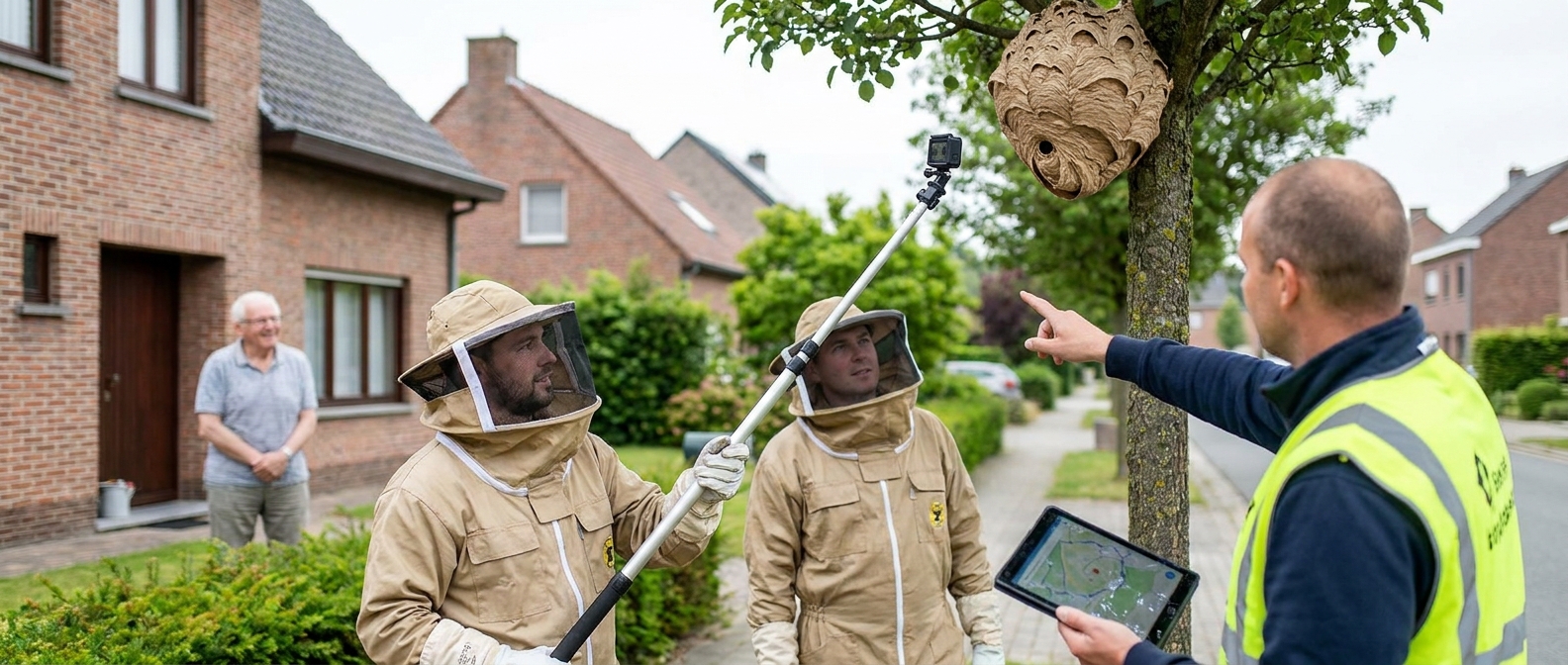
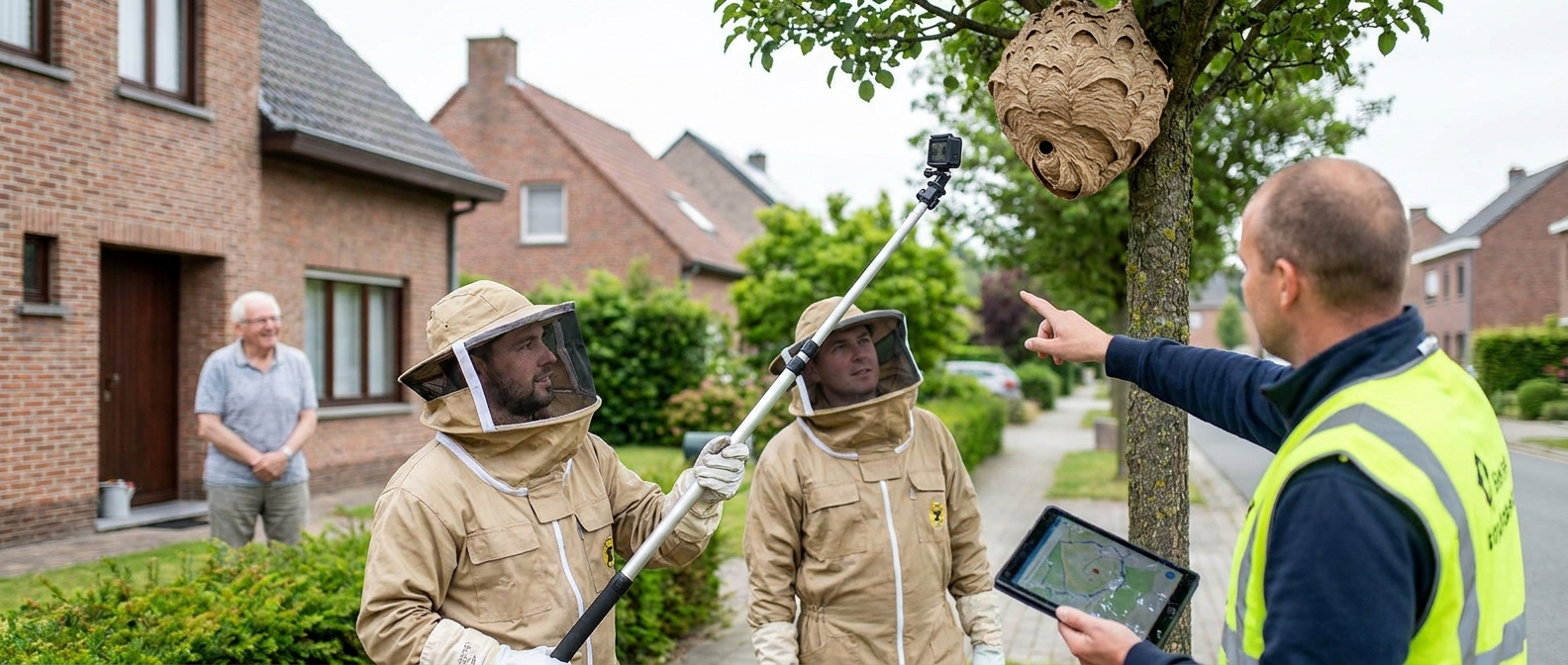
Our technician arrives fully equipped: full protective suit, telescopic pole (up to 25 meters), approved biocidal product and height access equipment if necessary. The first thing we do is set up a safety perimeter. We ask you to stay indoors, windows closed, with your children and pets. This isn't a movie: when you touch the nest, the hornets come out en masse, and they don't mess around.
3. Neutralizing the nest
The technique depends on the location. For a nest high up in a tree, the telescopic pole is used to inject the product directly into the nest, via the entrance opening. The biocide takes effect in just a few minutes. For a nest under a roof or in a cavity, the approach is similar, but sometimes requires the creation of an access point. Neutralizing the nest itself takes between 15 and 45 minutes, depending on the configuration.
No fire, no expanding foam, no DIY. The products we use are specifically authorized for this purpose in Belgium, and we dose to the minimum necessary. The aim is to eliminate the colony without contaminating the surrounding environment.
4. Nest removal and follow-up
Where technically possible, we remove the nest after treatment. If the nest is 20 metres away in a poplar, we leave it in place: once treated, it will not be recolonized. Hornets in flight at the time of treatment return to the nest in the hours that follow, and are exposed to the residual product. This is why we recommend not touching the area for 24 to 48 hours.
We sometimes come back a few days later to check that there's no more activity. A second visit is rarely necessary, but it does happen on very large autumn nests.
What it costs
We're transparent about this. The price depends on the height and accessibility of the nest. We give you a price before we intervene, so there are no surprises at the end. And no, the fire department no longer comes to deal with hornet nests in Belgium: it's up to specialist companies like Frelons.be to take over.
One final point: we intervene all year round. In spring for trapping and destroying primary nests, in summer and autumn for secondary nests, and even in winter to remove empty nests and assess risk areas for the following season. The fight against the Asian hornet in Beersel is not a one-off operation, it's an ongoing process.
Conclusion
The Asian hornet is established in Beersel. It's not a hypothesis, it's a fact. The good news is that solutions exist and they work, provided you act fast. Spot it, report it, let the pros do their job.
If you have the slightest doubt about an insect or a nest in your garden, attic or hedge, contact Frelons.be. We know Beersel, we know our neighborhoods, and that's what we're here for. A simple call can save a whole season of nuisance, for you and the local bees.
Frequently asked questions
How can you tell an Asian hornet from a European hornet in Beersel?
The Asian Hornet can be recognized by its all-black thorax, two-tone legs (black at the base and yellow at the tips) and dark abdomen with a single orange ring. The European Hornet is larger, with russet hues and a predominantly yellow abdomen.
Where are Asian hornet nests usually found in the commune?
In spring, primary nests (the size of a tennis ball) hide at ground level in garden sheds, hedges or under awnings. In summer and autumn, secondary nests (up to 80 cm) develop high up, often in treetops or under roof timbers.
What should you do if you discover a hornet's nest in your home in Beersel?
The absolute rule is not to approach within 5 meters and never attempt to destroy it yourself, as the Asian hornet attacks in groups to defend its colony. Take a photo from a safe distance and report it on the official Vespawatch platform, or contact a local expert directly.
Do the fire department still destroy hornet nests in Beersel?
No, in Belgium and the Beersel area, the fire department no longer travels for this type of intervention. The safe destruction and neutralization of Asian hornet nests is now handled by specialized private companies such as Frelons.be.
How does a pest control procedure work with Frelons.be?
After a photo diagnosis, our technician intervenes within 24 to 48 hours, equipped with a full-body suit and a telescopic pole (up to 25 meters). He injects a targeted biocidal product directly into the nest, neutralizing the colony in just a few minutes, in a way that's safe for those around you.
 French
  English
  Dutch
Dutch
0 Comments