
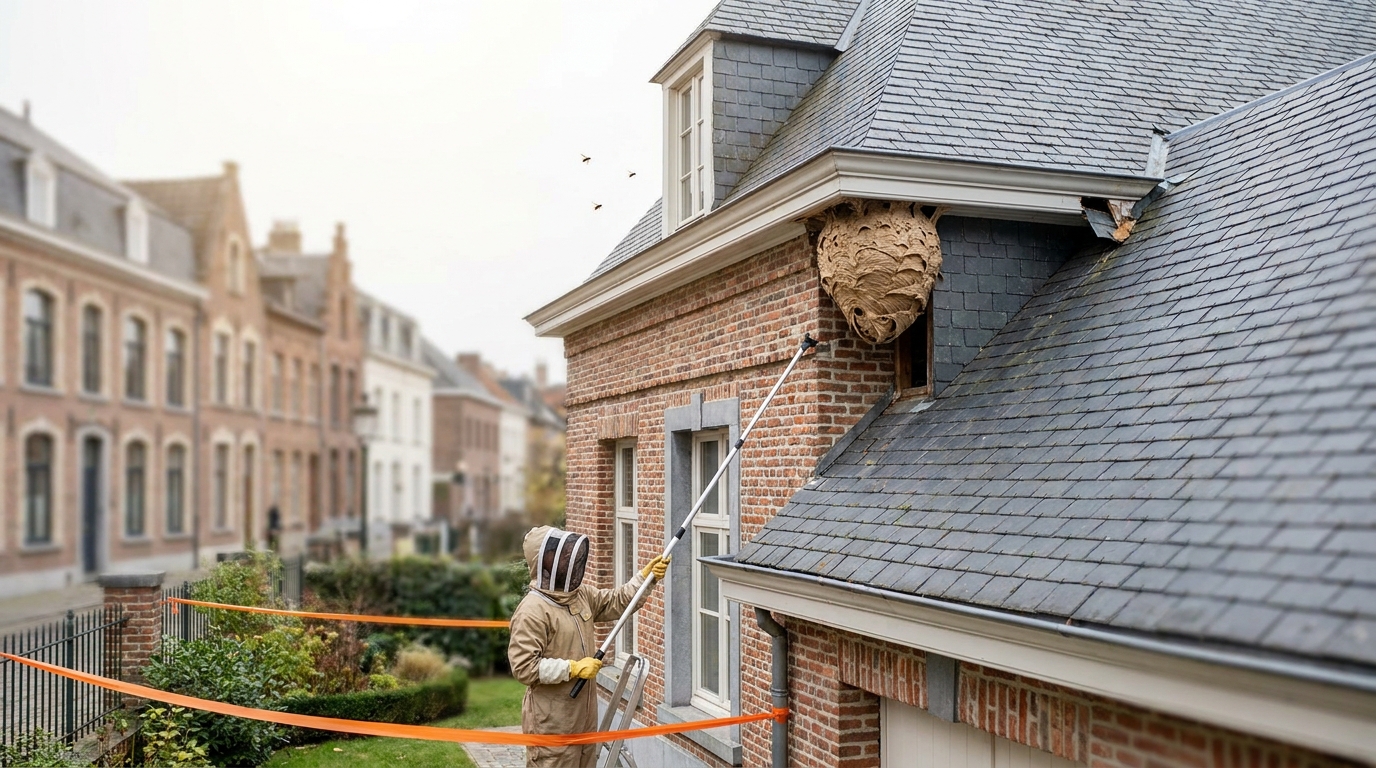
Hornets under the roof: Why are they there and what to do about it?
Contents
-
How do you know if an Asian hornet nest is hiding under your roof?
-
Secure the area and choose an effective professional intervention
A dull humming rising from the attic in the late afternoon. Insects circling around the same spot under the gutter, always the same. You look up, squint your eyes, and then doubt sets in: is there a hornet's nest under your roof?
Things to remember
-
This educational guide analyses why the Asian hornet prefers the high structures of Brussels homes
-
Combining technical expertise and proximity, we explain the nesting behavior under roofs and the essential safety protocols prior to intervention.
-
How do you know if an Asian hornet nest is hiding under your roof?
-
Why do you have so many hornets in your roof or attic?
In Brussels and the surrounding municipalities, we receive this type of call almost every day between May and October. Owners who are hesitant, not sure whether to worry or wait. The answer is simple: never wait. A hornet's nest under the roof, especially an Asian hornet's nest, is a problem that grows, literally, from week to week. And the longer you wait, the more complex and costly the intervention becomes.
This guide is here to give you the keys. Identify what's really going on under your roof tiles, understand why your house attracts them, and above all know what to do concretely to deal with the situation safely.
How do you know if an Asian hornet nest is hiding under your roof?
The first sign, the one everyone notices, is the noise. A dull, steady hum under the roof, intensifying in the heat. Not the sound of isolated flies. More like a continuous vibration, like a distant engine. If you can hear it from inside the house, the nest has already reached a significant size.
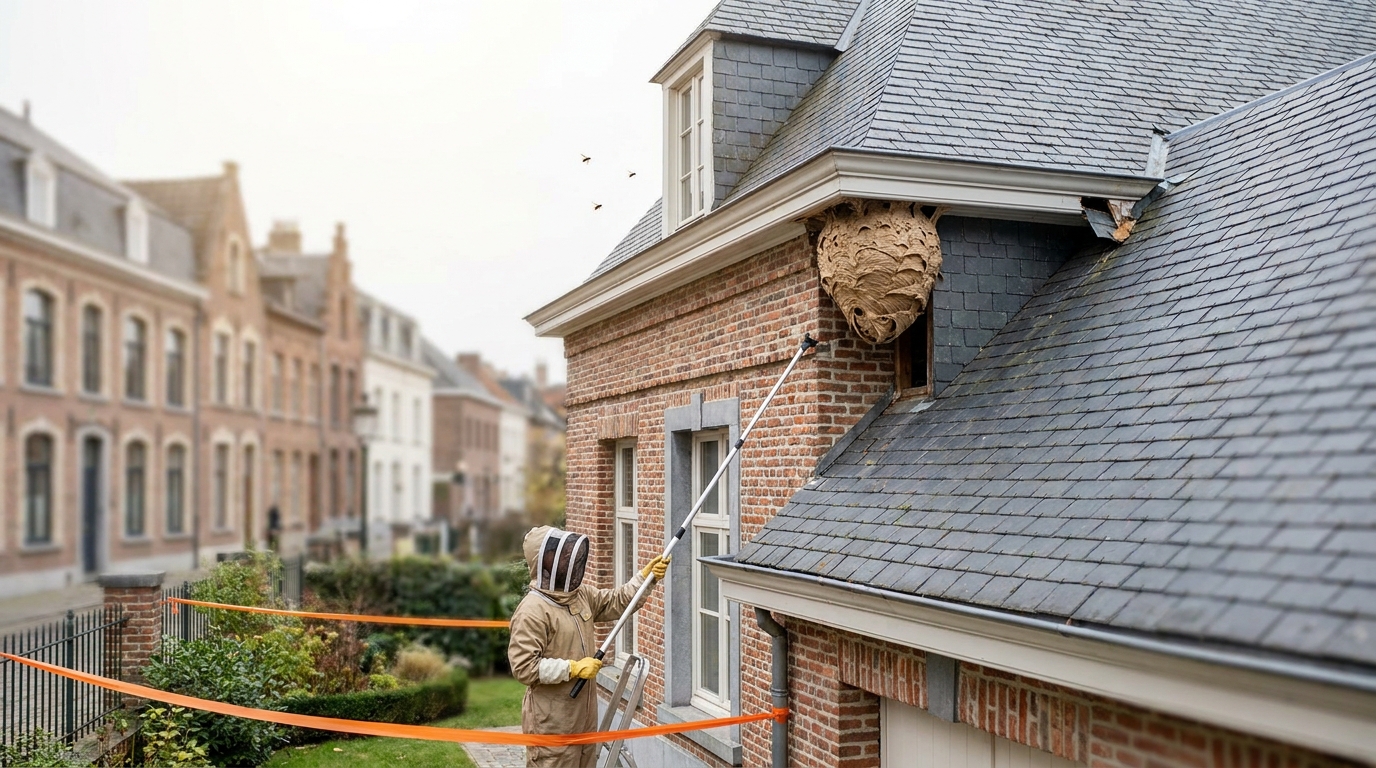
The second clue is the comings and goings of insects. Look at your facade at the end of the day, when the sun is still shining. Do you see hornets moving in and out of a particular spot: a hole in the roof edge, an offset tile, an opening in the ridge? This is an almost certain sign that a nest has been set up indoors. Asian hornets are methodical. They always use the same entrance, like an overhead highway.
To identify an Asian Hornet, look at its size and colors. It's smaller than the European Hornet (around 3 cm vs. 3.5 cm), with a dark brown, almost black thorax and a prominent orange stripe on the abdomen. Its legs are yellow at the tips, making it clearly distinguishable. If the insect you're observing fits this description, and flies quickly and directly, without the «clumsy» behavior of a wasp, you've got your answer.
An important point: Asian hornet nests under roofs are often invisible from the outside. Unlike wasp nests, which can sometimes be spotted under a roof overhang, Asian hornets build their nests indoors. In the attic, clinging to the roof structure, wedged between the insulation and the tiles. We've already found nests the size of basketballs in attics where no one had gone up for two years. The owner just heard «something» and thought it was birds.
Another sign not to be ignored: dead hornets on the floor of your attic or near roof windows. They are attracted by light and become trapped. If you regularly find dead insects in these places, don't just chalk it up to bad luck. Go up and take a look, with care, or better still, have someone who does.
A question we're often asked: how can you tell if you've got a hornet's nest in your attic without going there yourself? Honestly, from a distance, the most reliable signs are persistent buzzing, aerial ballet around an entry point, and the presence of dead insects inside. If you tick two of these three boxes, call in a professional for a diagnosis. There's no point in playing explorer in an attic potentially occupied by several hundred hornets.
Why do you have so many hornets in your roof or attic?
Your house hasn't done anything wrong. It's just got everything a hornet needs to set up shop.
The first and most obvious reason is the heat in the attic. An under-roof space, especially if poorly ventilated, accumulates heat during the day and releases it slowly in the evening. For a hornet colony, this is the equivalent of an apartment with central heating. When looking for a nesting site in spring, the queen locates these warm areas. The insulation of your roof plays a direct role: faulty or poorly installed insulation creates pockets of warm air, which is exactly what hornets are looking for. Paradoxically, a well-insulated roof with access gaps can also attract hornets, because the temperature remains stable.
The framework itself is an asset for them. The wood provides solid attachment points for the nest. Asian hornets build impressive structures, sometimes 60 to 80 cm in diameter, weighing several kilos. They need a sturdy support. A beam, joist or rafter is their preferred foundation. The wooden frames of Brussels houses, often old, with their nooks and crannies, are ideal spots.
What attracts hornets to a house, beyond the structure? Accessibility. A 2 cm hole is enough. A cracked tile, a damaged edge joint, a damaged ventilation grille: these are all entry points. Older houses, those that have lived, naturally have more openings. And once a founding queen has spotted the entrance, it's all over. She starts building, lays her first eggs, and within a few weeks the colony is growing.
There's also the proximity of food sources. Asian hornets are formidable predators of other insects, particularly bees. If you have a flower garden, fruit trees, or a neighbor with beehives, your neighborhood is a larder. Hornets never settle far from food. A 500-meter radius around the nest is their daily hunting zone.
A detail many people overlook: height. The Asian hornet, unlike the European hornet, prefers high places for its secondary nest (the big summer one). We're talking 10 meters and more. Your roof is exactly that. It's protected from the wind, from terrestrial predators, and difficult for humans to access. From the hornet's point of view, it's the perfect hideout.
One last thing: the cumulative attraction effect. Hornets leave pheromones. If a nest has been present under your roof in the past, even if it has been destroyed, the chemical traces can attract new queens the following year. That's why, after destroying a nest, a good professional cleans the area and treats the residues. Otherwise, you run the risk of reliving the same scenario twelve months later.
Secure the area and choose an effective professional intervention
Rule number one: don't touch anything yourself. I know it's tempting. You tell yourself that with a commercial insecticide spray and a little courage, you can solve the problem. No. A hornet's nest under the roof in summer can contain between 500 and 2,000 individuals. The sting of a single Asian hornet is painful enough. Multiply that by several dozen insects in defense mode, and you understand the danger. Every year in Belgium, people end up in emergency wards after trying to destroy a nest themselves.
Safety in the face of the risk of hornet stings is our top priority. Even before calling in a professional, take a few simple steps. Close roof windows and attic skylights. If hornets enter the house, don't chase them away with grand gestures: turn off the interior light and open a window to the outside, they'll go towards the natural light. Keep children and pets away from the area. And if anyone in the household is allergic to Hymenoptera bites, report it immediately when you call.
To destroy a hornet's nest under the roof, you need a trained, equipped and insured exterminator. In Brussels, we intervene with a full-body anti-sting suit, a system for injecting biocide directly into the nest, and sometimes a cherry picker or access from inside the attic. The protocol depends on the exact location of the nest, its size and accessibility. Every situation is different.
How to choose the right exterminator in Brussels? Here are a few concrete criteria. Check that the exterminator is licensed to carry out exterminations in the Brussels-Capital Region. Ask whether he uses approved products (no DIY with diverted agricultural products, they do exist). Make sure he offers a post-intervention check to make sure the nest is inactive. Above all, beware of abnormally low prices: destroying a hornet's nest on a roof requires specific equipment and time. A price that's too low often hides a botched job.
When it comes to the cost of destroying a nest, let's be clear. In Brussels, for a nest accessible from the roof, expect to pay between 100 and 250 euros on average. If the nest is very high up, requires a gondola or complex technical access, this can rise to 350 euros or more. These prices normally include travel, intervention, treatment and inspection. Always ask for a clear estimate before the job. No surprises at the end.
A word about timing. The earlier in the season you intervene, the easier it is. A nest in spring, with a queen and a few workers, can be treated in 30 minutes. The same nest in August, with hundreds of occupants, requires a much heavier intervention. If you have the slightest doubt as early as April or May, have it inspected. Your roof will be disinsected faster, less risky and less expensive.
After treatment, the professional must remove the nest or ensure that it no longer presents a risk. The remaining hornets, those in flight at the time of treatment, will return to the nest within a few hours and be exposed to the product. In 24 to 48 hours, activity will cease completely. If this is not the case, contact your exterminator again: a second visit should be scheduled in this type of situation.
Conclusion
A hornet under your roof is no small thing. It's an insect that has chosen your home for very concrete reasons: warmth, protection, accessibility. The signs are there if you know how to read them: buzzing under the tiles, a ballet of insects around a point of entry, corpses in the attic.
Don't take any chances. The only right thing to do is to secure the area and call in a qualified professional. At Frelons.be, we know Brussels roofs and their particularities, and we intervene quickly with the right equipment. One call, one diagnosis, one clean intervention: that's how we solve the problem, no other way.
Suspect a nest under your roof? Contact us. We'd rather come to you for nothing than let you live with a hornet colony all summer long.
Frequently asked questions
How do I know if a hornet's nest is hiding under my roof?
The main signs are a continuous, muffled buzzing coming from the roof structure, and a regular flow of insects towards a specific point (offset tile, gutter). The presence of dead hornets near interior skylights is also a reliable indicator.
Why do hornets often choose the attic to nest in?
Attics offer constant warmth, protection from predators and solid attachment points to the roof structure. The Asian hornet, in particular, seeks high, wind-sheltered locations for its summer colonies.
Is it dangerous to destroy a hornet's nest yourself?
Yes, it's extremely risky, because a nest under the roof can house up to 2,000 beetles ready to defend their colony. Without professional equipment, you expose yourself to massive attacks and multiple stings that can result in hospitalization.
What are the differences between a European hornet and an Asian hornet?
The Asian Hornet is darker, with a black thorax and a single orange stripe on the abdomen, while the European Hornet resembles a large yellow wasp. Another distinctive feature is the Asian hornet's yellow-tipped legs.
What is the average cost of removing a hornet's nest in Brussels?
In Brussels, professional intervention generally costs between €100 and €250, depending on the accessibility and height of the nest. This fee includes travel, targeted biocidal treatment and a guarantee of complete elimination of the colony.
What should I do if I see hornets getting under my roof tiles?
Never block the entrance yourself, as hornets may seek another way into your home. Keep your windows closed and contact a certified exterminator as soon as possible for a safe diagnosis.
 French
  English
  Dutch
Dutch
0 Comments