
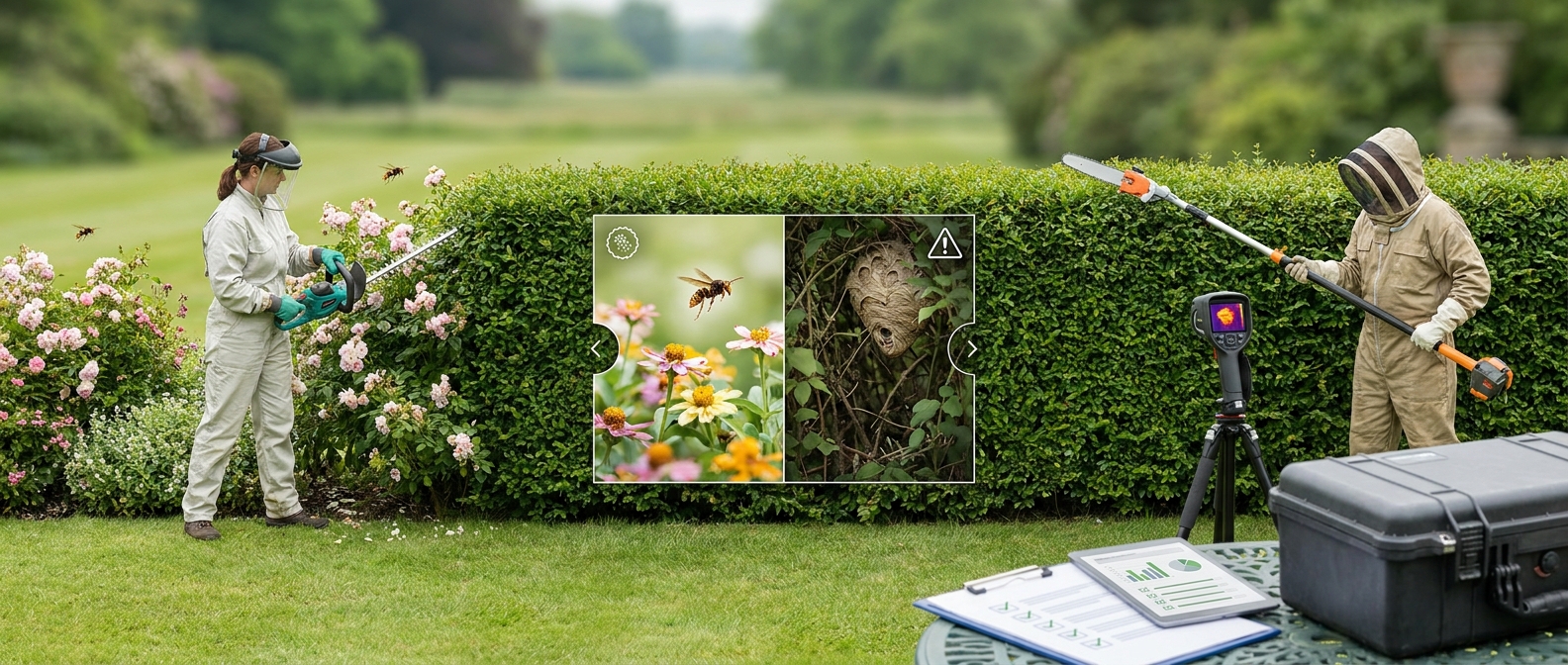
Asian hornet in the hedge: how to prune your garden without risk?
Contents
-
Why hornets invade your hedges: Feeding area vs. nesting site
-
Do-it-yourself hedge trimming or call in a professional: Choice criteria and risks
-
Manual detection vs. professional diagnosis: Recommendations before cutting
Every year, it's the same story. You take out the hedge trimmer, plug in the extension lead, and there's a dull buzzing sound that makes you freeze in your tracks. An Asian hornet. Then two. Then five. The question that follows is always the same: are they just passing by, or is there a nest hidden in my hedge?
Things to remember
-
This article deals with the duality of the hedge: hunting area (flowers) vs. hidden nesting site.
-
We offer a complete safety guide for the amateur gardener, differentiating between the simple presence of foraging hornets and a dangerous active nest, with a verification protocol prior to work.
-
Feeding area vs. nesting site
-
Selection criteria and risks
The answer changes everything. A hornet foraging on your laurel flowers is one thing. An active nest hidden 40 cm deep in your photinia is quite another. And the confusion between the two situations causes avoidable accidents every year.
That's what this article is all about: giving you a clear protocol, applicable before every pruning session, to distinguish the mere presence of hornets from a real danger. We're going to talk about what attracts hornets to your hedges, what the real risks are when you're pruning, and above all what you need to do to work safely in your garden.
Why hornets invade your hedges: Feeding area vs. nesting site
Your palm laurel hedge has been in flower for three weeks and you see Asian hornets circling it? No problem. It's not necessarily a sign of a nest. Hornets, like many insects, follow their food. And your hedge, depending on the species planted, can be a veritable open-air buffet.
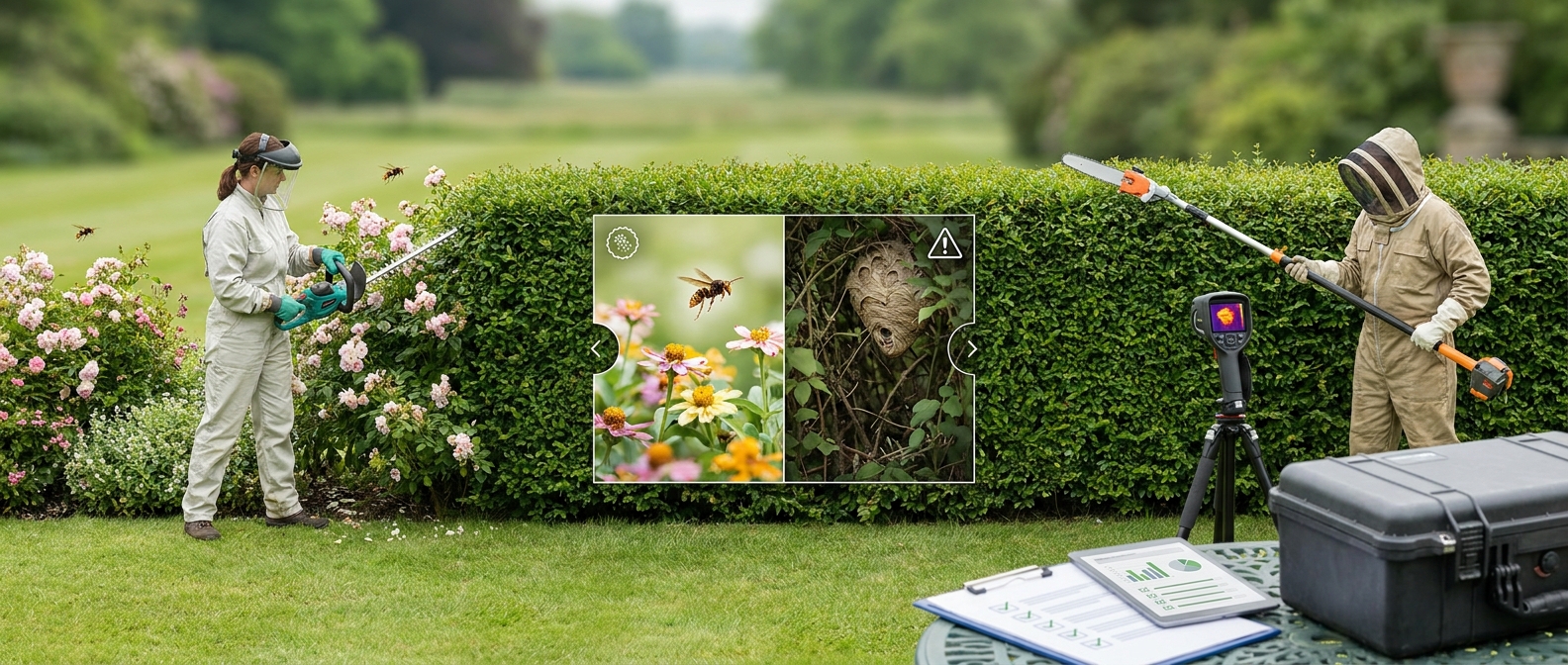
The Asian hornet in your garden has two main reasons for taking an interest in your hedges. The first is feeding. Flowering hedges, led by photinia, produce a lot of nectar. So does palm laurel. Tin laurel even more so: its winter bloom attracts hornets at a time when other food sources are scarce. If you see hornets coming and going on the blossoms without ever sinking into the foliage, you're probably looking at a hunting ground. They come to eat, then leave.
The second reason is more worrying: nesting. The Asian hornet sometimes builds its secondary nest directly in the thickness of a dense hedge. Thick cedar, laurel or cypress hedges provide ideal shelter. The evergreen foliage protects the nest from rain and wind, and makes it virtually invisible from the outside. We've seen nests up to 40 cm in diameter uncovered only at the time of pruning. At this stage, the colony can number several hundred individuals.
So, which hedges attract hornets? Any hedge that combines two characteristics: abundant flowering and dense foliage. Photinia ticks both boxes. So does palm laurel. Mixed hedges with climbing ivy are particularly at risk because ivy blooms in autumn, just when Asian hornet colonies are at their peak.
An important point: just because hornets are foraging on your hedge doesn't mean you need to panic. A feeding Asian hornet is not particularly aggressive. They won't attack you if you walk by. The danger comes when you bring a vibrating tool, such as a hedge trimmer, within 5 meters of a nest. The vibrations trigger a collective defensive response. And that can get very serious very quickly.
To put it simply: hornets on flowers are passing through. A hornet entering and leaving foliage in the same place, in a straight line, is a nest. This distinction is the basis of everything that follows.
Do-it-yourself hedge trimming or call in a professional: Choice criteria and risks
90% of Asian hornet stings in Belgium occur during gardening activities. Not in the forest, not hiking. In the garden, hedge trimmer in hand. That figure should be enough to make you think twice before starting the machine.
The danger of hedge trimming when hornets are present is the combination of three factors. The vibrations of the hedge trimmer, which agitate the colony. Physical proximity, because you're literally at arm's length from the foliage. And surprise, because the nest is invisible until you stumble across it. An Asian hornet sting is painful, but rarely dangerous for a non-allergic person. The problem is that a disturbed nest is not one sting. It's ten, twenty, sometimes fifty stings in a matter of seconds. And even without an allergy, we're talking about a medical emergency.
So, do it yourself or call someone? Here's how to decide.
You can prune yourself if :
-
You have observed your hedge for 10 minutes at different times of the day (early morning and afternoon) without seeing any regular comings and goings of hornets.
-
The hornets you see are foraging on flowers and heading off in different directions (no straight line to a fixed point).
-
You have visually inspected the hedge on the inner side without finding any suspicious structures.
-
Wear long, light-colored clothing and avoid perfume (hornets are attracted by sweet smells).
Call a professional if :
-
You observe hornets moving in and out of the same spot in the hedge.
-
The flow is regular: one hornet every 10 to 30 seconds in the same place
-
You can hear a dull buzzing sound if you put your ear close (at a reasonable distance) to the foliage.
-
If you have the slightest doubt
This last point is not an empty phrase. Doubt, in this case, is enough to warrant a call. A diagnosis by Frelons.be doesn't take long, so you don't have to play roulette with a potential nest. We intervene all year round, including in winter when nests are abandoned but need to be removed to prevent recolonization in spring.
A word about gardening safety in general: even if you can't see anything, always start your pruning with small, shallow passes. Don't make deep cuts right away. If a nest is present, the first light vibrations will cause a few scouts to emerge, giving you time to back off. A straight cut into a nest, on the other hand, triggers a massive attack immediately.
And if you're still stung? Move away quickly, but don't make any sudden movements (wide movements are more attractive to hornets). Remove any visible stings and apply cold. If you are stung more than 5 times, or if you are stung in the throat, mouth or near the eyes, call 112 without hesitation.
Manual detection vs. professional diagnosis: Recommendations before cutting
Before you plug anything in, take 15 minutes. Fifteen minutes that could save you a trip to the emergency room. Here's a verification protocol you can apply yourself, and its limitations.
How to find a hornet's nest in a hedge by yourself :
Stand 3 meters from the hedge, on the garden side. Watch for 5 minutes without moving. What you're looking for are trajectories. A foraging hornet flies erratically, moving from flower to flower, changing direction. A hornet returning to its nest flies straight, as if on rails. If you spot this straight-line trajectory, follow it with your eyes. The point of entry into the foliage is the nest area.
Do the same on the other side of the hedge, if possible. Some nests have inward-facing entrances, invisible from the garden.
The signs of a hornet's nest in your hedge are not always obvious. A recent nest (spring, early summer) may only be 10 cm in diameter. It looks like a grayish ball of papier-mâché, sometimes mistaken for an old wasp's nest or even a pile of dead leaves. In autumn, it can grow to 60-80 cm. At this size, you'll see it, but it'll be too late to intervene on your own.
Another clue: droppings. Under an active nest, you'll often find small dark pellets on the ground, the remains of prey (bees, flies) that hornets shell to feed their larvae. If you see this type of deposit concentrated under a specific spot on your hedge, it's a strong signal.
The limits of manual detection :
The problem is that all this works well when the nest is active and the colony has developed. In May-June, a founding queen with 20 workers produces so little traffic that you won't see anything. And it's precisely at this time of year that many people trim their hedges for the first time this season.
This is where a professional diagnosis comes into its own. At Frelons.be, we use behavioral observation combined with a physical inspection of the hedge. We know where to look, at what height (hedge nests are often between 1 m and 2 m from the ground), and we recognize clues that the untrained eye misses. When a hornet's nest is confirmed, it is immediately destroyed using the appropriate equipment.
A point about hornet prevention: you can't stop a hornet from foraging on your flowers, and frankly, you don't want to. The Asian hornet is an invasive species that poses real problems for bee populations, but killing an isolated individual is pointless. Why shouldn't we kill a passing Asian hornet? Because it makes no difference to the colony. What counts is locating and destroying the nest. A crushed hornet means a new one the next day. A destroyed nest means an entire colony is neutralized.
The real prevention is regular inspection. Before every pruning, every season. A 15-minute look. And if in doubt, a phone call. It's as simple as that.
Conclusion
Trimming your hedge when Asian hornets are prowling your garden doesn't have to be inevitable. It's a question of method. Observe before cutting. Distinguish between foraging and nesting hornets. Start with light passes. And above all, don't play the hero when a nest is suspected.
If you have the slightest doubt about the presence of a hornet's nest in your hedge, contact Frelons.be. We intervene quickly, anywhere in Belgium, all year round. Your hedge can wait a few days. Your safety can't.
Frequently asked questions
How do I know if a hornet in my hedge is a danger?
A hornet foraging on flowers (laurel, photinia) is in feeding mode and not very aggressive. On the other hand, if you observe regular comings and goings in a straight line towards the interior of the foliage, a nest has probably been set up: this is an immediate danger to pruning.
Why do Asian hornets choose hedges for their nests?
Dense hedges (cedar, laurel, cypress) offer perfect shelter from the weather and predators. The evergreen foliage makes the nest virtually invisible, allowing the colony to develop out of sight until the pruning season.
What are the risks of trimming a hedge containing a hornet's nest?
The main risk is a mass attack. The vibrations of the hedge trimmer alert the colony, which defends its territory with multiple bites. Unlike an isolated sting, a mass attack can result in a serious medical emergency, even without an allergy.
What should I do if I suspect the presence of a nest before gardening?
Observe your hedge from a distance for 15 minutes. If you see hornets moving in and out of the same spot, don't approach the machine. Call in a professional for a safe diagnosis and destruction of the nest using appropriate equipment.
Is it dangerous to kill a lone hornet in your garden?
Killing an isolated hornet is pointless, as it will be replaced by another member of the colony. Worse still, by crushing it, you can release warning pheromones that may attract and irritate other hornets in the vicinity.
 French
  English
  Dutch
Dutch
0 Comments