
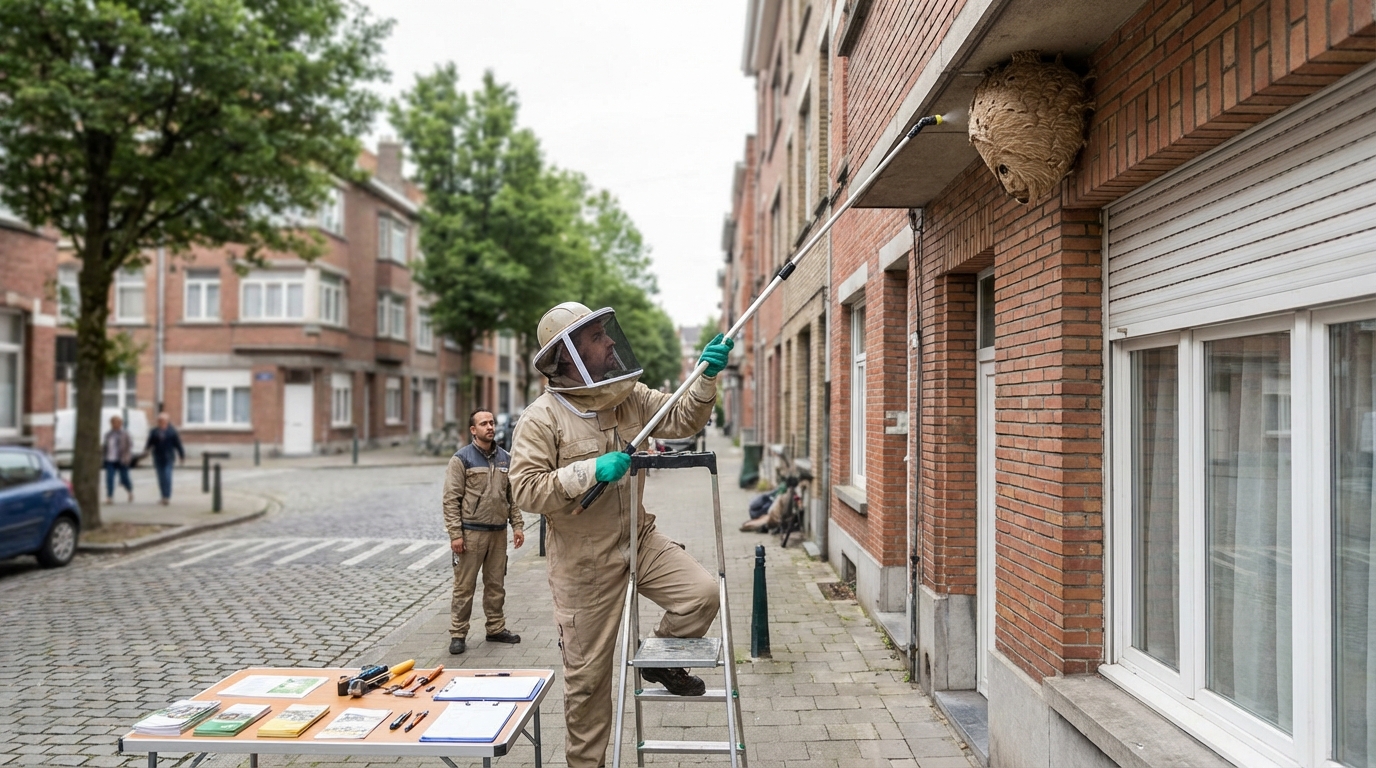
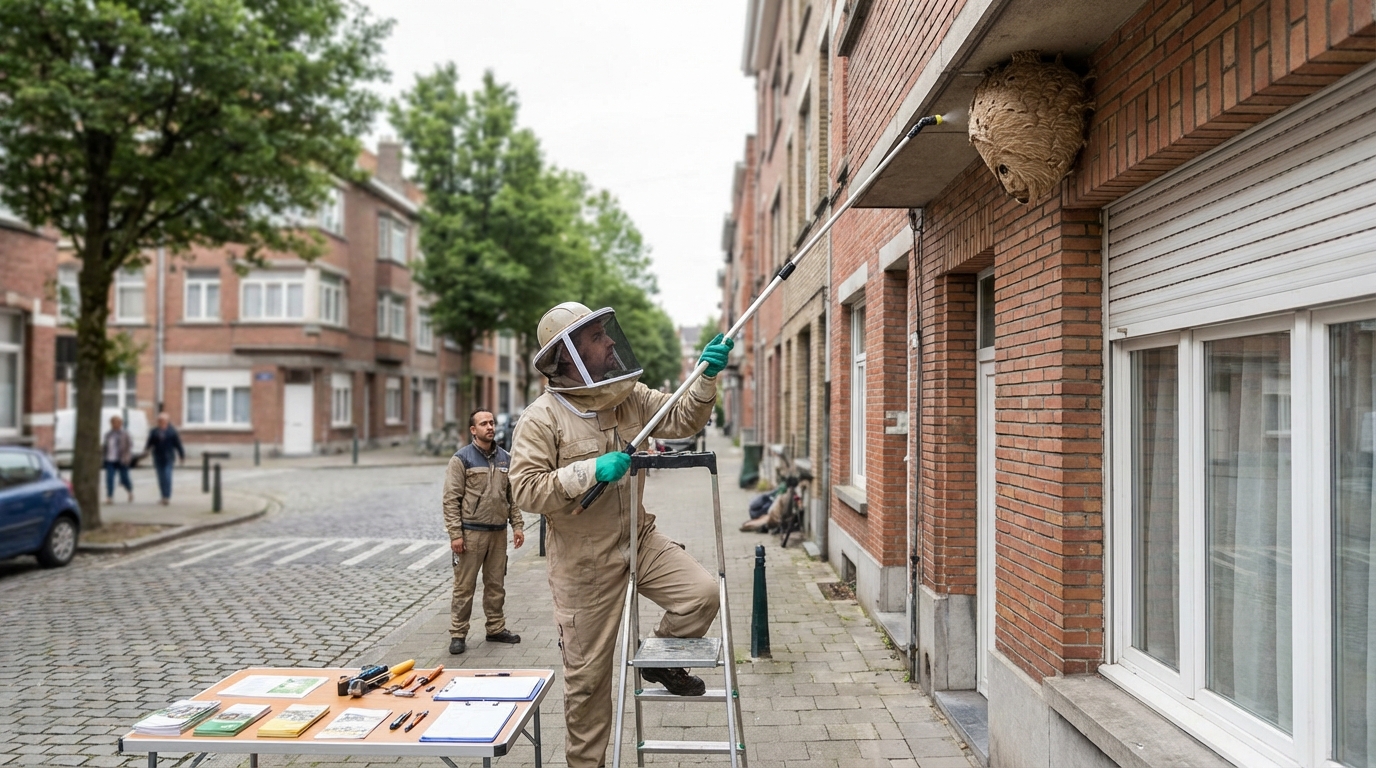
Wasp nest in Saint-Gilles: All you need to know about the intervention
Contents
Last summer, a homeowner on Chaussée de Waterloo discovered a wasp nest the size of a football wedged between the window frame and the brick wall. He had noticed the insects coming and going for two weeks, without really worrying about it. Until the day his daughter was bitten three times while out on the balcony. This kind of situation is encountered dozens of times a season in Saint-Gilles.
Things to remember
-
Ultra-local informational article on a typical intervention in Saint-Gilles (1060)
-
The aim is to educate people about the dangers of the Asian hornet in dense urban environments, and to explain the logistics of a safe extermination in Brussels homes.
-
Understanding the presence of Asian wasps and hornets in Saint-Gilles
-
Step-by-step guide to nest destruction in urban areas
The commune of Saint-Gilles (1060) has everything a wasp or hornet could want: terraced houses with old cornices, zinc roofs full of gaps, inner courtyards sheltered from the wind. Add to this the population density, restaurant terraces and overflowing garbage cans in summer, and you've got the perfect cocktail. Who do you call when you have wasps in these conditions? What's the practical procedure? And above all, how much does it cost? Here's the lowdown.
Understanding the presence of Asian wasps and hornets in Saint-Gilles
Saint-Gilles is not an isolated case in Brussels, but the municipality has a number of special features that favor the installation of colonies. First of all, the buildings. Typical early 20th-century Brussels houses, with their bluestone facades and elaborate cornices, offer an incredible number of cavities. Wasps love them. An 8 mm hole is all it takes for a founding queen to settle under a roof, in a roller shutter box or behind siding. And in Saint-Gilles, there are whole streets of houses like this.
The wasp life cycle explains why problems always explode between June and September. In spring, the queen comes out of hibernation and starts building a small nest, often no bigger than a golf ball. She lays her first eggs and feeds the first larvae on her own. At this stage, nobody notices a thing. But as soon as the first workers emerge, the colony accelerates. In July, a nest can count 2,000 to 5,000 individuals. August is the peak: the wasps become more aggressive as they seek sugar to feed the new queens. This is when stings multiply.
And then there's the Asian hornet. Its presence in Saint-Gilles is no longer anecdotal. Vespa velutina has been spotted in Belgium since 2016, and reports in the Brussels region are increasing every year. The Asian hornet in Saint-Gilles poses a specific problem: it often builds primary nests in low hedges or garden sheds in spring, then migrates to higher ground to build a secondary nest, sometimes 15 or 20 meters up a tree. In such a densely populated commune, this means nests at the top of plane trees in the forecourt, in building gutters or under school roofs.
What's the worst wasp to get stung by? The Asian hornet isn't the most dangerous individually (its sting is comparable to that of a common wasp), but it attacks in groups when you get too close to the nest. Three or four simultaneous stings can provoke a severe reaction, even in someone who is not allergic. German wasps (Vespula germanica), very common in Saint-Gilles, are also particularly virulent: they sting several times and their venom causes intense pain. All social wasps sting, without exception. Unlike bees, they do not lose their sting and can sting repeatedly.
The problem in a dense urban environment like the 1060 is proximity. A nest under the roof of an adjoining house is a risk for the whole building, for neighbors and for passers-by. Wasps follow regular flight paths between the nest and their food sources. If this trajectory passes over a sidewalk or schoolyard, the risk of stinging skyrockets. Not to mention people allergic to Hymenoptera venom: for them, a single sting can trigger anaphylactic shock.
Step-by-step guide to nest destruction in urban areas
First thing to know: never try to destroy a nest yourself. Every summer, the Saint-Pierre and Brugmann emergency departments receive patients who have tried to deal with the problem using insecticide spray from the supermarket. The result: dozens of stings, sometimes involving falls from ladders. An active wasp nest is an organized colony defending its territory. You can't improvise yourself as an exterminator.
Here's how a professional wasp nest removal in Saint-Gilles works, from the first call to the follow-up.
Step 1: Remote diagnosis. When you contact us, we ask you a few simple questions. Where did you see the insects? For how long? Can you send us a photo? This first exchange will enable us to distinguish a wasp from a hornet, assess the probable size of the nest and prepare the appropriate equipment. In Saint-Gilles, the most frequent configurations are nests under roofs (in the attic, between the rafters), nests in roller shutter boxes and nests in hollow walls on facades.
Stage 2: Arrival and assessment. The technician usually arrives within 24 hours, often the same day in high season. He inspects the site, locates the nest precisely and assesses accessibility. In the narrow streets of Saint-Gilles, this can be a logistical headache. A nest 12 meters high on a facade overlooking a busy sidewalk sometimes requires coordination with the commune to secure the perimeter. Neighborhood safety is the top priority: we don't treat a nest if passers-by risk being exposed to the escaping insects.
Step 3: Treatment. For wasp extermination in Saint-Gilles, the standard method is to inject a powdered insecticide directly into the nest or at its entrance. The product acts by contact: workers entering and leaving the nest carry it inside, contaminating the entire colony within a few hours. For nests under accessible roofs, a professional long-range aerosol can also be used. The technician wears a full-body anti-sting suit, reinforced gloves and a protective veil.
Step 4: Nest removal (where possible). Physical removal of the nest is not always necessary. If the nest is in a hollow wall or in an inaccessible space, we leave it in place after treatment: without a living colony, it will never be used again. Wasps will not reoccupy an old nest. On the other hand, if the nest is visible and accessible (under eaves, in an attic), we remove it for the comfort of the occupants.
Step 5: Follow-up. For 48 to 72 hours after the treatment, it is normal to see a few wasps still circling the nest site. These are workers who were in flight at the time of treatment, and who are trying to return. They will quickly die on contact with the residual product. If activity persists beyond 72 hours, we'll come back for free.
Urban logistics play an important role when working in 1060. Limited parking, access via shared courtyards, adjoining roofs: every situation is different. We've already dealt with nests that can only be accessed via the neighbor's roof, which obviously requires the neighbor's agreement. In apartment buildings, which are common in Saint-Gilles, we sometimes have to go through the common areas, so we have to inform the syndic. It's all part of the job.
Tariffs and the basics of nest prevention
How much does it cost to remove a wasp nest? It's a question that comes up time and time again, and rightly so. The price of wasp nest removal depends on a number of factors, but we can give clear ranges.
For an accessible nest (at a reasonable height, with no particular difficulty of access), expect to pay between €80 and €120 incl. VAT. This is typically the case for a nest under an eaves, in a garden shed or in a shutter box. For a nest under the roof requiring attic access or working at height with special equipment, the price rises to between 120 and 180 euros. Exceptional situations (very high nest, complex access requiring a gondola, Asian hornet nest in a tree) can exceed 200 euros, but this is rare in urban areas.
What makes the price vary, concretely :
-
Nest height. A 3-meter nest does not require the same equipment as a 15-meter nest.
-
Accessibility. Passing through a narrow velux window to reach crowded attic space is time-consuming.
-
The type of insect. An Asian hornet nest requires extra precautions than a common wasp nest.
-
The emergency. Weekend or evening service may incur an additional charge.
Beware of the abnormally low prices (40-50 euros) you sometimes see online. Either the service provider will add charges once on site, or will use low-end products that won't treat the colony thoroughly. And you'll be calling someone else back two weeks later.
In terms of prevention, let's be honest: you can't prevent 100 % of queen wasps from setting up shop somewhere. But you can seriously reduce the risks. Hymenoptera prevention is based on a few simple principles.
First, inspect your home in early spring, March-April. Look for small embryonic nests (about the size of a walnut) in the usual places: under cornices, in sheds, behind shutters. At this stage, the queen is alone and the nest can be removed by hand (with gloves, though). No need for a professional.
Next, seal off access points. Unscreened ventilation grilles, holes in masonry joints, gaps under tiles: these are all entry points. Silicone sealant or a thin mosquito net is all you need. In Saint-Gilles, where many houses have old façades with deteriorated joints, this sealing work makes a real difference.
Garbage cans also play a role. Wasps are attracted to proteins (meat, fish) in early summer, then to sugar (fruit, soft drinks) at the end of the season. Keeping garbage cans tightly closed and food scraps cleaned up quickly on terraces won't eliminate the problem, but it will prevent colonies from being attracted to your home.
A final point that's often overlooked: store-bought wasp traps are useless against an established nest. They capture a few workers, a drop in the ocean compared with a colony of several thousand. These traps are useful in the spring for capturing founding queens, but their effectiveness is still debated by entomologists. The only reliable treatment against an active nest is the intervention of a trained professional.
Conclusion
A wasp nest in Saint-Gilles isn't just a summer nuisance. In such a densely populated commune, with old buildings offering dozens of possible hiding places, each untreated nest represents a real risk for residents, neighbors and passers-by. The Asian hornet adds another layer of complexity, with nests that are sometimes very difficult to spot.
If you spot insects coming and going around your facade, roof or garden, don't wait. The larger the nest, the more complex the intervention and the greater the risk of stings. Contact Frelons.be for a fast response anywhere in the 1060 area. We intervene all year round, including for Asian hornet nests, with a clear estimate before each intervention.
Frequently asked questions
What should I do if I discover a wasp nest in my home in Saint-Gilles?
Never try to destroy it yourself with commercial products, as urban wasps become very aggressive in groups. Keep your distance, close nearby windows and contact a professional like Frelons.be for a safe intervention within 24 hours.
How much does it cost to remove a wasp nest in Brussels?
The standard price for an accessible nest in Saint-Gilles ranges from €80 to €120, all taxes included. This price may vary according to the height of the nest (cornices, roofs) and the specific equipment required, such as a gondola for high Asian hornets.
How can you tell an Asian hornet nest from a wasp nest?
Wasp nests are often hidden (shutter boxes, attics), while Asian hornets build large, visible spheres in trees or under roof timbers. The hornet is darker, with yellow legs, and its nest has a small, single lateral entrance.
Are the Brussels fire department still working on wasps?
Fire departments concentrate on vital emergencies, and now charge for their services (often more than private firms). For fast, guaranteed pest control in Saint-Gilles, we recommend that you call in a specialist pest control company.
Can a wasp nest return to the same spot the following year?
No, wasps never re-use an old nest; the colony dies in winter and only the queen survives elsewhere. However, if the access (hole in the wall, crack) is not blocked, a new queen may be attracted to the same cavity the following spring.
 French
  English
  Dutch
Dutch
0 Comments