
Destroying wasp nests in Watermael-Boitsfort: local expertise
Contents
-
Identifying and understanding wasp nests in Watermael-Boitsfort
-
The step-by-step guide to a successful insect control operation
Last summer, a resident of Avenue des Taillis called us on a Sunday morning. His children could no longer play in the garden. A wasp nest, as big as a soccer, had settled under the roof overhang, just above the terrace. Classic Watermael-Boitsfort: lots of greenery, houses with nooks and crannies, and insects that find it the perfect place to settle.
Things to remember
-
An informative story based on a real-life intervention in the leafy neighborhoods of Watermael-Boitsfort, combining technical expertise on the Asian hornet with safety tips for the gardens of 1170.
-
Identifying and understanding wasp nests in Watermael-Boitsfort
-
The step-by-step guide to a successful insect control operation
-
Seasonal prevention and management of Asian hornets
If you live in 1170 Brussels, you know that the commune is a real green lung. The Forêt de Soignes is just a stone's throw away, with gardens everywhere, hedges and fruit trees. It's beautiful, but it also attracts wasps, hornets and sometimes the Asian hornet, which has been gaining ground in Brussels in recent years. When faced with a nest, the question is not whether you should take action, but who to call and what to do about it.
This article is exactly that: we tell you how we identify the species, how a wasp nest is destroyed in Watermael-Boitsfort, how much it costs, and above all how to prevent the situation from recurring every year.
Identifying and understanding wasp nests in Watermael-Boitsfort
Before you pick up the phone to call a wasp exterminator in 1170, take thirty seconds to observe what's flying around your home. Not all wasps are created equal, and some pose no danger at all.
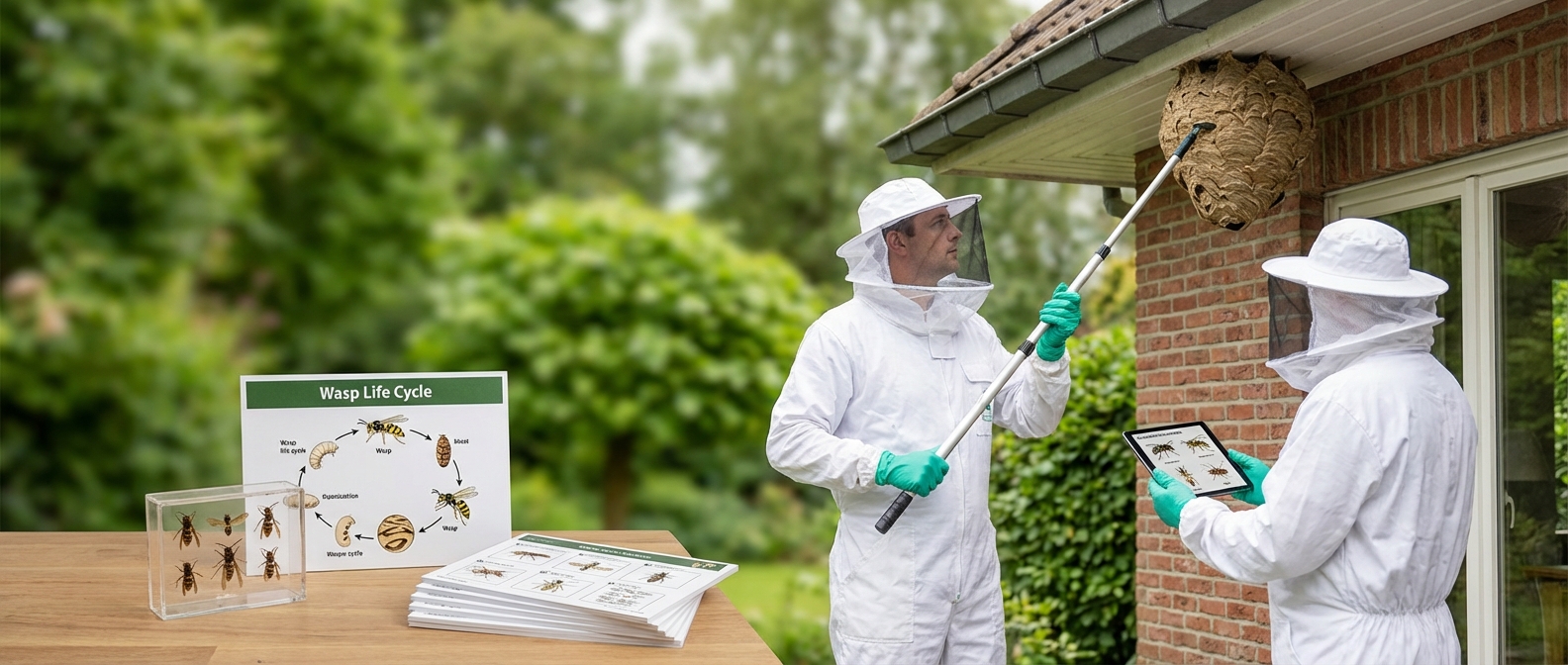
The common wasp (Vespula vulgaris) and the German wasp (Vespula germanica) are the two species most often found in the gardens of Watermael-Boitsfort. With their distinctive yellow and black stripes, nervous flight and attraction to your glass of lemonade on the terrace, they're easy to recognize. They're the ones who build those big papier-mâché nests in attics, garden sheds, letterboxes or even in the ground.
We're often asked: «What's that big wasp that doesn't sting?» In 90% of cases, it's the mason (or solitary) wasp. Impressive in size, but totally harmless. It doesn't live in a colony, doesn't defend a nest, and isn't interested in your food. If you see one flying in and out of a small hole in a wall, leave it alone. It pollinates, it regulates other insects, it's useful.
Hornet identification is another matter. The European hornet, brown and yellow-orange, has always been present in Belgium. It's big, it makes noise, but it's not aggressive unless you shake its nest. The Asian hornet in Brussels is a different story. Smaller than its European cousin, darker (yellow legs, black thorax, a single orange stripe on the abdomen), it is best recognized by its nest: a large closed sphere, often set high up in trees, sometimes over 15 meters away. More and more of them are being found in the Brussels region, including in the wooded areas of 1170.
Understanding the wasp's life cycle helps us to react at the right time. In spring, a fertilized queen emerges from hibernation and starts building a golf-ball-sized nest on her own. She lays her first eggs and feeds the first larvae. Within a few weeks, the workers take over, and the nest grows rapidly. Very quickly. By July-August, a colony can number 5,000 to 10,000 individuals. That's when people call us, because the wasps become more visible, more numerous, more nervous.
Why are there so many wasps at the moment? If you're asking this question in August or September, it's normal. The colony is at its peak. The workers are no longer feeding larvae (which provide them with a sweet liquid in exchange), so they're looking for sugar elsewhere: your fruit, your drinks, your garbage. They're hungry and more insistent than in early summer.
In Watermael-Boitsfort, typical nesting spots: under the tiles of the character houses along Avenue Delleur, in the thick hedges of the gardens on the Boitsfort side, in the garden sheds near the Tournay-Solvay park, and sometimes in the lawn soil, especially in slightly overgrown areas. If you see a ballet of insects moving in and out of the same spot, it's a nest. Don't go closer than three metres.
The step-by-step guide to a successful insect control operation
Let's return to our intervention on Avenue des Taillis. The owner had first tried to deal with them on his own, using a commercial insecticide spray. The result: three stings and even more aggressive wasps. This is the scenario we see every week. Commercial products don't have the range or concentration needed to neutralize an entire nest, and the main effect is to irritate the colony.
When you call a wasp exterminator in 1170, here's what happens, step by step.
Initial contact and diagnosis. We ask you a few questions: where is the nest, its approximate size, how long have you noticed it, is anyone in the household allergic? At Frelons.be, we intervene 7 days a week, including wasp emergencies at weekends. For sensitive cases (allergy, nest near a school, frequent passage), we come to you within a few hours.
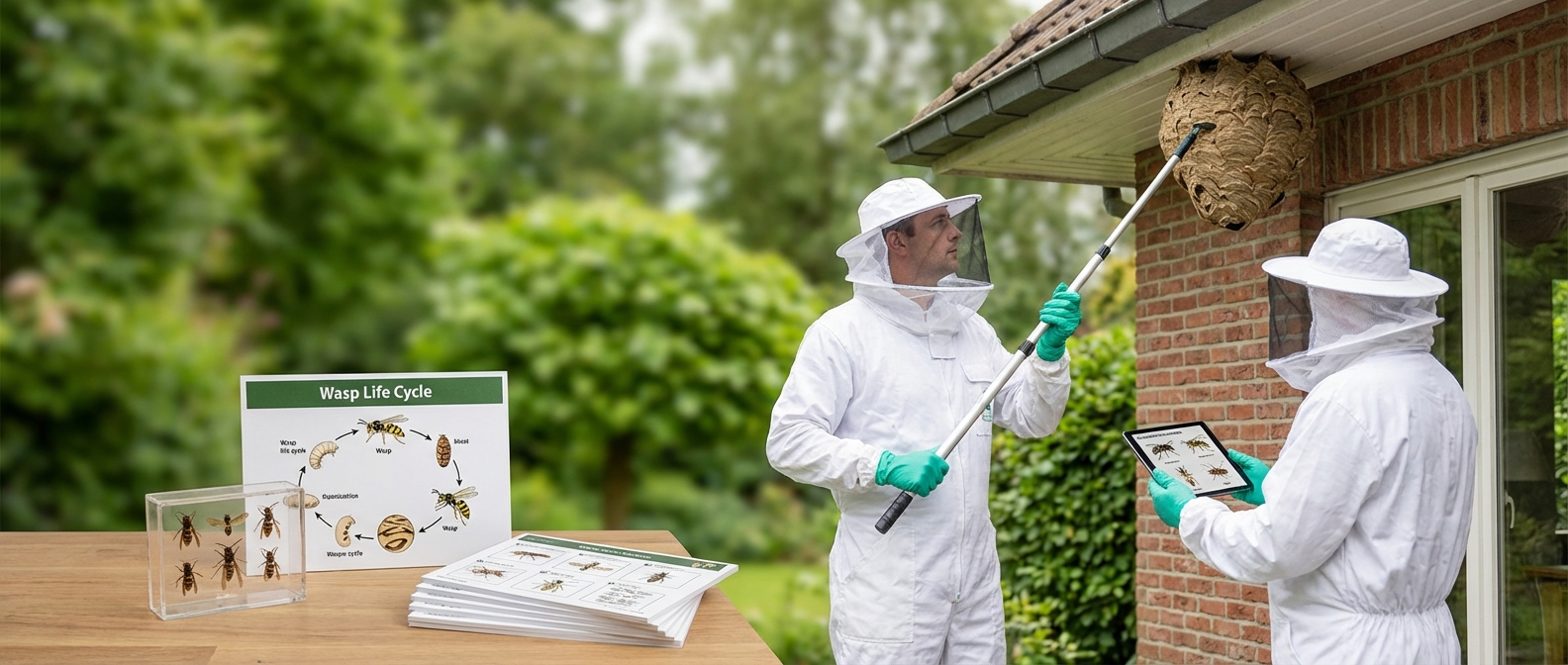
Arrival and assessment. The technician inspects the nest, identifies the species (common wasp, European hornet, Asian hornet) and assesses accessibility. A nest under a gutter two meters up is not the same intervention as an Asian hornet nest twelve meters up in an oak tree. Professional equipment is adapted to the situation: full-body sting-proof suit, reinforced gloves, breathing mask, and, depending on the case, a cherry picker or telescopic pole.
Treatment. We use a professional insecticide in powder or aerosol form, injected directly into the nest or at the entrance. The product acts by contact and ingestion: wasps entering and leaving the nest carry it inside, eliminating the entire colony within a few hours. Safety is our top priority. We secure a perimeter, ask residents to stay indoors with windows closed during the treatment, and only physically remove the nest when it is totally inactive (usually the next day or 48 hours later).
How much does it cost to destroy a nest? Extermination rates depend on a number of factors: height, accessibility, species, timing (some service providers charge extra on Sundays or public holidays). For a standard job in Watermael-Boitsfort, expect to pay between €80 and €150. A high nest requiring special equipment can cost between 200 and 250 euros. At Frelons.be, we announce the price before we intervene, so there are no surprises at the end.
An important point: some Brussels communes contribute to the cost of destroying Asian hornet nests, as part of the coordinated fight against this invasive species. Find out more from the Watermael-Boitsfort municipal administration - it could be worth your while.
After the operation. The technician will give you personalized advice based on your garden: where to look, what to change to reduce the risk of re-installation. We don't just destroy a nest, we explain why it was there and how to limit the chances of it happening again.
A final word on safety: never try to destroy a nest yourself with water, fire or by shaking the branch. Every year in Belgium, people end up in emergency wards because of such attempts. A single sting can cause anaphylactic shock in an allergic person, and an alert colony can inflict dozens of stings in a matter of seconds.
Seasonal prevention and management of Asian hornets
February 2024, a call from a resident of Rue du Loutrier. She had found a large, numb insect on her windowsill. Photo sent by SMS: it was an Asian hornet queen coming out of hibernation. We stepped in to inspect the surrounding area and set a trap. Because yes, the Asian hornet doesn't disappear in winter, it hides.
Understanding seasonal rhythms is the key to effective prevention. In winter, the Asian hornet is a fertilized queen who sleeps in a pile of leaves, a tree hole, an attic or a pile of wood. She waits for the February-March thaw to emerge and found a new colony. It's at this precise moment that we can take the most effective action, before she builds her primary nest and starts laying eggs.
Selective trapping in spring. Between mid-February and the end of April, queen bee traps are installed in high-risk areas. The principle: an attractive mixture (dark beer, blackcurrant syrup, a little white wine to repel bees) in a trap designed to let small non-target insects out. Selectivity is essential. A poorly designed trap will kill dozens of beneficial insects for every one captured. We use models with calibrated openings and check traps regularly to free accidental catches.
Protecting biodiversity isn't just a slogan for us. Wasps, European hornets, wild bees: they all play a part in the ecosystem of Watermael-Boitsfort gardens. Wasps regulate populations of flies, caterpillars and aphids. We only destroy a nest when it represents a real danger to the inhabitants. A wasp nest at the bottom of the garden, ten meters from the house, in a place where no one passes? Sometimes, the best thing to do is leave it alone until autumn, when the colony dies off naturally.
Summer: active surveillance. From June to September, we're in reactive mode. Nests are growing, wasps are everywhere, and Asian hornets are attacking beehives. If you have bees or know a beekeeper in your neighborhood, report any sightings of Asian hornets on the iNaturalist platform or directly to Frelons.be. The earlier nests are spotted, the less damage they cause.
A few simple steps to keep your garden safe all season long:
-
Cover your garbage cans and compost garbage cans (wasps love sweet waste and meat).
-
Pick up fallen fruit, especially apples and plums.
-
Inspect your garden sheds, shutter boxes and mailboxes in spring, before the nests grow.
-
Don't leave food or sugary drinks unattended on the terrace.
-
If you're trimming a hedge or moving stored wood, do so with care: these are classic hiding places.
Autumn and winter: time to prepare for the next season. Wasp colonies die with the first cold spells. Only the young, fertilized queens survive. An old nest will never be reused the following year (contrary to popular belief), but its presence indicates a favourable location. We recommend plugging access points: holes in walls, gaps under tiles, openings in sheds. For the Asian hornet, winter is also a good time to spot large nests in trees, when the leaves have fallen. An empty nest high up, clearly visible in December, tells you exactly where to look next spring.
At Frelons.be, we're active all year round against the Asian hornet. Not just in summer, when everyone panics. Winter and spring prevention work is what really makes the difference in the long term.
Conclusion
Living in Watermael-Boitsfort, with its large gardens and forest within easy reach, is a privilege. It comes with a few unwanted housemates, but nothing unmanageable when you know who to turn to. Identify the species, don't intervene yourself, call in a trained professional and know the right preventive reflexes: that's all it takes.
If you've spotted a suspicious wasp or hornet nest in your garden in 1170, don't let the situation escalate. Contact Frelons.be for a rapid diagnosis and safe intervention, 7 days a week. One phone call and we'll take care of it.
Frequently asked questions
How do I know if I have a wasp or hornet nest in my garden in Watermael-Boitsfort?
Observe the insects' comings and goings: if they systematically enter and leave the same opening (roof, hedge, ground), a nest is active nearby. In Watermael-Boitsfort, the density of greenery favors the nests of common wasps in the nooks and crannies of houses, and the nests of Asian hornets, recognizable by their large sphere shape often perched high in the trees.
How much does it cost to destroy a wasp nest in 1170 Brussels?
The price of a standard intervention in Watermael-Boitsfort generally varies between €80 and €150. This price may vary according to the accessibility of the nest (height requiring a ladder or a cherry picker) and the urgency of the situation, but calling in a local expert like Frelons.be guarantees a transparent estimate before any action is taken.
Why is it dangerous to destroy a wasp nest yourself?
Attempting to eliminate a nest with commercial products or artisanal methods (water, fire) makes the colony extremely aggressive, provoking massive attacks in a matter of seconds. Without professional full protective equipment, you expose yourself to multiple stings that can lead to anaphylactic shock, even if you don't know you're allergic.
Do the Brussels fire department still deal with wasp nests?
Firefighters now prefer to deal with life-threatening emergencies, and often charge more for their services than specialist private contractors. For a fast, safe and competitively-priced response in Watermael-Boitsfort, we recommend calling in a local pest control expert available 7 days a week.
 French
  English
  Dutch
Dutch
0 Comments