
Wasp nest destruction in Woluwe-Saint-Lambert : Complete guide
Contents
-
The basics: identifying a wasp or hornet nest in Woluwe-Saint-Lambert
-
Step-by-step guide: how a secure destruction operation works
One morning, you open your shutters and see them: wasps flying back and forth to a corner of your roof. It may be discreet at first, a few individuals here and there. Then it accelerates. By midsummer, a mature nest can be home to several thousand individuals. At this stage, the situation is no longer anecdotal.
Things to remember
-
An ultra-local article combining an account of an intervention in the neighborhoods of Woluwe-Saint-Lambert and a practical guide to municipal regulations.
-
We rely on education to reassure the residents of the 1200, while emphasizing our annual expertise on the Asian hornet.
-
Identifying a wasp or hornet nest in Woluwe-Saint-Lambert
-
How a secure destruction operation works
If you live in Woluwe-Saint-Lambert, you're not alone. The commune of 1200, with its many tree-lined gardens, cornice villas and parks like Woluwe Park, offers ideal terrain for wasps and, increasingly, for the Asian hornet. At frelons.be, we work all year round in the area, even outside the high season. This article gives you the keys to recognizing a nest, understanding how a pest control operation is carried out and how much it costs, while taking into account the local regulations in Woluwe-Saint-Lambert.
The basics: identifying a wasp or hornet nest in Woluwe-Saint-Lambert
Before you pick up the phone, you need to know what you're dealing with. Not all striped bugs are wasps, and not all nests represent the same level of risk.
The common wasp (Vespula vulgaris) and the German wasp (Vespula germanica) are the two species most often found in Woluwe-Saint-Lambert. Their nests resemble grayish, sometimes beige, papier-mâché. They can be found in protected places: under a roof, in a garden shed, behind a roller shutter, or even in the ground. If you see a regular flow of insects towards a particular spot on your facade, this is a strong indication. How can you tell exactly where wasps are coming from? Observe their flight path for a few minutes, without getting closer than three meters. They always follow the same path towards the nest entrance.
The European hornet, on the other hand, builds larger nests, often in hollow trees or attics. Their nests can be the size of a football, or even larger. Impressive, but not the species we're most concerned about.
The real issue is the Asian hornet. In Woluwe-Saint-Lambert, in the 1200 district, we're seeing more and more of them. It's no figment of the imagination: its progress in Belgium has been documented year after year. Recognizing an Asian hornet's nest is easy enough when you know what to look for. At the start of the season, the foundress builds a small primary nest, often under a shelter (roof overhang, garage). If the colony prospers, she migrates to a secondary nest, usually high up in a tree, sometimes more than ten meters away. This secondary nest is shaped like a large pear, with a side entrance, not underneath as with the European Hornet.
The insect itself is recognizable: darker than the European hornet, yellow-tipped legs, black thorax. If you spot one in your garden in Woluwe-Saint-Lambert, don't try anything yourself. The Asian hornet is aggressive when you approach its nest, and its stings can cause severe allergic reactions.
Why are there sometimes so many wasps at once? In July and August, colonies reach their peak population. The workers are looking for sugar to feed their larvae, and they become more insistent around your terrace meals. It's not that your neighborhood is «invaded»: it's the natural cycle. But if the activity is concentrated around a specific point in your home, there's probably a nest nearby.
One last point: don't confuse an active nest with an old, abandoned one. Wasps never reuse a nest from one year to the next. If you find a gray, empty nest in winter, leave it alone - it won't be recolonized.
Step-by-step guide: how a secure destruction operation works
Who do you call when you have wasps in your home? Not the fire department (in Belgium, they haven't been doing that for years). You need a professional exterminator. At hornets.be, we regularly receive calls from residents of 1200 who have first tried to deal with the problem on their own. Insecticide spray from the supermarket, boiling water, smoke... Result: stings, a still-active nest, and even more aggressive wasps. Please don't do this.
Here's how a nest destruction operation works, step by step.
1. Remote diagnosis. When you contact us, we ask you a few questions: where is the nest located (height, accessibility), what is its approximate size, what type of insect are you observing. A photo taken from a safe distance is a great help. This initial exchange enables us to prepare the appropriate equipment and estimate the time required.
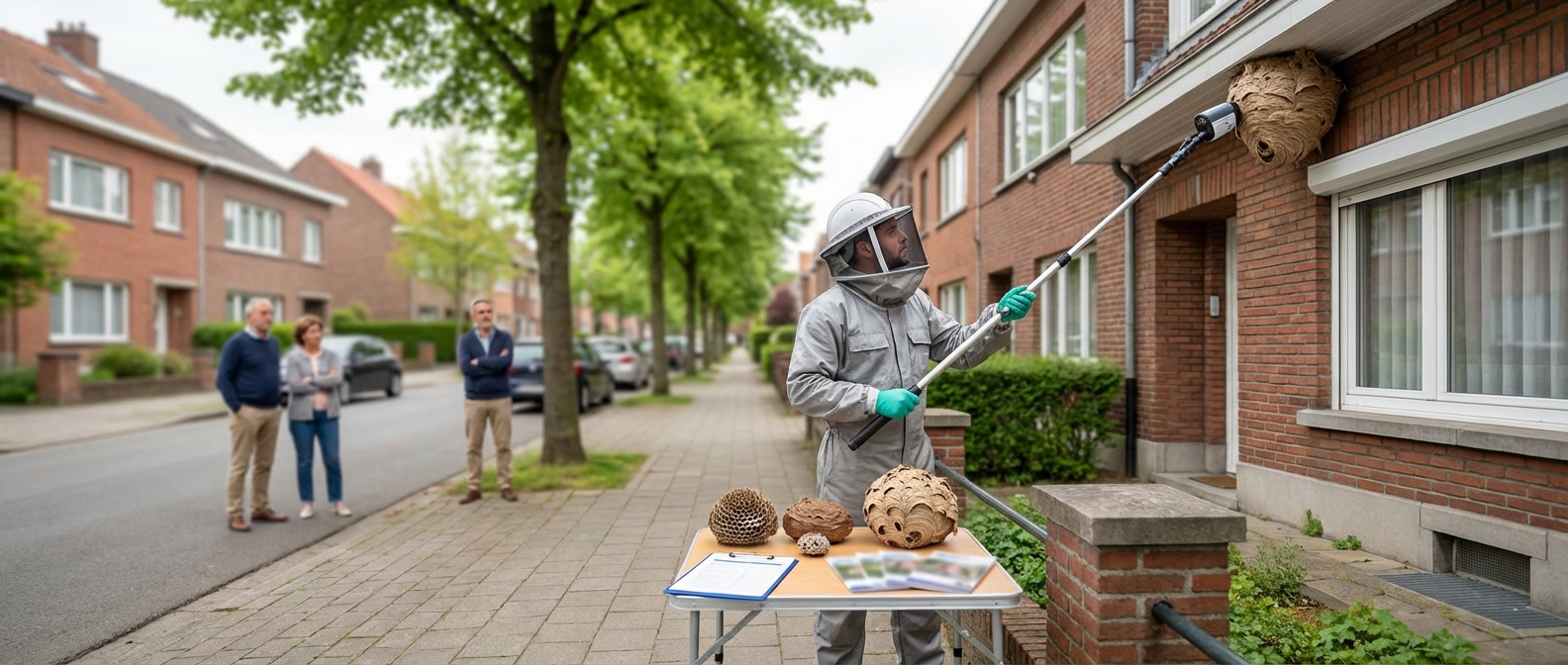
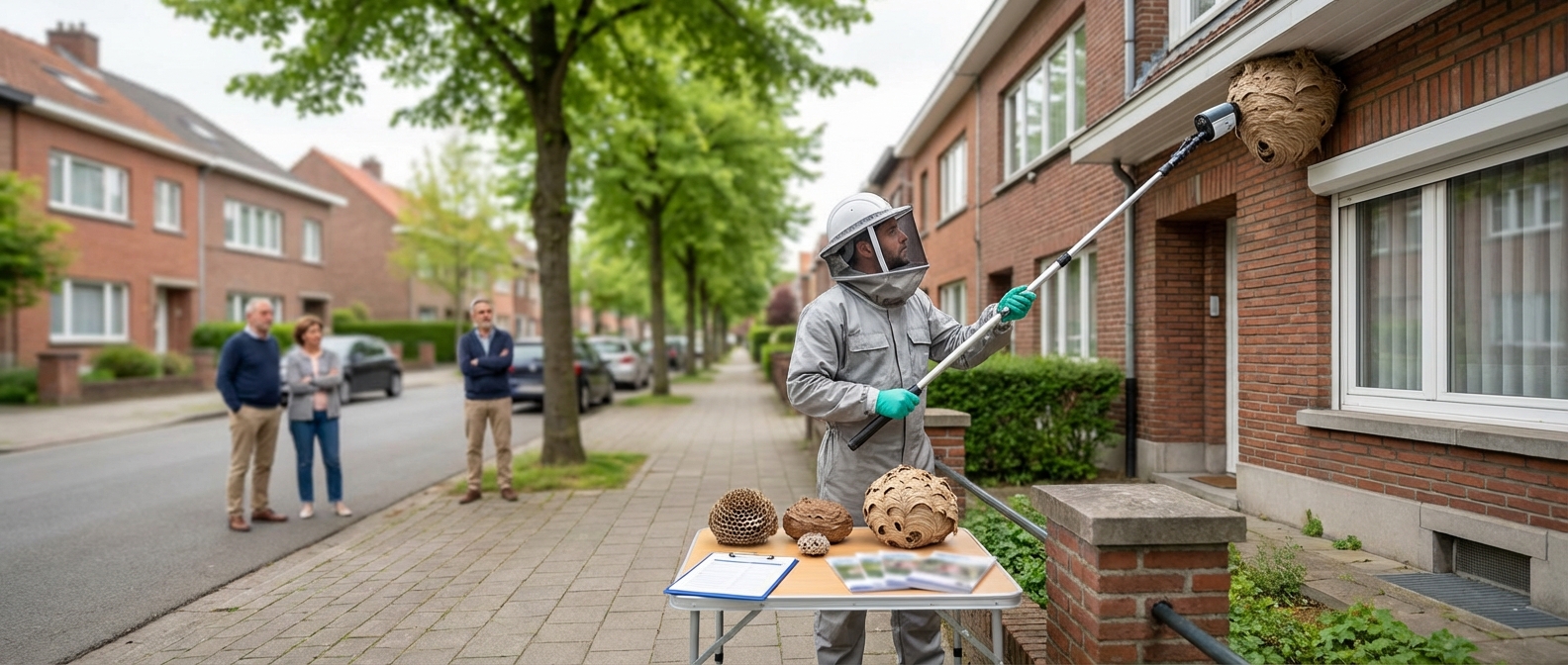
2. Arrival and assessment. Our technician arrives fully equipped: full-body anti-sting suit, reinforced gloves, breathing mask if necessary. Safety is our top priority, as it is for you and your neighbors. We define a safety perimeter. If the nest is high up, we use a telescopic pole or, in some cases, a gondola.
3. Nest destruction method. Depending on the situation, we use a professional insecticide in powder or aerosol form, injected directly into the nest. These are not the same products as those sold in supermarkets: their effectiveness is immediate and their application is targeted to limit the impact on the environment. For an underground nest, the technique is different: the burrow entrance is treated so that each worker who enters contaminates the colony. In all cases, wasp extermination is complete within a few hours.
4. Nest removal. Once the colony has been neutralized, the nest is removed where possible and accessible. If the nest is in a wall cavity, make sure the entrance is treated and sealed to prevent recolonization by other insects. The removed nest is taken away and destroyed.
5. Post-procedure advice. A few «late» wasps may hover around the nest site for 24 to 48 hours. This is normal: these are workers who were in flight at the time of treatment. They will not rebuild a nest. We'll explain it all to you before you leave.
The whole procedure takes between 30 minutes and two hours, depending on complexity. A nest under an accessible ledge is quick. An Asian hornet's nest 15 metres up in an oak tree in Roodebeek Park is a different story. Safety during intervention is not negotiable: we take all the time we need.
An important point for residents of Woluwe-Saint-Lambert: if you spot an Asian hornet nest, report it too on the vespawatch.be platform. This is a scientific monitoring tool that helps map the progress of the species in Belgium. It takes just two minutes and is useful for everyone.
Service operation: rates and current municipal regulations
How much does it cost to remove a wasp nest? That's the question we're asked most often, and the honest answer is: it depends. Not to confuse the issue, but because situations vary enormously.
The price of wasp extermination in Woluwe-Saint-Lambert is generally between 80 and 150 euros for a classic wasp nest, accessible without special equipment. If the nest is high up (roof, tree), if access is complicated (narrow attic, cavity wall), or if it's an Asian hornet nest requiring special equipment, the price can rise to 200 euros or more. At frelons.be, we always quote a price before we intervene, so there are no nasty surprises at the end.
Some factors that influence the price of a wasp nest :
-
Nest height : a nest two meters away in a bush is not the same as a nest ten meters away under a gutter.
-
Type of insect : the Asian hornet requires extra precautions and sometimes special equipment (long-range injection poles).
-
Emergency: weekend or evening work may incur a surcharge.
-
Accessibility: if you have to go through your neighbor's garden or use a cherry picker, it's a game-changer.
Here's what you need to know about municipal regulations in Woluwe-Saint-Lambert. The municipality has regulations governing animals, including pests. In practice, you are responsible for destroying a wasp nest on your private property. The commune does not provide a free service for this. On the other hand, if the nest is on public property (a communal tree, a public building), it's up to the commune to deal with it.
The situation is a little different for the Asian hornet. As it is an officially recognized invasive species, some Walloon and Brussels communes offer aid or subsidies for its destruction. In Woluwe-Saint-Lambert, contact the commune's environment department to find out whether an intervention against the Asian hornet is eligible for partial reimbursement. Policy changes every year, and budgets vary.
A practical tip: check your home insurance. Some policies will cover an exterminator in 1200, at least partially. It's worth giving your broker a call before paying out of pocket.
Another point often forgotten: if you're a tenant, who pays? In principle, the destruction of a wasp nest is considered to be routine maintenance and is the responsibility of the landlord. But it depends on your lease. If in doubt, contact your landlord as soon as you spot the nest, and don't let the situation escalate.
At hornets.be, we work in Woluwe-Saint-Lambert all year round. Yes, even in winter. Because the founding queens of Asian hornets start building their primary nests as early as February-March. If you wait until the summer peak, you'll be faced with a colony of several hundred individuals instead of a single queen. The earlier you act, the simpler, faster and less costly the intervention.
Conclusion
A wasp or hornet's nest in Woluwe-Saint-Lambert doesn't have to happen. It's a practical problem that can be solved in a matter of hours if the right people are called in. The key: never attempt to destroy a nest yourself, identify the species correctly, and act quickly, especially in the face of the Asian hornet, whose presence in the 1200 region is confirmed every season.
Have you spotted a suspicious nest in your home? Contact hornets.be. We'll get back to you as soon as possible, give you a clear price and intervene as quickly as possible for safe destruction. All year round, not just in summer.
Frequently asked questions
How much does it cost to destroy a wasp nest in Woluwe-Saint-Lambert (1200)?
The average cost of professional intervention varies between €80 and €150 for an accessible nest. This price may rise if the nest is located high up (ledges, roofs) or if it is an Asian hornet requiring special equipment.
Are the Brussels fire department still working on wasps?
No, the fire department of the Brussels rescue zone no longer comes to deal with wasp nests, except in cases of immediate vital danger on the public highway. For private homes in Woluwe-Saint-Lambert, you need to contact a certified exterminator.
How can I recognize an Asian hornet nest in my garden?
The Asian hornet nest is often spherical with a narrow side entrance. In summer, they are usually found in the treetops (Roodebeek or Woluwe parks). The insect is darker than the European hornet, with yellow-tipped legs.
Does the commune of Woluwe-Saint-Lambert reimburse the intervention?
Destruction on private property is the responsibility of the owner or tenant. However, some home insurance policies cover this risk. For the Asian hornet (an invasive species), contact your local environment department to check on possible assistance.
 French
  English
  Dutch
Dutch
0 Comments