
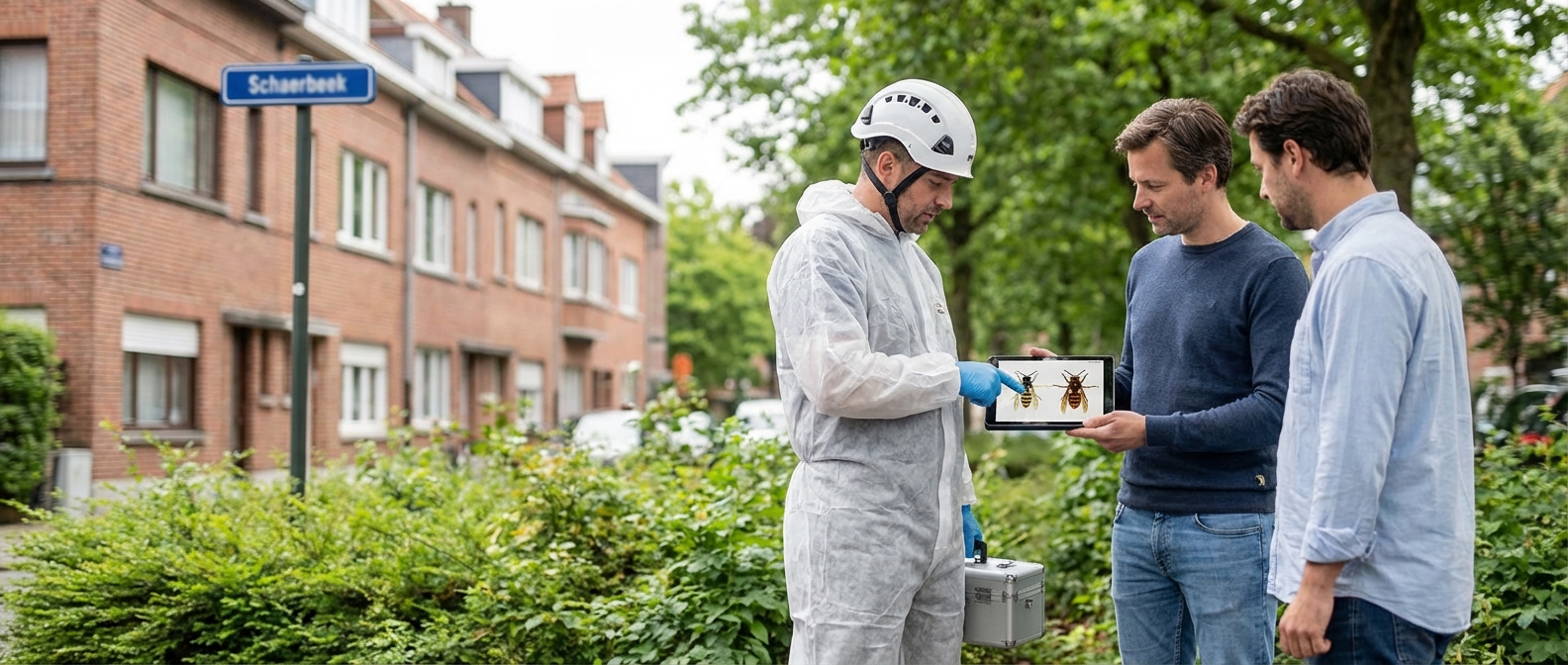
Wasp nest in Schaerbeek: Everything you need to know about the intervention
Contents
Last summer, a resident of the Helmet district called us on a Sunday morning. Shutters closed, windows blocked, his children confined to the living room. A wasp nest had settled under the cornice, just above the front door. It was impossible to get out without being harassed. This kind of situation can be seen every week in Schaerbeek between May and October. And sometimes even outside this period, when Asian hornets are involved.
Things to remember
-
This article offers an ultra-local account of an intervention in the neighborhoods of Schaerbeek (Helmet, Josaphat) coupled with educational expertise on the Asian hornet, active all year round, to differentiate itself from the classic rate pages.
-
Identification of wasp and hornet species in the Brussels region
-
How a pest control service works in Schaerbeek
-
Practical guide to dealing with a wasp nest in 1030
What we notice is that many people hesitate too long. They look for home-made solutions, try to plug a hole with expanding foam, or wait for «it to go away». But it doesn't. A wasp nest gets bigger every week. And when you intervene late, it's longer, riskier and more expensive. This article is exactly what we'd like our customers to read before calling us: how to recognize what's flying around your home, what to expect during an intervention, and above all what to do (and not to do) when you discover a nest in the 1030.
At Frelons.be, we're active all year round. Asian hornets and wasps don't take vacations, and neither do we.
Identification of wasp and hornet species in the Brussels region
Three wasps on a windowsill and all hell breaks loose. That's normal. But before you pick up the phone, there's one question that changes everything: what exactly is stealing from your home? Because the answer determines the level of urgency, the type of intervention, and even the rate.
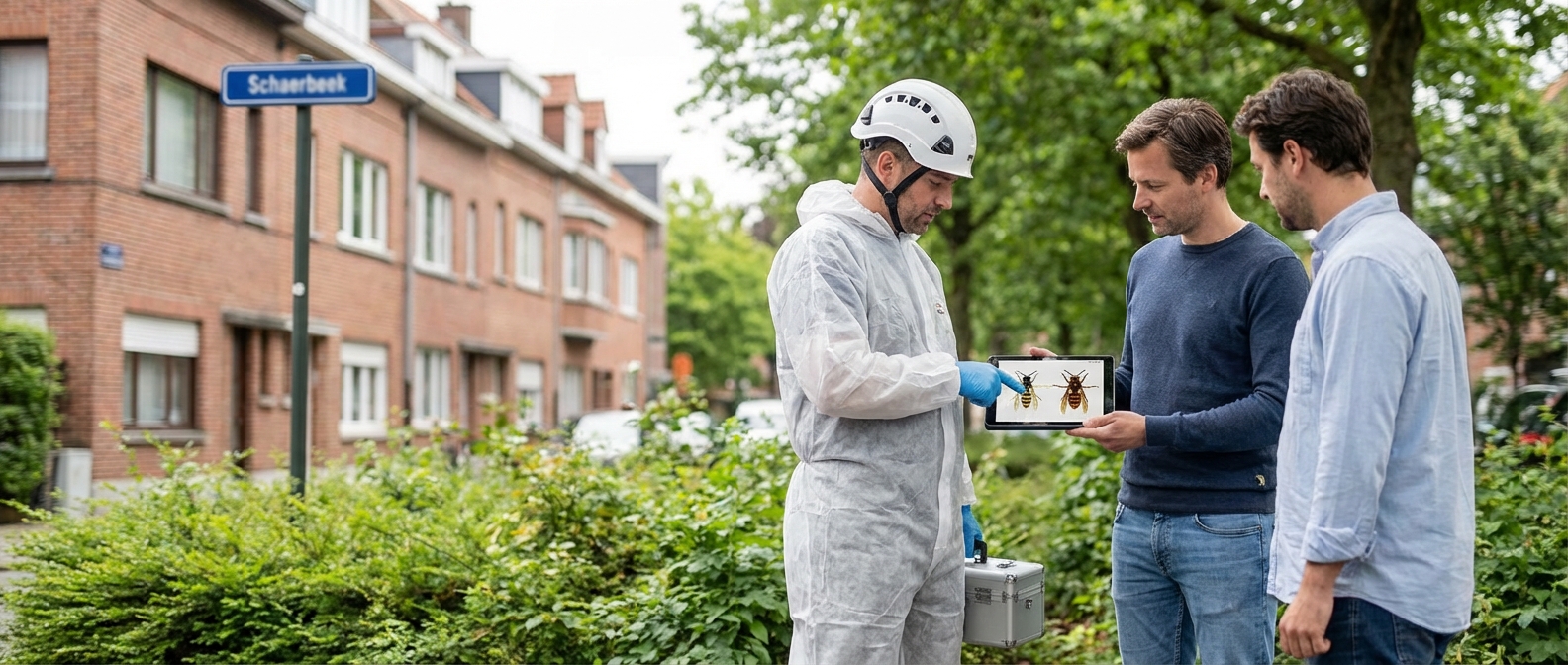
In Schaerbeek, there are four main types of insect that cause problems. The common wasp (Vespula vulgaris), the German wasp, the European hornet and, increasingly, the Asian hornet. Each has its own behavior, preferred habitat and level of danger.
Visit common wasp, It's the one everyone knows. Yellow and black, around 1.5 cm long, attracted by your soda can on the terrace. It builds papier-mâché nests in attics, shutter boxes and sometimes in the ground. A mature nest can contain between 3,000 and 5,000 individuals. It causes 80 % of our work in the commune.
Visit mason wasp, on the other hand, it's a special case. Does it sting? Very rarely. It's a solitary wasp that builds small earthen nests on walls, window frames and brick joints. They don't form aggressive colonies. If you see one, don't panic: it's quite useful as it hunts other insects. We don't necessarily recommend destroying it, unless it settles in a really annoying place.
Visit difference between wasp and hornet, Many people confuse them. The European hornet is a large wasp (around 3 cm), brown and yellow, rather quiet if you don't get too close to its nest. It flies at night, attracted by light. Its sting is painful, but no more dangerous than a wasp's, unless you have an allergy.
Visit Asian hornet in Schaerbeek, The European hornet is a different story. Smaller than the European hornet (2.5 cm), it can be recognized by its very dark, almost black body, with an orange stripe on the abdomen and yellow legs at the tips. Their nests are often high up, in tree tops or under roofs, sometimes 15 or 20 meters above the ground. What makes it a problem is that it is aggressive when approached, and decimates bee populations. More and more are being spotted in the Brussels region, including in residential areas such as Josaphat and Helmet. And contrary to popular belief, the Asian hornet can be active very early in the year: the founding queens emerge from hibernation as early as February if temperatures are mild.
Why are there so many wasps some years? It depends above all on the spring weather. A mild, dry spring is a jackpot for founding queens: they survive better, form more colonies, and nests grow rapidly. In 2023, we had a peak in calls as early as June in Schaerbeek, precisely because of a mild spring.
One last point: if you see a single insect moving in and out of the same hole in a wall, it's probably a solitary bee or a mason wasp. If you see dozens of insects constantly coming and going in the same place, you've got an active nest. And you need to take action.
How a pest control service works in Schaerbeek
A customer in Josaphat Park recently asked us, «But what do you actually do when you arrive?» Good question. Because destroying a wasp nest in Schaerbeek isn't just about a guy in a suit spraying a spray. It's a precise protocol, adapted to each situation.
Step 1: Remote diagnosis. When you call us, we ask you a few questions. Where is the nest? How high up is it? How long have you seen movement? Has anyone been bitten? With a photo (even a blurry one), we can often identify the species before we even start moving. This allows us to prepare the right equipment.
Step 2: On-site intervention. We usually arrive within 24 hours, sometimes the same day for urgent cases (known allergy, nest in front of a school entrance, etc.). The exterminator in 1030 works in full protective gear. Depending on the location of the nest, we use either an insecticide powder injected directly into the nest, or a liquid treatment for nests at height using a telescopic pole. For Asian hornet nests perched high above the ground, we have special equipment enabling us to intervene at heights of up to 25 metres.
The product takes effect within a few hours. Wasps returning to the nest after treatment are in turn contaminated. Within 24 to 48 hours, the colony is eliminated. The nest is not always physically removed: a treated nest will never be recolonized. Wasps do not reuse an old nest. If the nest is accessible and you'd prefer it to be removed for aesthetic reasons, this is possible, but not compulsory.
Step 3: Post-procedure advice. We'll check with you to see if there are any other potential points of entry. Roller shutter boxes are a classic in Schaerbeek, especially in Brussels houses, where the wooden boxes are never waterproofed. We'll tell you what to look out for in the weeks ahead.
Wasp extermination in the 1030 is a year-round activity. Yes, even in winter. Because the Asian hornet, as we've said, starts its cycles earlier than local species. And because «dormant» nests are regularly found during renovation work in the middle of January, with hibernating queens inside. It's better to treat then, rather than wait for the spring awakening.
An important safety point: every year in Belgium, several people end up in the emergency room after trying to destroy a nest themselves. Boiling water, fire, insecticide sprays from the supermarket: all this does is irritate the colony without neutralizing it. The nest defends itself. And a wasp that defends its nest is a wasp that stings. Repeatedly. Without hesitation.
Our intervention is fast, targeted and guaranteed. If the nest reactivates within a few days (this happens in less than 2 % of cases), we come back free of charge. It's as simple as that.
Practical guide to dealing with a wasp nest in 1030
You've just spotted a nest. Under a roof overhang, in the garden, behind a shutter. First instinct: don't touch anything. Seriously. No sudden movements in the vicinity, no spraying with water, no heroic attempts with a broom. Keep children and pets away from the area, and keep your distance (at least 5 metres).
Who do you call when you have wasps in Schaerbeek? You have several options, but they're not all the same. The fire department sometimes intervenes, but only in cases of immediate danger to public safety, and they charge for the trip. The commune of Schaerbeek does not offer a free nest destruction service. The most direct solution is to contact a specialized professional like Frelons.be, who knows the terrain and local specificities.
The question of cost of destroying a wasp nest always comes back. Let's be clear: expect to pay between 80 and 150 euros for a standard intervention in the Brussels region. This price varies according to three main factors. The height of the nest (a 10-meter nest requires more equipment than a ground-level nest). The species involved (the Asian hornet requires a specific protocol, so it's a little more expensive). And the urgency of the situation: a weekend or evening intervention may entail an extra charge.
Beware of the abnormally low rates found on some platforms. An «exterminator» advertising 40 euros is often someone who will spray a mass-market product and leave in ten minutes. With no guarantee, no follow-up and no appropriate protection. You pay twice when it's time to call back someone serious.
Here's what we recommend doing in order:
-
Identify the insect if possible (take a photo from a distance with a zoom lens).
-
Locate the nest by observing their flight paths. Wasps fly in a straight line towards their nest.
-
Secure the area Close nearby windows and keep children out.
-
Call a professional describing the situation as precisely as possible.
-
Never block the nest entrance. The wasps will find another exit, potentially inside your home.
For a fast response in Brussels, we commit to a maximum response time of a few hours. Most of our interventions in Schaerbeek are carried out the same day or the day after the call. We cover all neighborhoods: Helmet, Josaphat, Cage aux Ours, Pogge, Dailly, and of course the town center around Place Colignon.
One last piece of advice we often give: if you're allergic to wasp stings (or don't know if you are), don't take any chances. A severe allergic reaction can occur within minutes. Keep your distance, call us, and if anyone is stung and shows signs of severe swelling, difficulty breathing or discomfort, it's 112 first.
The cost of destroying a wasp nest is an investment in your peace of mind. Not a luxury. When you consider how quickly a colony can become unmanageable (a nest doubles in size in two weeks at the height of summer), every day counts.
Conclusion
A wasp nest in Schaerbeek is neither rare nor insignificant. Whether it's a common wasp in a shutter box or an Asian hornet in a tree in Josaphat Park, the right reaction is always the same: identify, secure and call in a professional. Not DIY.
At Frelons.be, we operate all year round in the commune of Schaerbeek and throughout the Brussels region. European hornets, Asian hornets, wasps of all kinds: we know every species, every situation, every nook and cranny of Brussels homes where a nest might be hiding. Contact us as soon as you have any doubts. The sooner we intervene, the simpler, faster and more affordable it is.
Frequently asked questions
How much does it cost to destroy a wasp nest in Schaerbeek?
The price of a standard intervention in Brussels generally varies between €80 and €150. The price depends on the height of the nest, the species (wasp or Asian hornet) and the urgency of the situation.
How to recognize an Asian hornet in the Josaphat or Helmet neighborhood?
The Asian hornet is darker than its European cousin, with an almost black body and yellow-tipped legs. Their nests are often perched high up in trees or under the cornices of Schaerbeek houses.
Do the Brussels fire department respond to wasp nests?
Fire departments only intervene in cases of immediate danger to public safety, and always charge for their services. For a fast, guaranteed response in the 1030 area, it's best to call in a private expert like Frelons.be.
What should I do if I discover a wasp nest in my shutter box?
Never try to block the entrance with expanding foam, as the wasps may seek an exit into your home. Keep your windows closed and contact a professional for targeted powdering.
What is the response time for an exterminator in Schaerbeek?
At Frelons.be, we generally intervene within 24 hours, and the same day for urgent cases (allergies or nests near schools). We cover the Plasky, Dailly, Helmet and Place Colignon areas.
 French
  English
  Dutch
Dutch
0 Comments