
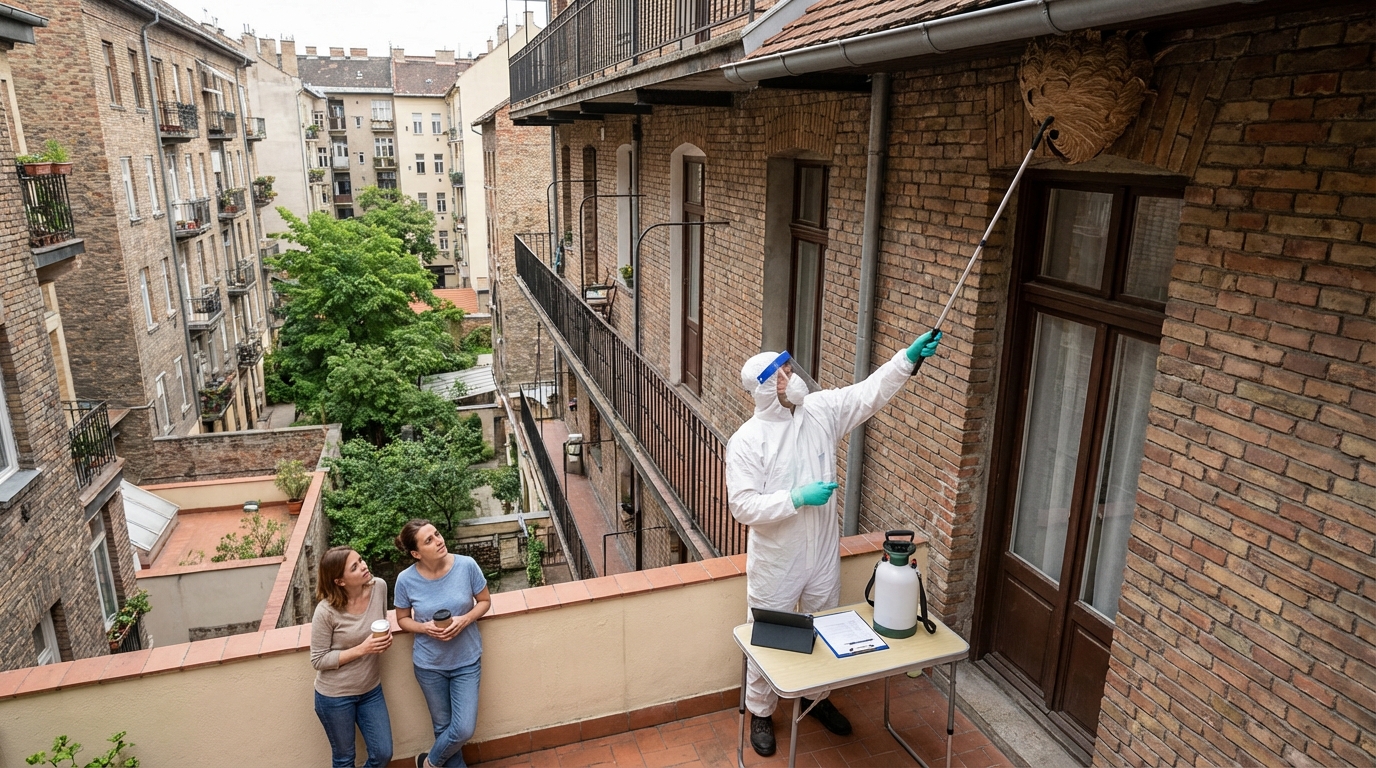
Wasp nest destruction in Saint-Josse: Guide and intervention
Contents
-
Understanding the wasp and hornet invasion in Saint-Josse-ten-Noode
-
Practical guide: Rates and procedures for residents of Saint-Josse
A wasp's nest under a balcony, in a roller shutter box or wedged between two adjoining buildings: in Saint-Josse-ten-Noode, this is the kind of discovery that spoils a summer evening. And given the density of the neighborhood, the problem never stays personal for long. Neighbors get involved, children play nearby, and everyone's looking for a quick solution.
Things to remember
-
This article takes an ultra-local approach, recounting a typical intervention in the dense urban context of Saint-Josse-ten-Noode.
-
It combines technical expertise on the Asian hornet with practical advice to reassure local residents about safety and transparent pricing.
-
Understanding the wasp and hornet invasion in Saint-Josse-ten-Noode
-
A professional intervention in a dense urban environment
At Frelons.be, we work all year round in Brussels and the surrounding area, even in the dead of winter when the queen wasps are seeking shelter. This article is exactly what we explain on the phone when someone from Saint-Josse calls us: how it's done, how much it costs, and why you shouldn't try to deal with it yourself with insecticide spray from the supermarket.
Let's get down to business. No blah, blah, blah about «the importance of biodiversity» (even if wasps have their role to play, we agree). Just what you need to know to act quickly and effectively.
Understanding the wasp and hornet invasion in Saint-Josse-ten-Noode
Every summer, the calls explode. Why are there so many wasps at certain times of the year? The answer is simple: the colony life cycle peaks between July and September. A founding queen who has survived the winter can generate a colony of 5,000 to 10,000 individuals in just a few months. When this nest is located in a neighborhood as densely populated as Saint-Josse, the nuisance quickly becomes unmanageable.
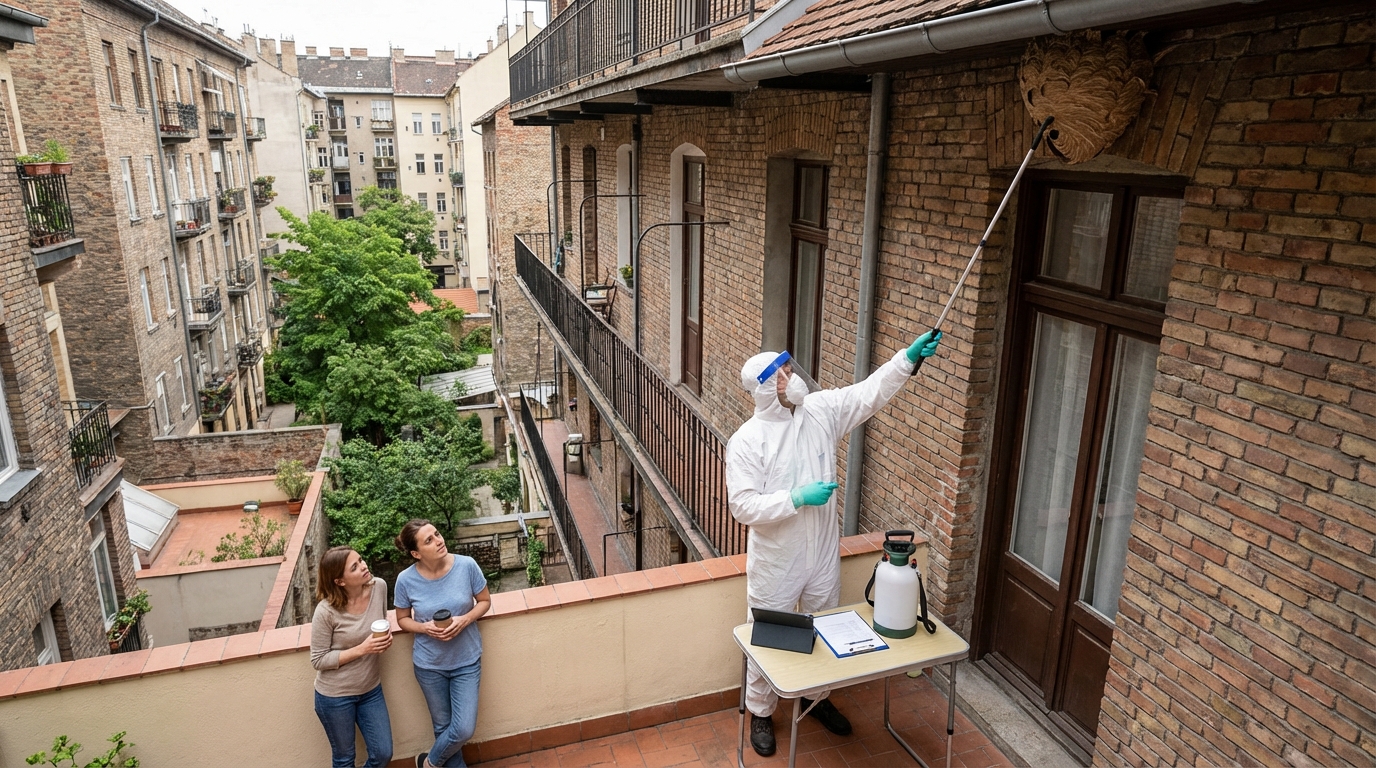
Saint-Josse-ten-Noode is Belgium's most densely populated municipality. Around 24,000 inhabitants per square kilometer. Buildings stuck together, tiny courtyards, shared terraces. Wasps in Saint-Josse find exactly what they're looking for: cavities in old facades, spaces under roofs, gaps in window frames. Brussels' 19th-century buildings, with their cornices and ornamentation, are a veritable catalog of nesting sites.
And then there's the Asian hornet. It's the talk of Brussels, and with good reason. The Asian hornet in postal code 1210 is no longer a hypothesis, it's a reality that's been confirmed for several seasons now. Vespa velutina builds nests high up, often in trees or under roofs, sometimes over 15 meters away. Its nests are larger than those of common wasps, and above all, its stings are more painful. For allergy sufferers, this is a real danger.
Which wasp is the most aggressive? Contrary to popular belief, it's not necessarily the hornet. The German wasp (Vespula germanica) is often more quarrelsome, especially at the end of the season, when the workers have no more larvae to feed and turn to our plates. The Asian hornet, on the other hand, attacks when you get too close to its nest. The problem is, in a dense urban environment, «too close» can simply mean opening your window.
Pests in Brussels thrive in this urban environment for one obvious reason: food is everywhere. Garbage garbage cans, restaurant terraces, markets. Saint-Josse is a hub of commercial activity, particularly around the Chaussée de Haecht and Rue de Brabant. All these food sources attract wasps and keep them in the neighborhood.
A detail many people don't know: a wasp nest abandoned in autumn will not be reused the following year. But the decomposing structure attracts other insects. And fertilized queens hibernate in the vicinity. If you've had a nest this year, there's a good chance that a new colony will set up nearby next season. That's why we stay active even in winter: to locate and treat sites before the cycle starts all over again.
A professional intervention in a dense urban environment
Monday morning, 8:30 a.m., call from a resident of rue Royale Sainte-Marie. A nest in the roller shutter box of her bedroom. She hears wasps buzzing in the night. Her three-year-old son sleeps in the next room. We deal with this kind of situation several times a week in Saint-Josse.
First step: diagnosis. Precise questions are asked over the phone. Where is the nest? How big is it? How long has it been there? Are there allergic people in the household? Pets? Is the nest accessible from inside, or does it have to be accessed from outside? In Saint-Josse, access is often the first headache. No garden, no space for a ladder, adjoining facades, sometimes a passage through the neighboring building.
Wasp extermination in 1210 requires logistics adapted to the terrain. You don't drive a bucket truck into a one-way street lined with double-parked cars. Our technicians arrive in light vehicles, with compact equipment: telescopic poles, full-body suits, professional insecticides (not available to the general public, and for good reason). For high-altitude nests, we sometimes use a remote injection system that allows us to treat without having to climb.
Insect control in Saint-Josse follows a strict protocol. First, we secure the perimeter. In an apartment building, this means notifying direct neighbors, closing adjacent windows, and sometimes temporarily blocking access to a common courtyard. Neighborhood safety is non-negotiable. A disturbed colony can send dozens of workers into defensive mode in a matter of seconds. In a confined space, the consequences can be serious.
The treatment itself takes between 20 and 45 minutes, depending on the situation. A biocide is injected directly into the nest or at its entrance. Wasps returning from outside pass through the product and contaminate the rest of the colony. Within 24 to 48 hours, the nest is inactive. We then return to physically remove it whenever possible and desirable (sometimes the nest is inaccessible without breaking through a wall, in which case we leave it in place once treated, as it will decompose naturally).
One point we'd like to make clear: some companies charge extra for nest removal. With us, if the nest is accessible, removal is included. If this isn't technically possible, we'll explain it clearly. No surprises on the bill.
For Asian hornet cases in Brussels, the protocol is a little different. Primary nests (in spring, small, often at ground level) are relatively simple to treat. Secondary nests, those found in summer and autumn, sometimes at the top of a tree, require specific equipment and sometimes coordination with the municipality. Every Asian hornet nest is systematically reported to the relevant authorities, as part of the national surveillance plan.
We can intervene 24 hours a day, including weekends. Because a wasp nest doesn't choose when to become a problem. And in Saint-Josse, when a nest blocks access to a stairwell or threatens a business, every hour counts.
Practical guide: Rates and procedures for residents of Saint-Josse
How much does it cost to remove a wasp nest? That's the question we get asked most. And the honest answer is: it depends. Not to drown the fish, but because destroying an accessible nest under an awning two meters above ground and treating an Asian hornet's nest 20 meters away in a lime tree are not the same job.
Here is a realistic grid to give you an idea of the cost of destroying a wasp nest:
-
Accessible nest (less than 3 metres, easy access) between €80 and €120 incl. VAT
-
High nest or difficult access (shutter box, under-roof, chimney) between €120 and €180 incl. VAT
-
Asian hornet nest at height (basket or long-reach pole) between €150 and €250 incl. VAT
-
Evening or weekend emergency service surcharge from €30 to €50
These extermination rates include travel, treatment, nest removal where feasible, and a guaranteed result. If the wasps return within 15 days, we come back for free. It's written in black and white in our quotation.
By the way, let's talk about the estimate. We don't charge for diagnosis. You call, describe the situation (a photo over the phone helps enormously), and we give you a firm price before we come out. No vague estimate that doubles once you're there. The rate quoted is the final rate, unless the situation in the field is radically different from what has been described, in which case you'll be warned. before to intervene.
If you live in Saint-Josse-ten-Noode, here is a practical guide to rapid wasp control:
-
Do not touch the nest. No boiling water, no insecticide sprays, no smoke. You risk a swarm attack, and in an urban environment, the people around you are also at risk.
-
Identify the insect if possible. Common wasp (yellow and black, 1 to 2 cm), European hornet (larger, reddish-brown), Asian hornet (yellow legs, black thorax). Just take a photo and we'll take care of identification.
-
Just give us a call. We're available 7 days a week. For emergencies (nest in a high-traffic area, allergic person in the home, business affected), we generally respond within 2 to 4 hours.
-
Warn your neighbors. In a building, inform the building manager or direct neighbors. This facilitates access and avoids unpleasant surprises during the intervention.
-
Keep windows closed in rooms close to the nest, awaiting our arrival.
As far as administrative procedures are concerned, the commune of Saint-Josse-ten-Noode does not (as yet) offer a direct bonus for the destruction of wasp nests. For the Asian hornet, the Brussels Region coordinates a surveillance plan, and some interventions may be partially covered. We'll be happy to advise you if this is the case.
A final word of advice for the safety of your urban garden or terrace: commercial wasp traps mainly attract workers at the end of the season, but never eliminate the colony. They can even exacerbate the problem by attracting wasps from neighboring nests. The only lasting solution is to treat the nest at source. The rest is a matter of DIY.
If you are a tenant, you should be aware that destroying a wasp nest is generally part of routine maintenance and may be the responsibility of the landlord, especially if the nest is located in common areas or in the structure of the building. Don't hesitate to contact your landlord or building manager, but don't waste time going back and forth between administrative bodies if the situation is urgent. Deal with the problem first, then discuss who pays.
Conclusion
A wasp nest in Saint-Josse-ten-Noode, in such a dense neighborhood, can't wait. The risks to you, your children and your neighbors are real, and home-made solutions often do more harm than good.
At Frelons.be, we know the terrain. Narrow streets, old buildings, complicated access: we deal with it every day. Our rates are transparent, our intervention is fast, and we don't leave you with a half-treated nest.
Have you spotted a nest or suspicious wasp or hornet activity? Give us a call now. We'll give you a diagnosis and a price within minutes, and we can be at your home today.
Frequently asked questions
Should a wasp nest be destroyed immediately?
Yes, especially in dense urban areas like Saint-Josse. The longer you wait, the more the colony grows, and the greater the risk to the neighborhood.
Can you remove a wasp nest yourself?
No, we strongly advise against this. Commercial products are ineffective and can cause a dangerous attack.
How much does it cost to remove a wasp nest in Saint-Josse?
Between €80 and €250, depending on accessibility and type of nest. A clear price should always be quoted before any work is carried out.
How long does a procedure last?
Usually 20 to 45 minutes. The nest is then neutralized within 24 to 48 hours.
Can wasps return after treatment?
No, if the treatment is carried out correctly. A guarantee is generally included in case of reappearance.
Should the nest be removed after treatment?
Not always. If it's inaccessible, it can remain safely in place once neutralized.
What to do while waiting for surgery
Avoid handling, keep your distance and close windows close to the nest.
 French
  English
  Dutch
Dutch
0 Comments