
Asian Hornet in Berchem-Sainte-Agathe: how to react?
Contents
-
Vespa velutina biology and ecological issues at Berchem-Sainte-Agathe
-
How to identify a nest in your neighborhood: from Parc Pirsoul to Avenue Josse Goffin
-
Nest destruction protocol and safety: professional intervention by Pest Patrol
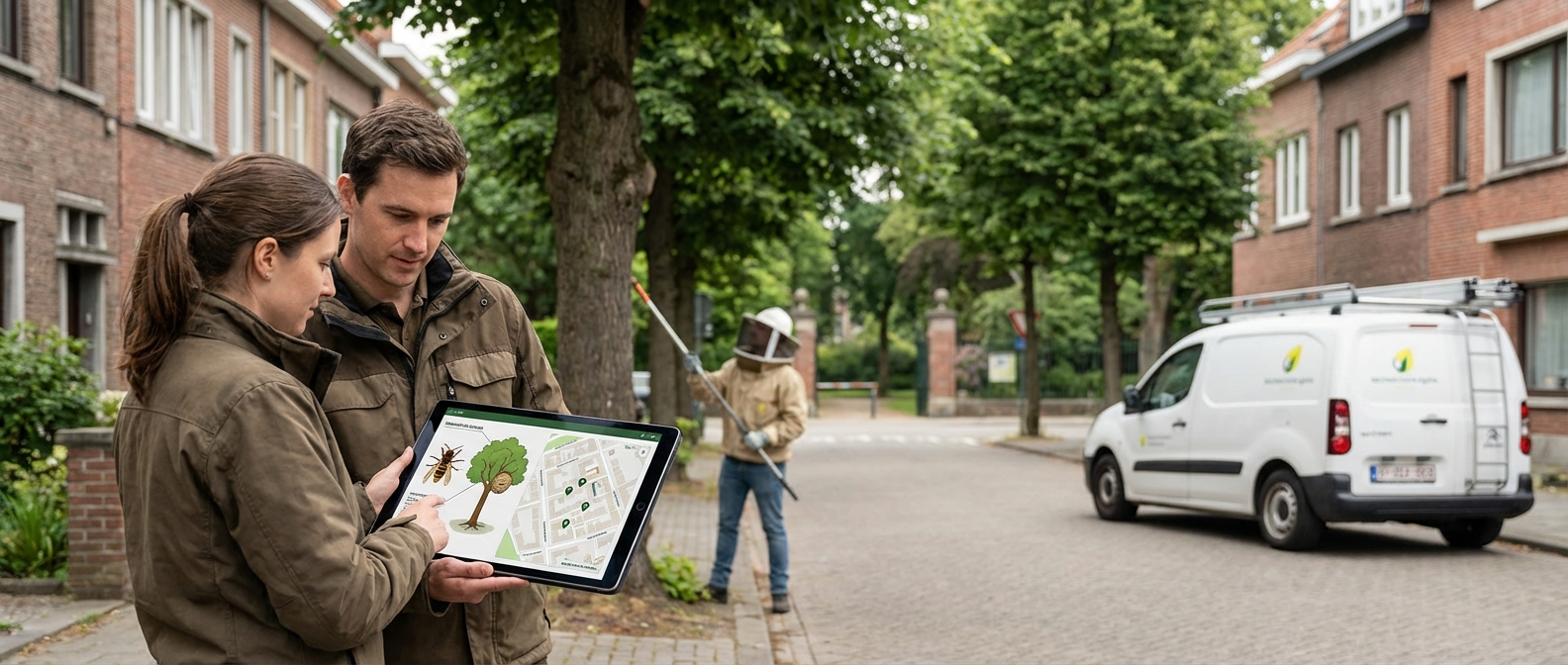
In the summer of 2023, Parc Pirsoul was closed to the public because of an Asian hornet nest. Not a small, discreet nest tucked away in a corner: a secondary nest the size of a basketball, suspended over ten meters up a tree. Local residents discovered the news on the commune's social networks, and the question spread as fast as the insect itself: «Are there any more where we live?»
Things to remember
-
This guide combines scientific expertise with deep local roots
-
We analyze the behavior of Vespa velutina specifically in the urban fabric of Berchem-Sainte-Agathe, citing key locations such as Parc Pirsoul and Avenue Josse Goffin to offer a precise and reassuring response to the commune's inhabitants
-
Vespa velutina biology and ecological issues at Berchem-Sainte-Agathe
-
From Parc Pirsoul to Avenue Josse Goffin
The short answer: yes, probably. The Vespa velutina, which is its scientific name, has been colonizing the Brussels region for several years. Berchem-Sainte-Agathe, with its parks, private gardens and semi-residential areas, offers exactly what this species is looking for. Reports of Asian hornets in Berchem-Sainte-Agathe are multiplying, and this is not a fad: it's a biological reality.
This guide is not here to panic you. It's here to give you the practical keys: understanding the insect, spotting a nest in your neighborhood, and knowing exactly what to do if you find one. It's based on scientific data, our experience in the field at Pest Patrol, and our in-depth knowledge of the 1082 commune.
Vespa velutina biology and ecological issues at Berchem-Sainte-Agathe
Visit Vespa velutina nigrithorax, The "P", originally from South-East Asia, arrived in France in 2004 in a batch of Chinese pottery. Since then, it has been moving northwards. Belgium has been affected since 2016, and Brussels has not been spared. A study published by the Centre wallon de Recherches agronomiques (CRA-W) in 2022 confirms that the species is now permanently established in the Brussels Region. We're no longer talking about one-off sightings: we're talking about colonization.
To understand why this is a problem in Berchem-Sainte-Agathe, you need to know the life cycle of the Asian hornet. In spring, a founding queen emerges from hibernation and builds her own primary nest, often the size of a tennis ball. Here, she lays her first eggs. This primary nest is generally located at low level: under an awning, in a garden shed or in a hedge. Nothing spectacular. That's why it's often missed.
Around June-July, the colony moves. The workers build a secondary nest, this time high up in the tree crown, under the roof or on a pylon. These nests can be up to 80 cm in diameter and house several thousand individuals. In autumn, the colony produces males and new queens. These fertilized queens leave the nest to hibernate and repeat the cycle the following year. According to Monceau et al. (2014), a single nest can produce up to 350 new foundresses, Journal of Pest Science). Do the math: expansion is exponential.
Why is biodiversity in Berchem under direct threat? The Asian hornet is a formidable predator of both domestic and wild bees. It hovers in front of beehives and captures foragers one by one. A study by the Muséum national d'Histoire naturelle in Paris estimates that a single nest can decimate 30 to 40 % of a neighboring bee colony in a single season. In Berchem-Sainte-Agathe, green spaces such as Parc Pirsoul and the gardens of Avenue Josse Goffin are home to a variety of pollinating fauna: solitary bees, bumblebees and hoverflies. These insects are essential to the pollination of the commune's fruit trees and ornamental plants.
Visit Vespa velutina is not limited to bees. It also consumes flies, caterpillars and butterflies. It's a generalist predator that disrupts the entire local food chain. Insectivorous birds, bats, spiders: the whole food web suffers. When you consider that Berchem-Sainte-Agathe is one of the communes in Brussels that invests in the ecological management of its green spaces, it's a real waste to let an invasive species undermine these efforts.
One final point worth noting: the Asian hornet adapts very well to the urban environment. Contrary to popular belief, it does not shun the city. House attics, loft spaces and high structures are ideal for secondary nests. The density of gardens in Berchem, with their hedges, sheds and covered terraces, multiplies the number of potential nesting sites. It's an almost ideal environment for this bird.
How to identify a nest in your neighborhood: from Parc Pirsoul to Avenue Josse Goffin
80 % of Asian hornet nests found in urban areas are spotted by private individuals. Not by professionals, not by high-tech sensors: by people who look up at the right time. Knowing how to identify a hornet nest is the first useful thing you can do.
Let's start with the primary nest. Between March and May, the founding queens look for a quiet, sheltered spot. A garden shed on avenue Josse Goffin, the underside of a balcony, an electricity meter, an abandoned bird box: anything will do. The primary nest resembles a small grayish sphere, a little like papier-mâché, with an opening at the bottom. It's rarely bigger than an orange. At this stage, the queen is often alone or accompanied by a few workers. The nest is fragile and unobtrusive, and most people walk past without seeing it.
If you spot a primary nest, that's great news. Intervention is quick and easy, and prevents the formation of a secondary nest, which will be much more difficult to manage. Don't try to destroy it yourself: even a small nest can harbour a queen capable of stinging. But make a note of its precise location and contact a professional immediately.
The secondary nest is another story. From June onwards, the colony moves to higher ground. At Parc Pirsoul, the nest that caused the park's closure was located in the canopy of a lime tree. Typical. These nests are often spherical or pear-shaped, with a small lateral opening (not at the bottom like the primary nest). The color is grayish-brown, with visible concentric striations. They can measure from 40 to 80 cm in diameter. At this size, we're talking about several thousand individuals.
How can you tell them apart from a common wasp nest? Three reliable clues:
-
Height : Asian hornets generally nest more than 10 metres away. Common wasps prefer low cavities (basements, walls, floors).
-
The opening: the nest of Vespa velutina has a small side opening. Wasp nests often have a wider entrance at the bottom.
-
Air traffic : observe the comings and goings. Asian hornets have a characteristic flight, with their legs hanging down in plain view. Their thorax is black, their legs yellow at the tips. They don't look like wasps.
In Berchem-Sainte-Agathe, the areas most at risk are predictable. The area around the Parc Pirsoul, with its tall trees and dense vegetation, offers ideal nesting sites. Avenue Josse Goffin, lined with houses with gardens, offers plenty of potential shelter for primary nests in spring. The residential streets around the park, with their old roofs and sometimes poorly ventilated attics, are also targets.
If you see a steady stream of large black and yellow insects coming and going in a particular direction, follow them with your eyes. They'll lead you to the nest. This is the simplest and most reliable method. You can report a nest in Brussels via the following platform iNaturalist or directly via the commune's portal. Don't hesitate: every report counts in mapping the progress of the species in commune 1082.
An important point: never stay within five meters of an active secondary nest. Asian hornets are not spontaneously aggressive towards humans, but they will defend their nest vigorously. The defense perimeter can extend up to ten meters around the nest. If you spot a nest in your garden or close to your home, move away, keep children and pets away, and call a specialist.
Nest destruction protocol and safety: professional intervention by Pest Patrol
Every year, emergency rooms in Brussels hospitals receive patients who have been stung after trying to destroy a nest themselves. Garden hose, insecticide spray from the supermarket, rubbish bag stuffed over the nest: we've seen it all. And every time, the result is the same. The swarm attacks en masse, the stings number in the dozens, and sometimes it all ends badly. Safety in the face of Asian hornet stings is not a luxury: it's a basic necessity.
At Pest Patrol, the destruction of a hornet's nest in Berchem-Sainte-Agathe follows a precise protocol. No improvisation. Here's how it's done, step by step.
Step 1: Remote diagnosis. When you contact us, we start by assessing the situation. Photos, exact location, estimated nest height, immediate environment (nearby school? restaurant terrace? garden with children?). This diagnosis enables us to choose the most suitable intervention method and plan the necessary equipment.
Step 2: Securing the perimeter. Before any intervention, a safety zone is set up. Local residents are notified. If the nest is in a public space, as was the case at Parc Pirsoul, we coordinate with the commune and the SIAMU (Service d'Incendie et d'Aide Médicale Urgente) if necessary. The SIAMU sometimes intervenes on the front line in emergency situations, but the definitive destruction of the nest is entrusted to specialized operators like us.
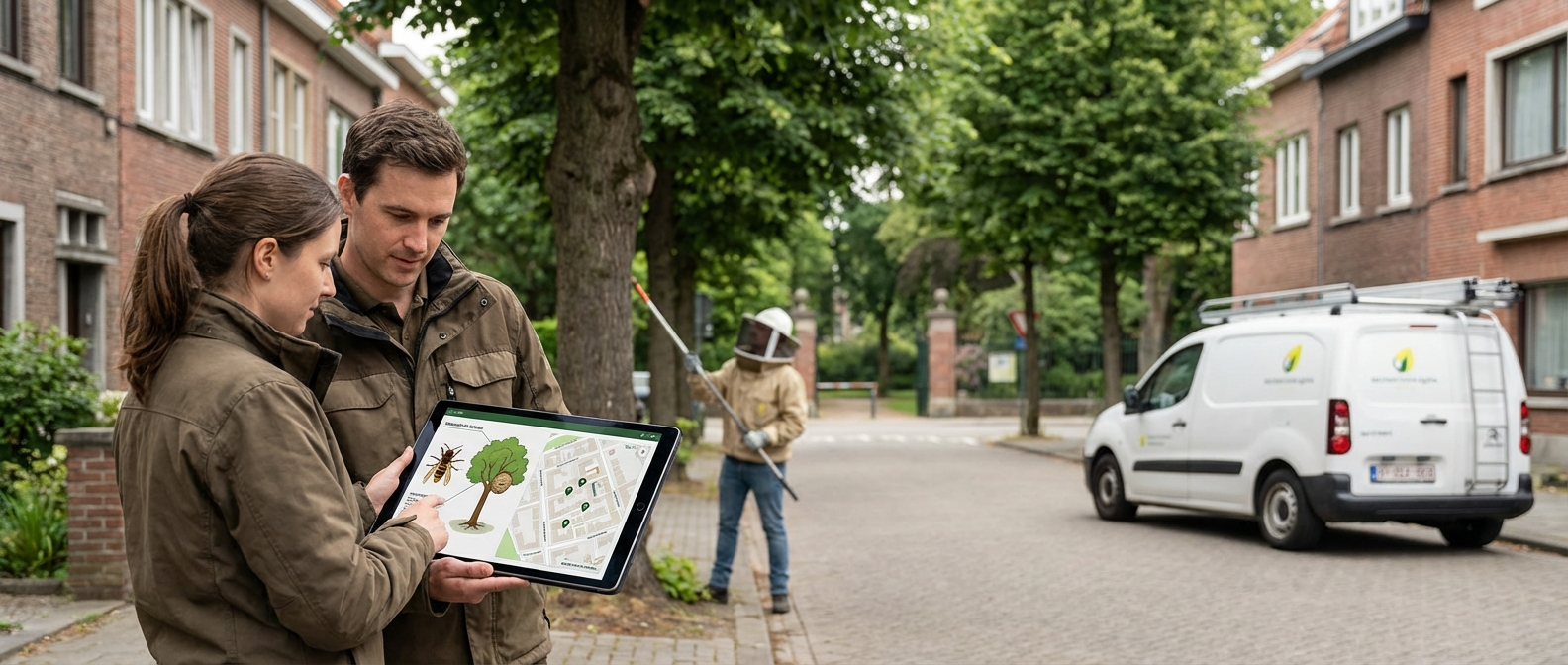
Stage 3: the intervention itself. Our technicians wear full-body sting-resistant suits, approved to withstand hornet stings (which can easily penetrate jeans). For high-altitude nests, we use telescopic poles that can reach 40 meters. The insecticide used is a professional biocide, applied directly at the nest entrance. The aim is to neutralize the entire colony, including the queen. Without it, the surviving workers can rebuild.
Step 4: Nest removal. Once the colony has been neutralized (usually waiting 24-48 hours to ensure that all individuals have returned to the nest and been exposed to the treatment), the nest is unhooked and disposed of. We check that there is no satellite nest nearby, which happens in around 15 % of cases.
Step 5: Follow-up. We return a few days later to check that no residual activity remains. Hornets that were in flight at the time of treatment may return to hover around the nest site for 48 to 72 hours. This is normal, and resolves itself.
Let's talk about the health risk. For most people, the sting of an Asian hornet is no more dangerous than that of a wasp. It hurts, it swells, it passes in a few days. The real danger lies in numbers. In a defensive attack, a swarm can inflict dozens of stings in a matter of seconds. For someone allergic to hymenoptera venom (around 3 % of the population, according to EAACI, the European Academy of Allergology), a single sting can trigger anaphylactic shock. If you know you're allergic, keep your adrenaline auto-injector handy during the hornet season, from May to November.
Professional hornet control in Berchem-Sainte-Agathe is not just another option. It's the only reasonable response. In fact, the commune of Berchem-Sainte-Agathe explicitly recommends that you do not take action yourself, but rather call on the services of approved professionals. Pest Patrol operates throughout the 1082 zip code area, with short lead times, including at weekends during busy summer periods.
A final word on cost. We are often asked this question. The cost of destroying a hornet's nest in Berchem varies according to the height, accessibility and size of the nest. You should also check with your home insurance company: some plans cover the cost of pest control. And the Brussels Region sometimes offers assistance in the fight against invasive species. It's worth checking before you call.
Conclusion
The Asian hornet is here in Berchem-Sainte-Agathe. No longer a hypothetical threat, it's a reality with which the commune has to contend every summer. Your role as a resident is simple but essential: observe, report, do not touch. Spotting a primary nest in spring means potentially avoiding a nest of 5,000 individuals in September.
If you suspect a nest in your home, garden or neighborhood, contact Pest Patrol. We'll assess the situation, intervene quickly and make sure the problem is dealt with properly. Every nest destroyed means hundreds fewer founding queens for next year. The fight against Vespa velutina is played out nest by nest, neighborhood by neighborhood. And that's what Berchem-Sainte-Agathe is all about.
Frequently asked questions
How can I recognize an Asian hornet in my garden in Berchem?
The Asian hornet (Vespa velutina) can be distinguished by its very dark (almost black) body and yellow-tipped legs. It is slightly smaller than the European hornet. If you see a dark insect hovering in front of flowers or a beehive near Avenue Josse Goffin, it's probably an Asian hornet.
Where do hornet nests usually hide in 1082?
In spring, queens build primary nests (the size of an orange) at low level: garden sheds, hedges or ledges. In summer, they often move to the tops of tall trees to create a massive secondary nest, like the one that caused the closure of Parc Pirsoul in 2023.
What should I do if I discover an Asian hornet nest in Berchem-Sainte-Agathe?
Never come closer than 5 metres and never try to destroy it yourself. Report it immediately to your local council or to an expert such as Pest Patrol. Attempting to destroy it yourself can lead to a massive attack on the colony, which is particularly dangerous in dense residential areas.
How much does it cost to destroy a hornet's nest in Berchem?
The cost of a job in Berchem-Sainte-Agathe depends on the height and accessibility of the nest (use of a telescopic pole or a cherry picker). Prices generally range from €90 to €250. Some home insurance policies or regional grants may cover part of the cost of insect removal.
 French
  English
  Dutch
Dutch
0 Comments